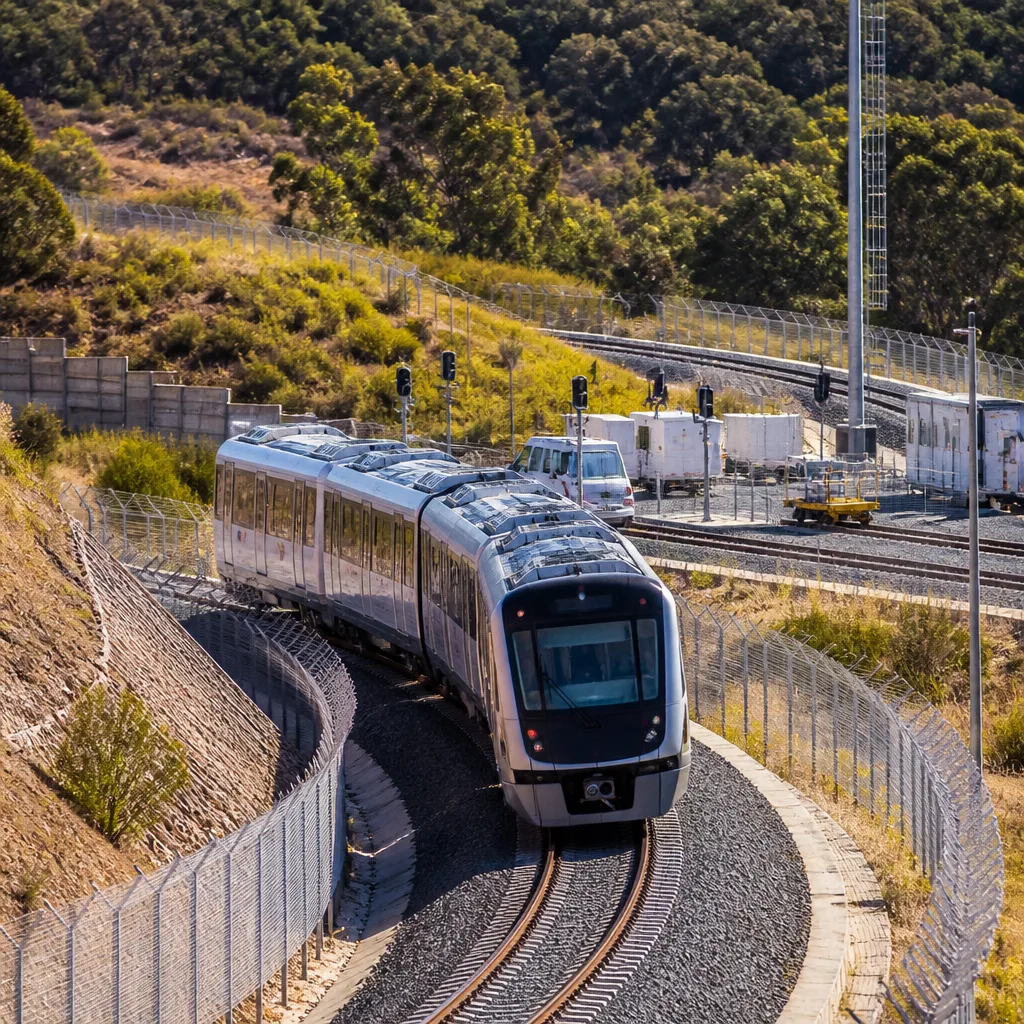
One of 62 three-car trainsets that Hyundai Rotem is building for Singapore’s Jurong Region Line has started commissioning trials at the Korea Railroad Research Institute test circuit in Osong, South Korean media reported.
Tests target steep gradients and tight curves
The vehicle is undergoing runs designed to validate performance on sharp curves and steep gradients before being shipped to Singapore. The rolling stock is being manufactured at Hyundai Rotem’s Changwon plant under a contract valued at S$416.5 million, according to Singapore’s Land Transport Authority (LTA).
The order comprises 62 three-car trainsets that will operate on the 24 km elevated Jurong Region Line. The first of the new sets arrived in Singapore in September and a further six trainsets have been delivered; those units are undergoing system integration and acceptance tests at the Tengah Depot.
- Rolling stock: 62 three-car trainsets supplied by Hyundai Rotem
- Contract value: S$416.5 million (Hyundai Rotem Changwon plant)
- Route: 24 km elevated Jurong Region Line
- Phase 1: 10 stations from Choa Chu Kang to Bahar Junction; planned opening in 2027
- Operations: Joint venture of SBS Transit and RATP Dev Asia Pacific for nine years, with a two-year option
Features and intended operation
The new trains include design elements aimed at passenger flow and infrastructure reliability: wide doorways to support quicker boarding and an automatic track inspection system that detects and diagnoses rail faults in real time. LTA-supplied details indicate the vehicles are being subjected to comprehensive integration checks at Tengah before entering passenger service.
| Item | Detail |
|---|---|
| Trainsets ordered | 62 three-car units |
| Contracting firm | Hyundai Rotem (Changwon plant) |
| Contract value | S$416.5 million |
| First phase length | 24 km elevated line; 10 stations |
| Planned opening (Phase 1) | 2027 |
Operation of the Jurong Region Line will be handled by a joint venture between SBS Transit and RATP Dev Asia Pacific, contracted to run the line for nine years with an option to extend for two additional years. The first phase runs south‑west from Choa Chu Kang on the North South Line to Bahar Junction.
Why the tests matter
Commissioning trials at specialised test tracks are a routine but critical stage in rolling stock delivery. They allow manufacturers and authorities to check dynamic behaviour, traction performance and systems such as automatic fault detection under controlled but demanding conditions. Completing these trials successfully de‑risks later on‑network testing and speeds deployment once units arrive at the depot.
For transit planners and operators worldwide, the Jurong Line project will be watched for its procurement model, automated inspection capability and the split between manufacturing in South Korea and testing both abroad and locally. The project also underlines continuing regional cooperation in rail supply chains as Asian cities expand urban transit networks.
Singapore’s LTA is overseeing the programme; the agency and Hyundai Rotem have provided the details about production and testing phases. The initial delivery schedule — one unit in September followed by six more — indicates a staged approach to system integration ahead of passenger service in 2027.
As cities including ones in South Africa consider expanding rail services, the Jurong Region Line provides a contemporary example of modular train procurement, offsite testing and operator partnerships intended to speed commissioning while maintaining reliability standards.