
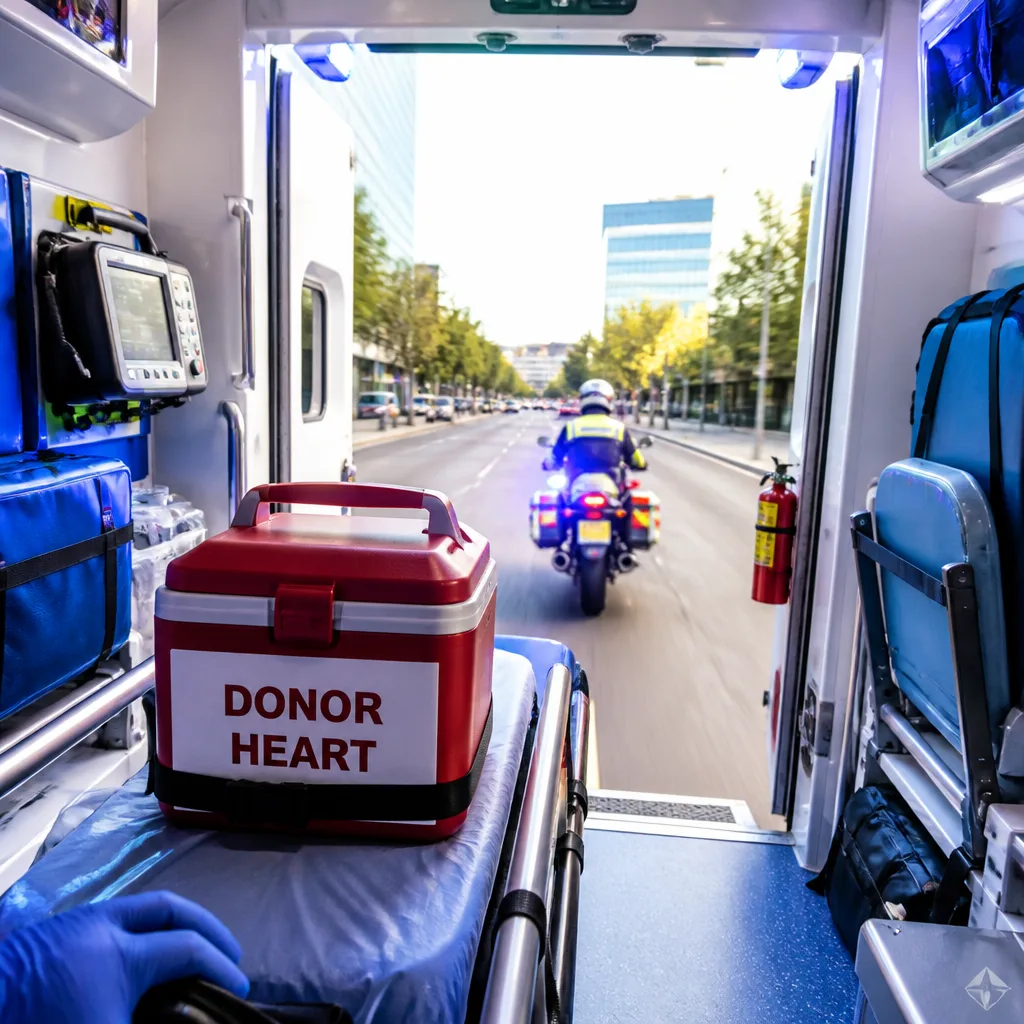
When a donor heart leaves an operating theatre it is already running a countdown. The journey from a brain‑dead donor to a recipient is a tightly choreographed medical and logistical operation: intensive care teams stabilise organs, transplant surgeons assess suitability, and police‑escorted ‘green corridors’ shorten travel time between hospitals. On Organ Donation Day, recalling these steps helps explain why every minute matters.
From brain death to donor management
The process begins after irreversible loss of brain‑stem function has been certified by the mandated panel of doctors. Although the brain has ceased to function, mechanical ventilation and medicines can temporarily maintain oxygen delivery to organs. Once families give consent for donation, clinical priorities shift to preserving organ health for transplantation.
In practice, a heart in a brain‑dead donor is vulnerable to rapid physiological change. Without brain‑stem regulation, temperature falls, hormonal control collapses and blood pressure becomes unstable. The intensive care unit team focuses on:
- stabilising blood pressure to maintain coronary perfusion;
- balancing fluids to avoid overload or hypovolaemia;
- optimising oxygen delivery through ventilation and haemodynamic support.
These steps are essential to keep the heart functioning until retrieval and transport can take place.
Assessing whether a heart can be transplanted
Not every heart is suitable for transplantation. Transplant teams run a set of investigations to judge whether a donor organ can successfully sustain another life. Common assessments include:
| Test | Purpose |
|---|---|
| Echocardiography | Measures pumping function (ejection fraction), structure and valve performance |
| Coronary angiography | Rules out significant coronary artery disease, particularly in older donors |
| Infection and serology screening | Detects transmissible infections that would contraindicate transplantation |
These tests reduce the risk that a transplanted heart will fail because of pre‑existing disease or an undetected infection. Surgeons combine imaging and laboratory results with the donor’s clinical history to reach a decision.
Transport and the green corridor
Once retrieval is authorised and the organ deemed suitable, teams move quickly. The term green corridor describes an escorted ambulance route — often cleared by police — that shortens transit time through congested urban routes. The corridor is a visible reminder that a donated organ is perishable biological tissue and that even hours of extra delay can worsen outcomes.
Within the operating theatre and during transport, chemical measures such as cold preservation solutions and controlled cooling slow tissue metabolism and extend viability. But these are stopgap measures: the shorter the ischaemic time (time without native blood flow), the better the chance of successful transplantation.
Why the public should understand the process
Greater public awareness of the clinical and logistical demands of organ donation helps families make informed choices and supports the professionals involved. Understanding that brain death is a legal and clinical diagnosis, distinct from deep coma, and that donor management aims to preserve organs for others, may influence family consent decisions.
On a systems level, co‑operation between hospitals, emergency services and law enforcement is essential to give a donated heart the best possible chance. For clinicians and planners, each successful transplant is the product of hours of intensive care, prompt specialist assessment and precise transport coordination.
Key takeaway: organ donation is a time‑sensitive, multidisciplinary effort. From stabilising a brain‑dead donor’s physiology to rapid assessment and an escorted transfer, every stage reduces the risk that a precious, donated heart will not reach its recipient in time.









