
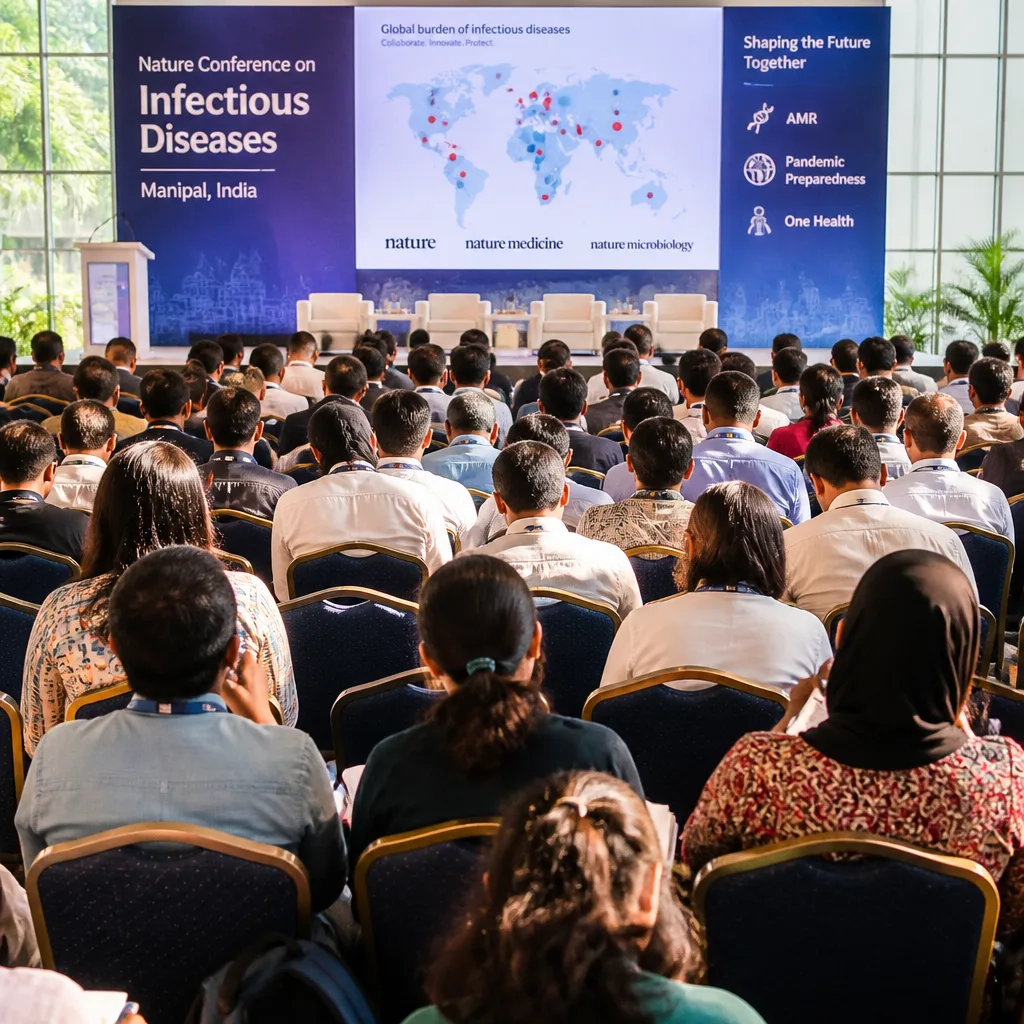
The Nature Conference titled Meeting the Challenge of Infectious Diseases in a Changing World will be held in Manipal, Karnataka, from 14–16 October 2026, organisers announced. The three-day meeting, hosted by the Manipal Academy of Higher Education, will bring together researchers and policymakers to address emerging pathogens, antimicrobial resistance (AMR), pandemic preparedness, disease surveillance, diagnostics, therapeutics, vaccination strategies and one health approaches.
International speakers, South African participation
The conference is being organised in partnership with several Nature journals: Nature Medicine, Nature Microbiology, Nature Health and Nature Communications. The line-up of invited speakers includes international academics from North America and Europe as well as at least one prominent South African researcher.
| Speaker | Affiliation |
|---|---|
| Alessandro Vespignani | Northeastern University, United States |
| Elaine Nsoesie | Boston University, United States |
| Lauren Gardner | Johns Hopkins University, United States |
| Madhukar Pai | McGill University, Canada |
| Shabir A. Madhi | University of the Witwatersrand, South Africa |
| Marion Koopmans | Erasmus University Rotterdam, Netherlands |
The inclusion of Prof Shabir A. Madhi of the University of the Witwatersrand underlines the conference’s relevance to South African research and public-health priorities. Madhi is widely recognised for his work on vaccine-preventable diseases and clinical trials, and his presence may create pathways for South African institutions to exchange findings and build collaborations with global partners.
Topics that matter to schools, universities and public health
According to the conference brief, sessions will focus on:
- Emerging pathogens — identifying and characterising new infectious agents;
- Antimicrobial resistance (AMR) — strategies to monitor and counter drug resistance;
- Pandemic preparedness — surveillance, rapid diagnostics and health-system readiness;
- Vaccination strategies and therapeutics — including development, deployment and equity considerations;
- One Health approaches — integrating human, animal and environmental health perspectives.
For the education sector, these topics intersect with curriculum, research training and capacity building. Universities and postgraduate programmes that train epidemiologists, clinical researchers and laboratory scientists can use conferences such as this to align training with current global priorities, while school-level public-health education programmes may draw on the evolving evidence base discussed at the meeting.
Organisers have made available further details through a conference web link. The event’s collaboration with high-profile scientific journals suggests an emphasis on cutting-edge research and peer-reviewed evidence, which could inform teaching materials and postgraduate supervision.
Opportunities and implications for South African institutions
South African universities and health departments may benefit from the conference in several ways. Attendance or virtual engagement can bolster exposure to the latest surveillance methods, vaccine trial design and AMR stewardship practices. These are relevant to institutions involved in clinical trials, laboratory diagnostics and public-health policy development.
At the school level, curriculum planners and teachers focused on life sciences and health education will find renewed material to contextualise infectious-disease topics for learners. Embedding one health and AMR themes in senior-phase biology or life sciences can help learners appreciate the interconnectedness of human and environmental health.
Registration and programme information are available via the organisers’ published link. As global outbreaks and resistance patterns evolve, forums such as this conference remain important to align research, training and policy — and to ensure that South African learners and researchers remain connected to international advances.











