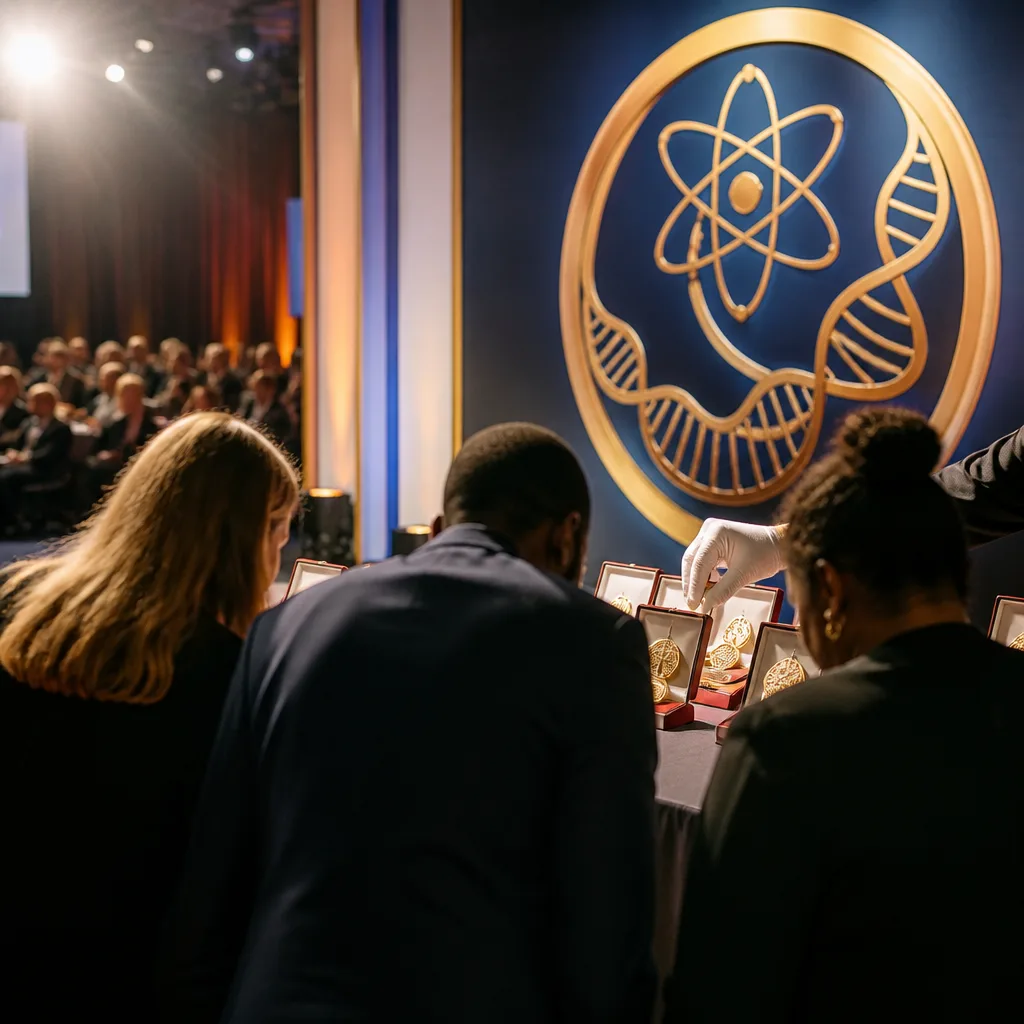
Four women were among the nine recipients of the ICBS Medal announced at the 2026 International Congress of Basic Science (ICBS), organisers reported, a result that brought attention to gender representation at the highest levels of fundamental research.
Recognition across disciplines
The laureates named by the ICBS include mathematician Claire Voisin, physicist Andrea J. Liu, materials scientist Bao Zhenan and geneticist Zhuang Xiaowei. The awards were highlighted in the Congress opening address by ICBS chair Shing‑Tung Yau, who emphasised the contribution of women to scientific progress.
"Women researchers are contributing to every stage of scientific progress through their distinctive intellectual perspectives and sustained dedication," the ICBS chair said.
The selection underscores the rising visibility of women in core areas of basic science. While the medal covers multiple fields, the four women recognised represent different research traditions, from pure mathematics to experimental physics and materials science, illustrating the breadth of work now honoured on the international stage.
Profiles and pathways
The source material provides particular detail about Claire Voisin. Born in France as the tenth of 12 children, Voisin found mathematics a refuge amid a large family and pursued study at the École Normale Supérieure. Her intellectual interests extended to philosophy, painting and poetry, and she considered switching from mathematics to philosophy during her student years before deciding to remain in mathematics on the advice of a friend.
Voisin characterises mathematical research as "a wonderful experience, made of freedom, adventure, and hope," while acknowledging the inevitable failures and despair that are part of a research career. Her work centres on algebraic geometry, a field she values for its conceptual richness and multiple viewpoints. She told the Congress that powerful theoretical tools developed in pure mathematics often later find applications — a standard defence of basic research's long-term value.
The available reporting does not provide equivalent personal detail for the other three women medal recipients, Andrea J. Liu, Bao Zhenan and Zhuang Xiaowei, beyond their names and fields. Still, the ICBS chair expressed hope that the laureates' scholarly journeys would inspire more women to pursue science and to engage courageously with research careers.
Why this matters
Recognition at high‑profile gatherings such as the ICBS can influence both perception and policy. Awards draw attention to role models, which research shows can encourage greater participation from underrepresented groups. They also serve as signals to funders and institutions about where excellence is perceived to lie.
At the same time, individual awards are not a substitute for structural change. The presence of four women among nine medallists is notable, but it is one indicator among many: hiring practices, promotion rates, grant success and workplace culture all determine whether aspiring scientists find a sustainable career path.
- Numbers: 9 total ICBS Medal recipients; 4 are women.
- Representative fields: mathematics, physics, materials science, genetics.
- Message: ICBS chair emphasised women's distinctive contributions and hoped laureates would inspire others.
| Metric | Value |
|---|---|
| Total ICBS Medal recipients (2026) | 9 |
| Women recipients | 4 |
For readers in South Africa and elsewhere, the story offers both celebration and a prompt for reflection. Celebrating excellence matters — winners provide visible proof that women can and do reach the highest levels of discovery. Yet policymakers and institutions must convert such moments into durable support: improved training pipelines, equitable funding, family‑friendly career structures and attention to bias in evaluation.
The ICBS awards also reiterate a familiar point in debates about basic science: deep, curiosity‑driven work can produce conceptual frameworks and tools that later find practical applications. Voisin's view that theoretical advances often lead to later use is a reminder that investment in foundational research is a long‑term commitment.
As the scientific community digests the 2026 ICBS outcomes, the presence of four women among the medallists will be cited both as evidence of progress and as an argument for continued, deliberate action to ensure diversity becomes the norm rather than the exception.