
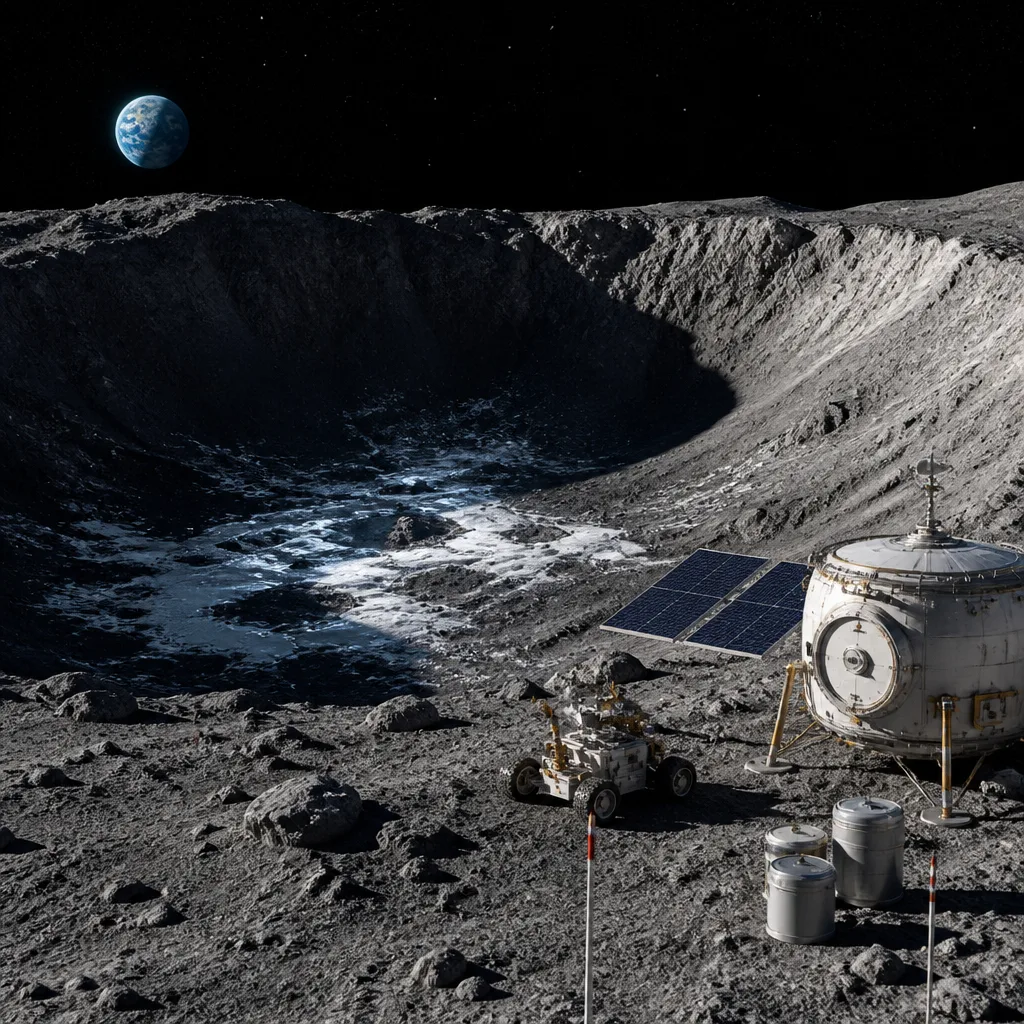
Recent calculations published in Frontiers in Space Technologies suggest that discoveries of water at the lunar poles, while scientifically important, are far too limited to support long‑term, large‑scale human cities or heavy industry on the Moon.
Cold traps hold ice, but not unlimited reserves
Researchers Dr Martin Elvis and Dr Jonathan McDowell examined what can reasonably be done with the amounts of water detected in permanently shadowed polar craters. These cold traps—crater floors that have avoided direct sunlight for about four billion years—remain below roughly 110 K (about −163°C). At such temperatures, water ice is stable against sublimation for geological timescales, making these locations repositories for water delivered by ancient asteroid impacts.
Missions orbiting the Moon since 2013 have progressively mapped likely water‑ice deposits. Estimates based on those data place the total frozen inventory in these cold traps at up to around one billion tonnes of water ice. That figure has fuelled visions of permanent settlements able to use in‑situ water for life support, agriculture and propellant production.
Practical limits to reuse and scale
Elvis and McDowell modelled how far those supplies would go under optimistic assumptions about extraction and recycling efficiency. Their conclusion: even with generous yields and highly efficient recycling, a city of one million people would exhaust available water within about 100 years. That timeframe is short in civilisational terms and well below the sustained self‑sufficiency often imagined in speculative plans.
- Available ice: up to ~1 billion tonnes (current upper estimate).
- Cold trap temperature: below ~110 K, which preserves ice for billions of years.
- Longevity for 1 million people: about 100 years under generous reuse scenarios.
The analysis underlines a simple point: water at the poles changes what is possible for initial human return and scientific outposts, but it does not mean the Moon can sustainably host large, permanent cities or support heavy industry at Earth‑like scales.
"self‑growing cities"
The discovery of polar ice has encouraged ambitious proposals from private sector actors, including plans to shift heavy industry off Earth and to found expanding lunar settlements. The authors caution that such ambitions must be reconciled with resource constraints. In short, water availability imposes a hard ceiling on the scale and duration of lunar habitation unless substantial new sources are found or technologies dramatically improve recycling and resource efficiency.
What this means for policy and planning
For policymakers, space agencies and companies planning missions, the paper stresses the need to treat lunar water as a scarce resource. Early human outposts can benefit greatly from in‑situ water—enabling drinking water, hygiene, food production and propellant manufacture for further exploration—but the economics and ethics of extracting and using a finite resource on another world require careful assessment.
The study also serves as a reminder about the distinction between scientific detection and operational sufficiency. Finding water in cold traps confirms a crucial enabling resource for exploration; it does not automatically validate visions of large‑scale colonisation or industrial migration without new discoveries or breakthroughs in resource use.
Conservative planning, continued robotic prospecting, and transparent international discussion about resource rights and stewardship will be important as nations and companies map and seek access to the Moon’s polar deposits. The calculations by Elvis and McDowell provide a useful quantitative constraint on those conversations.









