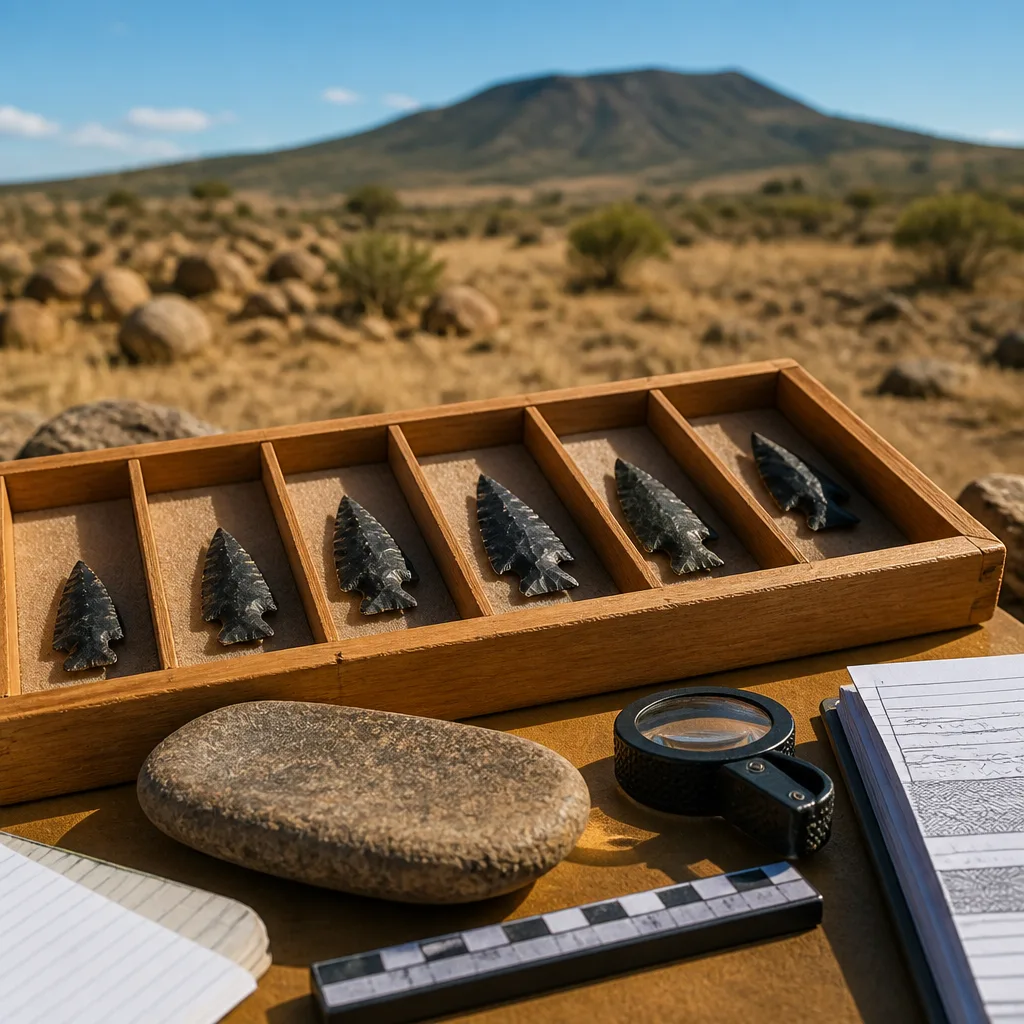
Archaeologists have described another cluster of carefully incised obsidian arrowheads from central Anatolia, a finding that adds to a small but puzzling corpus of marked weapon tips dating to the Late Neolithic. The new study, led by researchers affiliated with Aix Marseille Université and published in PLOS One, documents 11 newly recorded examples from the village site of Tepecik-Çiftlik and places them within a broader set of similarly scored points.
Small marks, big questions
The incisions — short, deliberate scratches cut into the surface of obsidian tips — are rare. Across the region investigators now count about 54 comparable incised arrowheads, some of which are nearly 9 000 years old. At Tepecik-Çiftlik itself the authors report 12 known incised obsidian points, including the 11 newly catalogued pieces.
Obsidian, a volcanic glass valued for its sheen and ability to fracture into extremely sharp edges, was widely used by Neolithic communities on the Melendiz plain. The scratch marks, however, would have required a hard, abrasive implement such as flint to produce — a material that appears to have been scarce in the immediate region. That scarcity complicates simple functional explanations for the incisions and suggests either the deliberate use of a costly tool or specialised technique.
“It was very exciting to see similarities emerging across the different sites,” said archaeologist Alice Vinet, a co-author of the study. “At the same time, every arrowhead is unique: none of the incisions are exactly alike.”
What the marks might mean
The marks have attracted attention since the late 20th century. Kathryn Ataman first described a group of incised points in 1988, examining 31 examples from a nearby locality and proposing that the incisions could function as individual signatures — a way for hunters to mark arrows and, perhaps, record claims over kills.
The new publication neither confirms nor rejects Ataman’s interpretation. The authors emphasise that while similarities occur across sites, the individual patterns show considerable variation. That combination — shared practice but unique execution — is compatible with several hypotheses, including:
- Identification marks attached to individual hunters or households
- Manufacturing marks used to track production or repair
- Symbolic or ritual markings that carried social or communicative meaning beyond immediate utility
None of these possibilities can be accepted as definitive on current evidence. The limited presence of flint, the choice of obsidian as raw material, and the spatial distribution of incised points all feed into interpretive uncertainty.
Context: Tepecik-Çiftlik and the Melendiz plain
Tepecik-Çiftlik, situated on the Melendiz plain, was occupied between roughly 7 100 and 5 800 BCE. Archaeological work at the site has yielded hundreds of obsidian tools, reflecting the importance of volcanic glass to daily life, from cutting implements to weaponry. The plain lies between two major obsidian sources, which partly explains the abundance of glass artefacts.
Even so, the incisions stand out. The study presents photographs and cataloguing data for the newly documented pieces and situates them among the broader dataset from central Anatolia. While the authors note that each incised arrowhead is different, the repeat occurrence of scoring across multiple sites indicates that the practice was not an isolated curiosity.
What comes next
Resolving why Neolithic makers chose to mark these points will require further comparative work: microscopic analysis of incisions to determine tool type and technique; contextual study of find locations (domestic versus hunting caches); and broader surveys to establish how common the practice was across neighbouring communities. Each line of evidence could narrow the interpretive field, but the current dataset supports several plausible readings rather than a single, decisive answer.
For now, the etched arrowheads remain a subtle but persistent trace of behaviour at the transition to settled farming and herding in Anatolia — a practice that combined skilled stone-working with actions whose meaning we are still learning to read.
| Category | Number |
|---|---|
| Incised obsidian arrowheads at Tepecik-Çiftlik | 12 |
| Newly catalogued from the site | 11 |
| Total documented, central Anatolia | 54 |
| Arrowheads examined by Ataman (1988) | 31 |