Scientists at the University of Connecticut, Columbia University and Brookhaven National Laboratory report a new class of structural material: a pure glass nanolattice assembled with DNA scaffolds that, according to the team, is four times stronger and five times lighter than steel. The group describes the material as the strongest known for its given density.
How DNA helps make glass behave like a structural metal
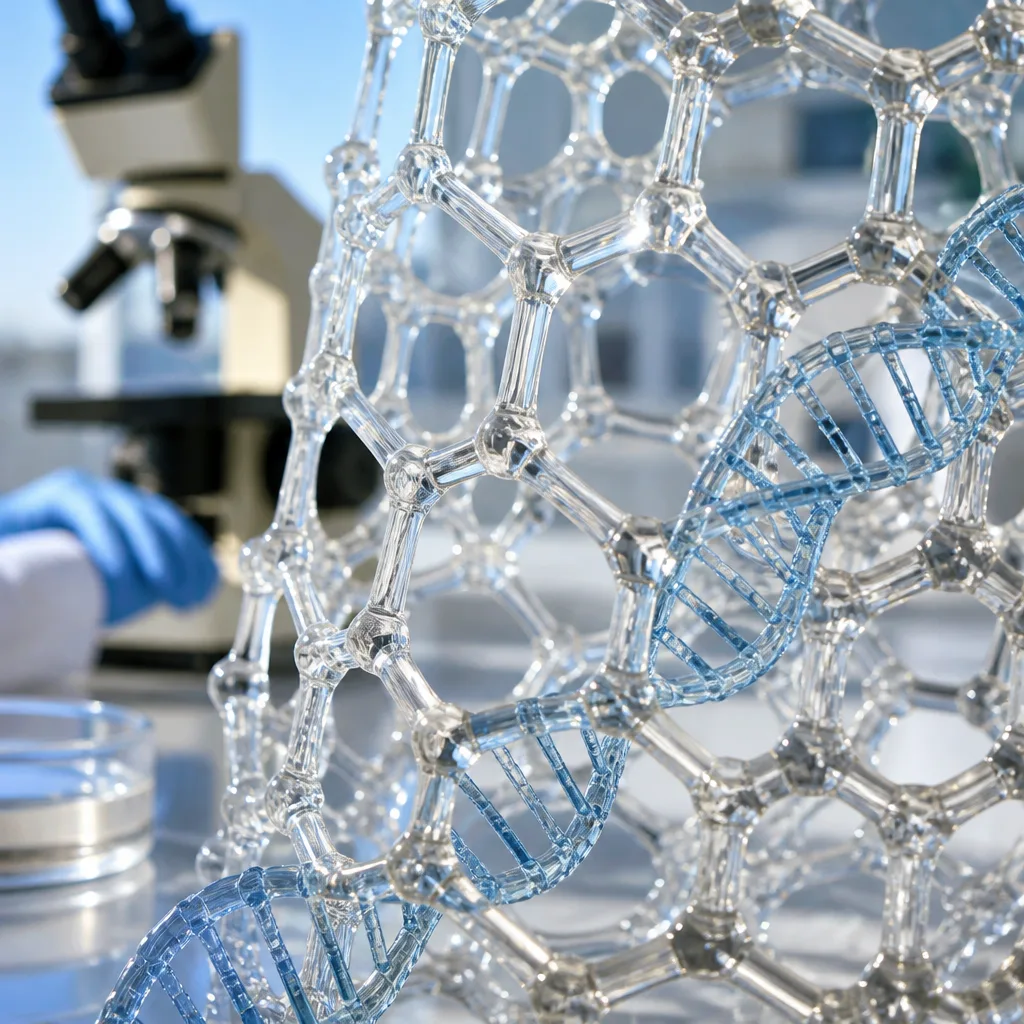
Glass is usually brittle because microscopic defects — cracks, voids or missing atoms — act as stress concentrators and make pieces shatter under load. The researchers took a different approach: instead of trying to eliminate defects in large monolithic glass, they built a repeating microscopic lattice from very small, near-flawless glass elements arranged and held in place using DNA as a programmable scaffold.
At these size scales, a tiny glass element can withstand very large pressures before breaking. By linking many such elements into an ordered lattice, the team exploited that high intrinsic strength while keeping overall density low. The result is a material that combines low mass with high mechanical strength — properties that are normally in tension.
"I am a big fan of Iron Man movies, and I have always wondered how to create a better armor for Iron Man. It must be very light for him to fly faster. It must be very strong to protect him from enemies’ attacks. Our new material is five times lighter but four times stronger than steel. So, our glass nanolattices would be much better than any other structural materials to create an improved armor for Iron Man," said Oleg Gang, a nanomaterials scientist at Columbia University.
Why this matters
Light, high-strength materials are in demand across many sectors — aerospace, automotive, protective equipment, and certain civil applications — because lower mass can translate directly into energy savings, higher payloads or improved mobility. A material that offers steel-like strength at a fraction of the mass could lead to lighter vehicles and more efficient structures where strength-to-weight ratio is a critical parameter.
But there are important caveats. The report emphasises a laboratory-scale demonstration. Producing kilometre-scale or even metre-scale structural components from nanolattices assembled with DNA is not the same as the one-off fabrication common in research. The practical challenge is scaling a precise, molecular assembly technique to sizes and production rates demanded by industry while preserving the pristine structural features that confer strength.
- Claimed performance: four times stronger and five times lighter than steel (for the material's density).
- Institutions involved: University of Connecticut, Columbia University, Brookhaven National Lab.
- Approach: assemble near-flawless glass building blocks into a nanolattice using DNA scaffolds.
Translating a promising material from laboratory proof-of-concept to industrial reality often requires new manufacturing methods, cost reductions and durability testing in real-world environments (temperature changes, humidity, fatigue loading, impact). The report does not provide those downstream results, so the material's commercial timeline remains uncertain.
| Property | Glass nanolattice (reported) | Typical steel |
|---|---|---|
| Relative strength | 4× (stronger) | 1× |
| Relative density | 0.2× (five times lighter) | 1× |
Next steps and scientific context
Materials constructed from architected lattices — sometimes called metamaterials or nanolattices — have been a growing area of research because their mechanical response can be tuned by geometry as well as composition. Using biological molecules such as DNA as an organising scaffold is a relatively recent strategy that leverages the predictability of base-pairing to place components precisely.
Future research will need to address long-term durability, how the material behaves under real service conditions (impact, abrasion, temperature cycles), and whether manufacturing can be scaled economically. For now the work is a clear demonstration that combining molecular self-assembly with inorganic building blocks can produce mechanical properties previously thought unattainable at low density.
The development is an intriguing step in materials science: it highlights how cross-disciplinary techniques — here borrowing ideas from DNA nanotechnology and glass physics — can yield unexpected performance gains. It is a promising laboratory advance; whether it becomes an industrial game-changer will depend on overcoming engineering and manufacturing hurdles.