
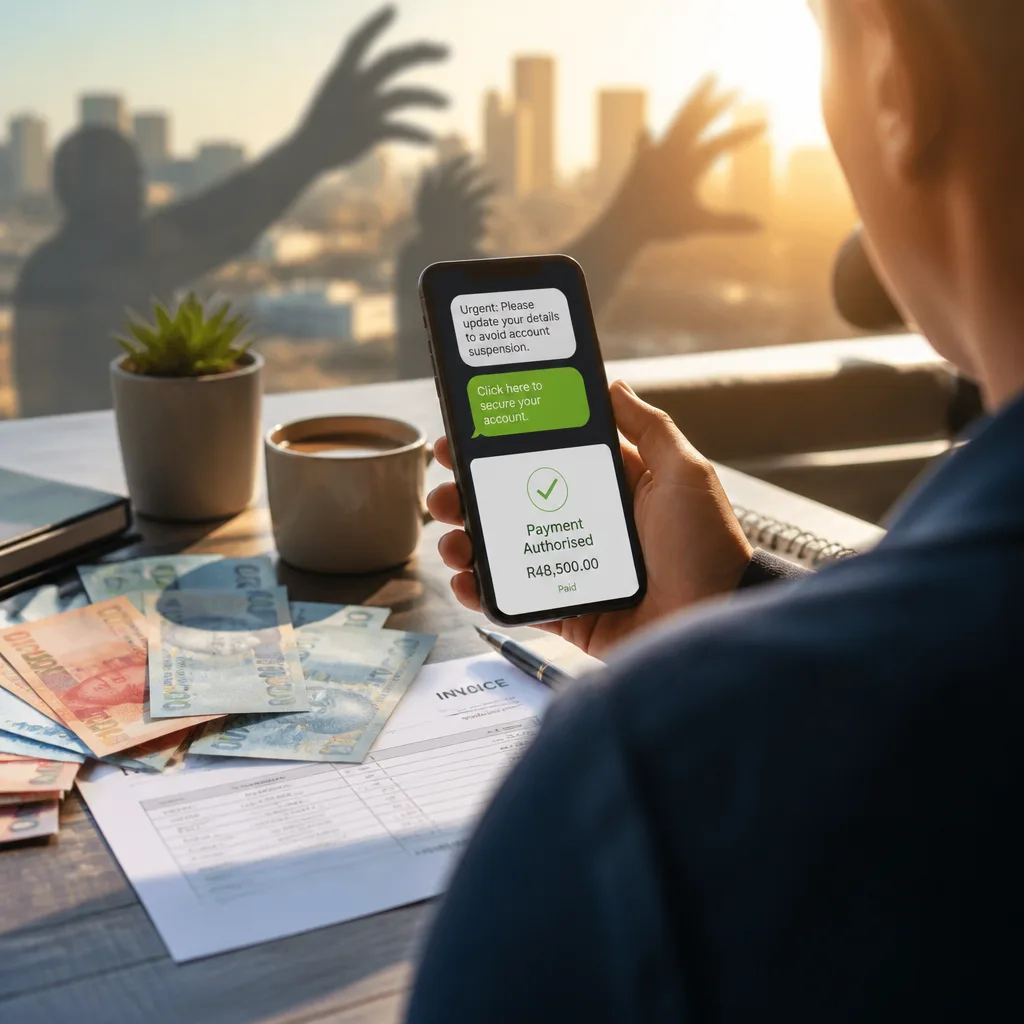
South Africa’s move to mobile and online banking has made everyday financial tasks faster but also opened new avenues for criminals, with the South African Banking Risk Information Centre (SABRIC) reporting that digital banking fraud accounted for the bulk of banking crime and produced losses exceeding R1.4 billion in 2024.
Criminals exploit people, not only systems
Industry figures say the most damaging incidents are not always the result of complex hacks into bank servers, but of scams that persuade customers to authorise transactions themselves. Michael Whitehead of Aon South Africa told the Business Explainer that fraudsters increasingly rely on manipulation techniques that exploit human trust.
“Instead, many scams exploit something far more accessible: human trust. Convincing phishing emails, fake banking messages, fraudulent WhatsApp conversations, AI‑generated voice calls, bogus online stores and scam property rentals are designed to trick people into authorising payments or revealing sensitive banking information,” Whitehead said.
That shift helps explain why recovery of lost funds is often difficult. Banks, insurers and law enforcement face a steeper uphill battle when the account holder has authorised a transfer under false pretences.
Common scams and how they hit household budgets
The Business Explainer lists typical scenarios where victims end up authorising payments or providing credentials:
- Paying for accommodation that does not exist.
- Purchasing goods from fake online marketplaces.
- Responding to intercepted and altered supplier email invoices.
- Transferring funds to incorrect bank details supplied by scammers.
- Falling for phishing, vishing (voice phishing) or smishing (SMS phishing) attacks.
- Losing access to banking profiles following SIM swap or identity theft fraud.
Each of these can produce direct losses for households and small businesses. When a consumer authorises a payment, the legal and practical options to reverse the transaction narrow, leaving many victims unable to recover life‑changing sums.
| Scam type | Immediate effect |
|---|---|
| Fake property rentals | Upfront deposit lost; travel and relocation costs also wasted |
| Counterfeit online shops | Purchaser loses money and receives no goods |
| Invoice interception | Businesses pay scammers instead of legitimate suppliers |
Prevention, detection and the limits of recovery
Whitehead warned that while banks continue to invest in cyber defences, prevention alone will not stop the trend because so many attacks hinge on human behaviour. That reality puts a premium on public awareness campaigns and stronger verification practices by both consumers and businesses.
For the average household, the practical takeaway is to treat unexpected messages and payment requests with scepticism, confirm banking details independently and use multi‑factor authentication where available. Businesses should scrutinise supplier invoices, verify requests for payment changes by phone and ensure staff are trained to spot social‑engineering attempts.
Industry bodies, law enforcement and financial firms will also need to cooperate more closely to improve real‑time detection and recovery mechanisms. SABRIC’s figures underline that digital fraud is not a niche cyber problem but a banking and consumer protection challenge that directly affects household budgets and confidence in the financial system.
These developments carry broader implications for trust in digital financial services at a time when many South Africans rely on apps and mobile banking for everyday finance. Greater public education, stronger authentication and faster reporting channels will be critical to slowing the rise in losses and protecting the rand balances of households and small businesses alike.
WE NEWS does not provide financial advice.













