
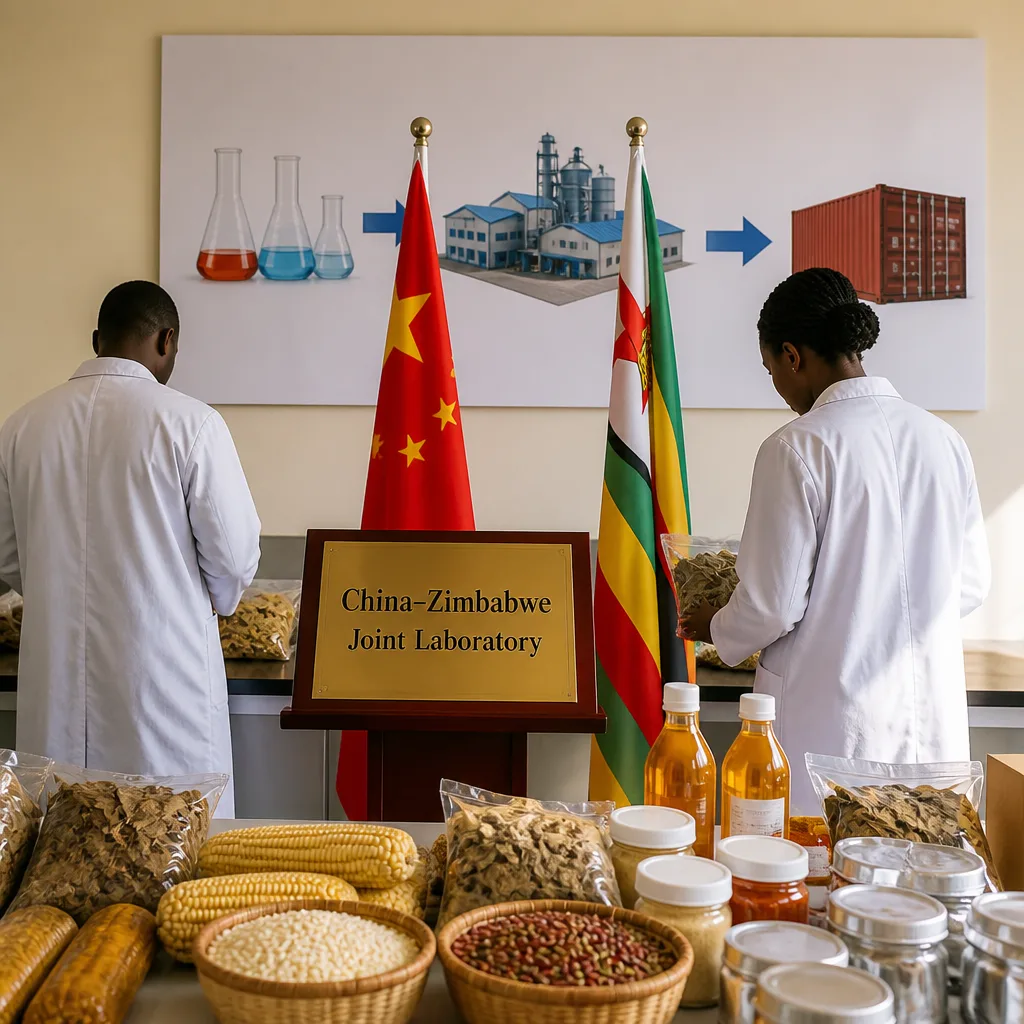
The University of Zimbabwe (UZ) has formally opened the China–Zimbabwe Belt and Road Joint Laboratory on Agriculture Ecology and Cash Crops, a partnership presented as a vehicle to translate agricultural research into commercially useful products and services for farmers.
From laboratory to market
At the commissioning, Chinese Ambassador to Zimbabwe Zhou Ding urged the laboratory to go beyond conventional academic cooperation and to help bridge the gap between scientific research and value addition. He framed the partnership as an avenue for Zimbabwe to benefit from China's manufacturing capacity and large markets while raising the productivity and competitiveness of its agricultural sector.
“By capitalising on China’s comprehensive industrial chains and vast market potential, both sides will accelerate the commercial and industrial application of research outputs,”
The event showcased senior academic and government representation. Present were Professor Norman Takaidza, chief director of Human Capital Planning and Skills Development at the Ministry of Higher and Tertiary Education, Innovation, Science and Technology Development; Professor Paul Mapfumo, vice-chancellor of UZ; and Professor Edmore Gasura, UZ deputy dean in the Faculty of Agriculture, Environment and Food Systems. The laboratory is housed on the UZ campus in Harare.
Stated priorities and potential benefits
The laboratory is described as focusing on agro-ecological systems and cash crops, with an explicit aim of strengthening links between scientific innovation and value-added processing. According to Ambassador Zhou, the collaboration should support:
- Optimisation of agro-ecological systems — better matching of crops and practices to local environments.
- Upgrading of farming techniques — adoption of improved methods developed through joint research.
- Stronger science–industry linkages — translating research outputs into products and processes that reach markets and producers.
The ambassador also highlighted recent moves by China to expand preferential market access for African countries, framing the laboratory as a means for Zimbabwe to exploit zero-tariff and other market opportunities. The emphasis is therefore on converting scientific outputs into commercially viable goods and services for both domestic benefit and export.
What this means for research and farmers
The commissioning signals a shift from traditional capacity-building projects that emphasise training and basic research towards an applied approach prioritising commercialisation. For farmers, the practical outcome would ideally be improved seed or crop management technologies, better value-chain processes and access to markets with favourable terms.
For the university and national research system, the laboratory presents both an opportunity and a challenge: to manage collaborative projects that meet rigorous scientific standards while also producing outputs that can be scaled and adopted in real-world agricultural production. Close coordination between researchers, extension services and agribusiness will be necessary if research is to translate into higher incomes or greater resilience for farmers.
| Name | Role |
|---|---|
| Norman Takaidza | Chief director, Human Capital Planning and Skills Development, Ministry of Higher and Tertiary Education, Innovation, Science and Technology Development |
| Paul Mapfumo | Vice-Chancellor, University of Zimbabwe |
| Zhou Ding | Chinese Ambassador to Zimbabwe |
| Edmore Gasura | Deputy Dean, Faculty of Agriculture, Environment and Food Systems, UZ |
How quickly benefits reach farmers will depend on several factors not detailed at the commissioning: the laboratory's research agenda, funding mechanisms for pilot projects, intellectual property arrangements, and the capacity of Zimbabwean processors and exporters to scale up value-added goods for the Chinese market. The statement about preferential Chinese market access suggests an export focus, but the laboratory's contribution to local food security, crop diversification and smallholder livelihoods will be an important measure of success.
The commissioning marks a clear intent to align scientific collaboration with trade and industrial policy. Whether the joint laboratory becomes a conduit for enduring, locally relevant agricultural innovation will depend on sustained commitment from the partners and on concrete projects that move beyond the laboratory bench to farms, factories and markets.









