Chief financial officers should treat artificial intelligence in business travel as a governance and fraud risk, according to a survey and industry commentary reported this week. The research, commissioned by SAP Concur and reported by CFO Brew, found that three-quarters of business travellers worldwide have used AI tools to coordinate trips — frequently tools not approved by employers — while a large majority of CFOs view this as a material risk to expense integrity and corporate information.
Survey highlights and concerns
The Wakefield Research survey, conducted in April and polling 3,300 business travellers, 800 travel managers and 700 CFOs across 21 markets, revealed sharp gaps between employee practice and corporate control. Key findings include:
- 75% of business travellers use AI to help plan or book travel.
- 72% said they have used or would use an AI tool that is not approved by their employer to plan or book travel.
- 85% of CFOs said they were worried that employees were using unapproved AI for travel planning.
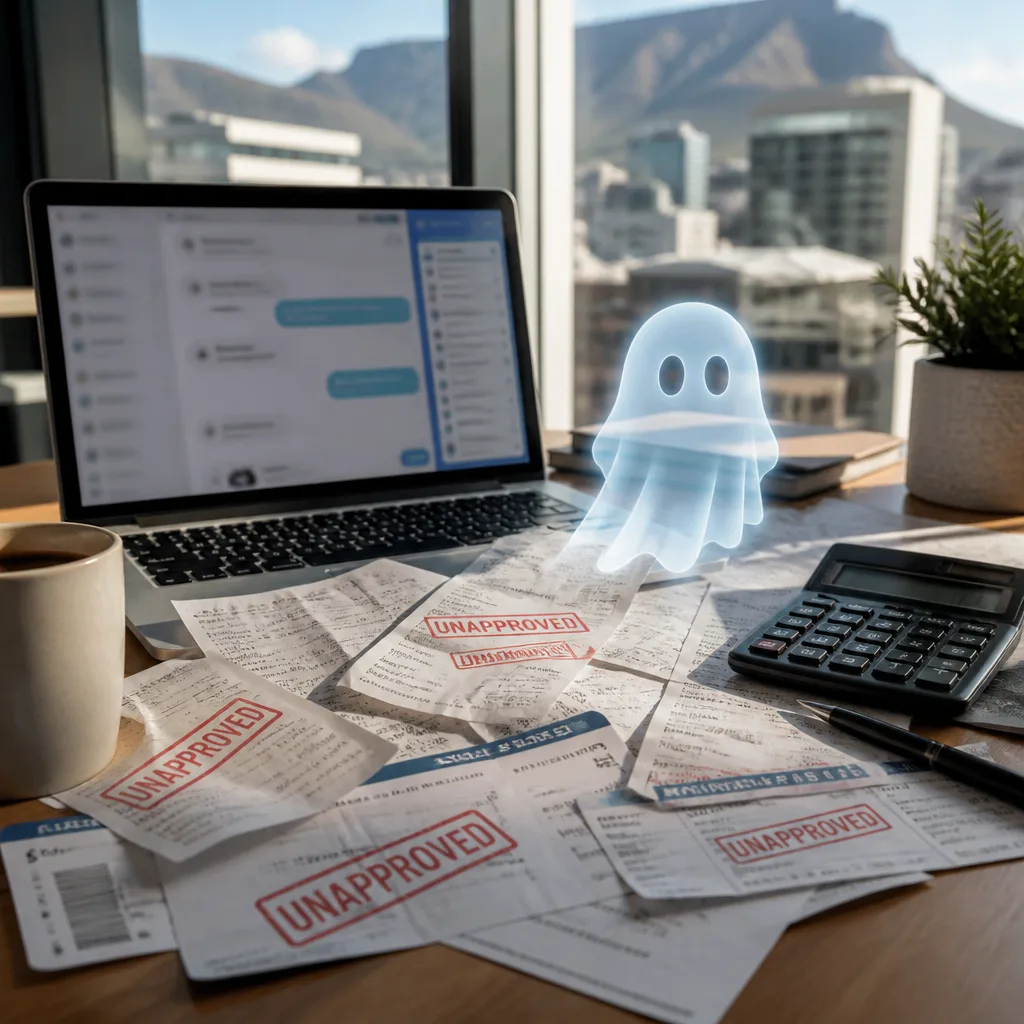
- 92% of CFOs judged it at least somewhat likely that employees are using AI to falsify expenses or receipts.
“Companies aren’t quite moving fast enough and keeping up with their travelers, who are already using the tools in the market, and they should be really embedding them into their ecosystems,” Paul Dear, VP of travel for EMEA at SAP Concur, told CFO Brew.
Dear told CFO Brew that the speed of AI adoption among travellers has outpaced many enterprises’ ability to govern those tools. He warned that the use of public AI services can expose competitive information and that employees may increasingly rely on such tools for tasks that touch financial controls.
What this means for finance teams and employers
For South African CFOs and finance managers, the findings underline several practical challenges. First, the availability of convenient consumer-grade AI travel assistants increases the risk of unauthorised systems being used for bookings, itineraries and receipts — all touchpoints for expense claims. Second, AI-generated documentation and manipulated receipts could complicate expense audits and increase the incidence of fraudulent claims. Third, use of public AI services may expose commercially sensitive itinerary details, vendor preferences or negotiated rates.
One immediate mitigation is to make secure, enterprise-approved AI tools available to staff so that employees do not resort to "shadow AI" — the informal, unmanaged use of third-party AI. As Paul Dear put it, controlling an AI tool within the corporate ecosystem is how organisations gain governance.
Actions finance leaders should consider
Practical steps companies can take include tightening policy, improving detection and providing sanctioned tooling. At a minimum, finance teams should:
- Update travel and expense policies to explicitly cover AI-assisted bookings and AI-generated documents.
- Deploy or licence secure AI or automation tools within the corporate travel and expense ecosystem to reduce reliance on public services.
- Enhance expense-audit rules and exception reporting to flag AI-typical artefacts (for example rapid, formatted receipts or identical template language across claims).
- Train travel managers, accounts payable and frequent travellers on acceptable AI use and data-sensitivity risks.
| Group | Sample size | Key finding |
|---|---|---|
| Business travellers | 3,300 | 75% use AI for travel |
| Travel managers | 800 | 72% open to unapproved tools |
| CFOs | 700 | 92% concerned about AI-enabled expense falsification |
For South African firms that rely on centralised travel booking and negotiated corporate rates, unchecked AI use could erode hard-won discounts and complicate vendor relationships. Smaller firms with limited compliance headroom face greater relative risk, since manual reconciliation of AI-generated claims is time-consuming and prone to error.
Finally, while AI can streamline travel administration and reduce friction for employees, finance executives must balance convenience with controls. Making secure, approved tools available and updating policies are steps that protect both company finances and employees from unintended exposure. These measures also help keep travel costs and reimbursements predictable — a direct benefit to the balance sheet and, ultimately, to job security and household budgets.
WE NEWS does not provide financial advice.