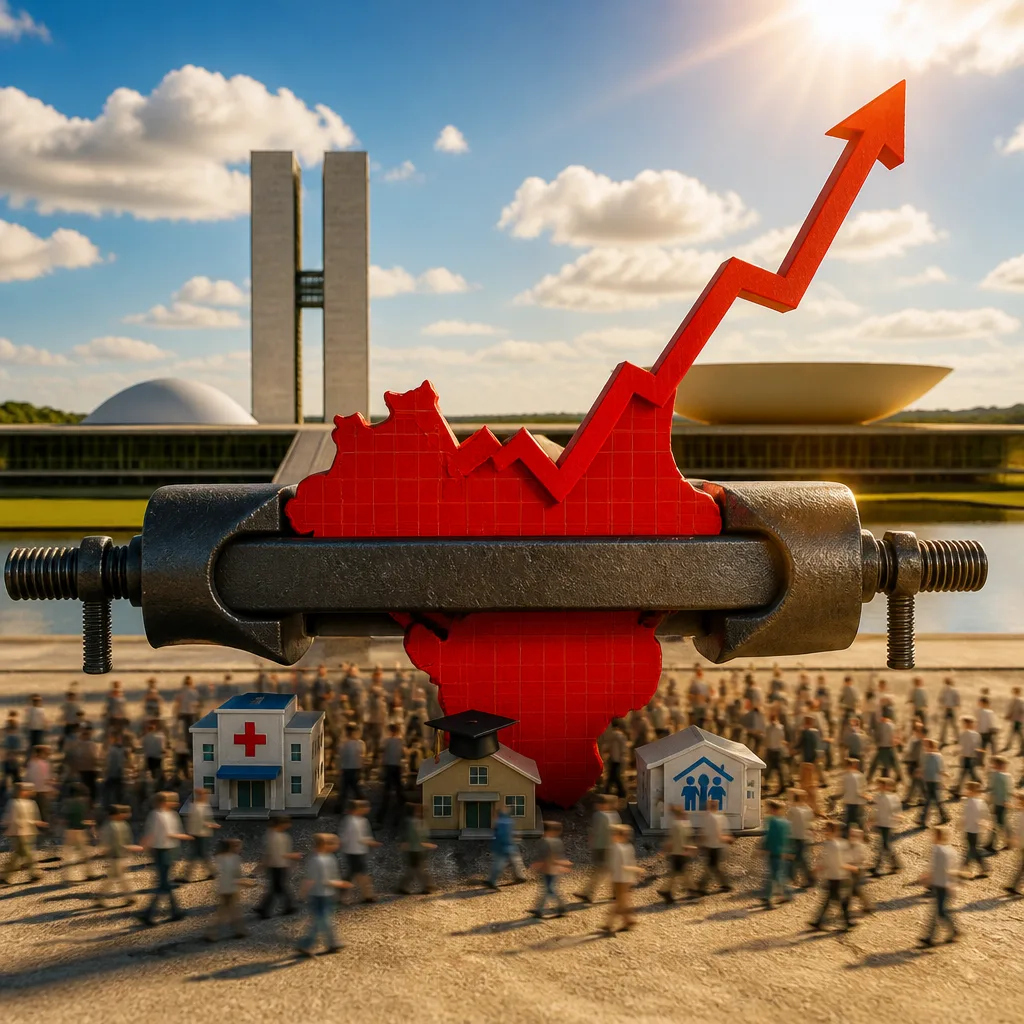
An economic adviser to Senator Flavio Bolsonaro said the campaign will introduce a public debt ceiling if Bolsonaro wins Brazil’s presidential election, a measure designed to improve fiscal credibility but one that would automatically trigger spending cuts.
What was announced
Adolfo Sachsida, described in the report as a lawyer and economist who recently joined Bolsonaro’s economic team, said in a social media post that the campaign would approve a ceiling for public debt. In a video shared on X, Sachsida said the mechanism would automatically force spending restraint when debt reached the cap.
“We will approve a ceiling for public debt. If debt is too high, a spending cap is triggered, putting the fiscal trajectory on a sustainable path,” Sachsida said in the video.
The proposal comes as Brazil approaches a hotly contested election in October, with Senator Bolsonaro the main challenger to incumbent President Luiz Inácio Lula da Silva. The campaign is positioning the debt ceiling as a tool to restore Brazil’s fiscal reputation and rein in public spending.
Economic and political context
Brazil’s public debt is reported at about 82% of GDP, an increase of more than 10 percentage points since President Lula returned to office in 2023. The economy has shown some positive signs recently — inflation has slowed and unemployment has fallen to lower levels — but fiscal policy remains a central battleground for voters and analysts.
Conservatives favour debt caps as a means of imposing discipline on public finances, and the Bolsonaro campaign frames the proposal as a stabilising measure. Critics warn that rigid ceilings can force cuts to social programmes precisely when governments need flexibility to respond to economic shocks or rising poverty.
Where the politics stands
Recent polling indicates a tight race. A Nexus poll cited in the report put President Lula on 46% and Senator Bolsonaro on 45% should the contest go to a run-off. Other polls have shown varying leads for Lula, but the margin between the two candidates is narrow enough that fiscal pledges are likely to weigh heavily with undecided voters.
The debate over a debt ceiling is therefore both fiscal and political: proponents say it can signal commitment to creditors and markets, while opponents say it risks undermining social protections and macroeconomic stabilisation tools.
Implications for markets and households
- Markets: A legally binding debt ceiling could reassure investors about fiscal discipline, potentially narrowing sovereign risk premia — but the prospect of abrupt spending cuts could also unsettle domestic demand forecasts.
- Households: Automatic cuts typically fall on public services and transfer programmes, so lower-income households reliant on social support could face the sharpest impact if a ceiling binds.
- Policy flexibility: Critics argue that ceilings reduce a government’s ability to respond to crises, such as economic downturns, natural disasters or public-health emergencies.
| Indicator | Reported figure |
|---|---|
| Public debt | ~82% of GDP |
| Nexus poll (run-off) | Lula 46% — Bolsonaro 45% |
As the campaign unfolds, investors and policy watchers will be parsing the detail of any proposed debt ceiling: how the cap is set, what triggers an automatic cut, which spending lines would be protected, and whether fiscal rules would include escape clauses for exceptional circumstances.
For Brazilians, the technicalities will matter in practical terms: the shape of any spending cuts will determine whether pensions, education and health services are insulated or face reductions — with direct consequences for household budgets.
The announcement, reported by Al Jazeera, positions fiscal restraint as a central plank of the Bolsonaro campaign’s economic message ahead of October’s vote.