
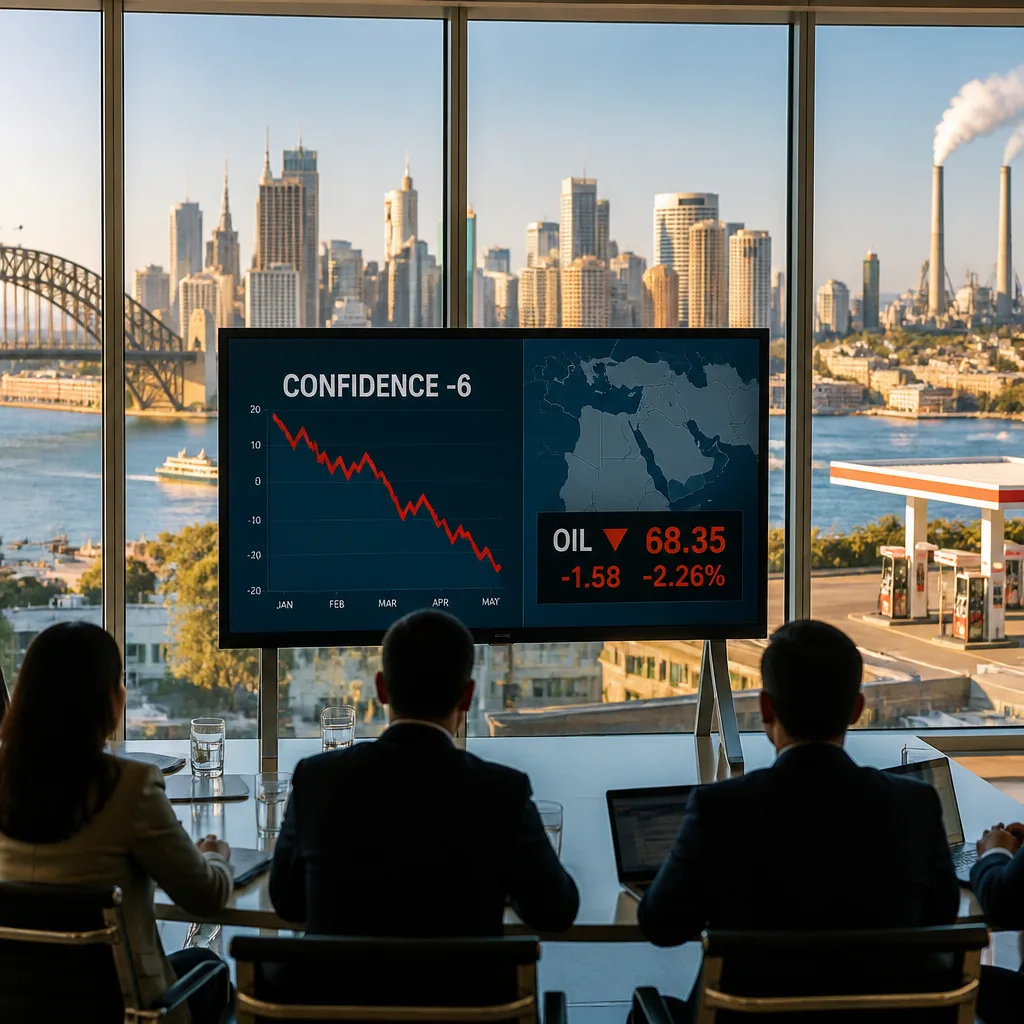
Australian business confidence weakened in July, sliding to minus six points as worries about the Middle East conflict and ongoing energy-price strength eroded the outlook for firms, a National Australia Bank (NAB) survey showed on Tuesday.
Conditions improve modestly but underlying pressures remain
While the survey's conditions measure — which aggregates profitability, sales and employment — ticked up by one point to four points, NAB warned that elevated uncertainty was continuing to weigh on sentiment and that cost pressures would keep squeezing margins.
"Despite improved outcomes relative to those seen at the peak of the impact of the Middle East crisis, the survey shows that the elevated uncertainty has continued to weigh on business confidence," NAB said.
The bank highlighted several specific cost trends in the quarterly survey. Labour cost growth rose by a further 0.5 percentage point to 2.2% in quarterly terms, the highest since January 2025. Purchase cost growth also rose 0.2 point in July, partially reversing an easing seen the month before. NAB tied part of the labour-cost increase to a minimum-wage decision that took effect on 1 July.
Capacity use and investment indicators
Capacity utilisation climbed 0.9 percentage point to 83%, with gains concentrated in finance, business and property, and wholesale industries. Despite the higher utilisation, the survey found forward orders and capital expenditure intentions (capex) remained weak in July.
Those mixed signals — rising current utilisation but soft forward demand and investment — point to a business sector that is operating closer to capacity while simultaneously wary about future conditions, a dynamic that can keep margins under pressure and restrain hiring.
- Business confidence: minus six points in July (down one point)
- Business conditions: four points (up one point)
- Capacity utilisation: 83% (up 0.9 percentage point)
- Labour cost growth: 2.2% (quarterly)
- Purchase cost growth: +0.2 point in July
| Indicator | July result | Change |
|---|---|---|
| Business confidence | −6 points | −1 point |
| Business conditions | 4 points | +1 point |
| Capacity utilisation | 83% | +0.9 pp |
| Labour cost growth (quarterly) | 2.2% | +0.5 pp |
What this means for policy and households
The survey comes as the Reserve Bank of Australia (RBA) was widely expected to hold policy rates after having raised them at its first three meetings of the year. NAB noted that the RBA had started tightening before the US attack on Iran and the subsequent energy-price shock.
For households, the signal is twofold. Higher labour-cost growth and cost-pass-through from purchase-price increases imply wage and price pressures that can keep inflation elevated. That, in turn, narrows the room for rates to fall quickly, meaning mortgage and loan costs may remain higher for longer than consumers would prefer. For businesses, persistent input-cost pressures alongside weak forward orders and capex point to tighter margins and cautious hiring plans.
In short, the survey portrays an economy that has regained some operational normality since the peak of the Middle East conflict but still carries a "soft underbelly", to borrow NAB's phrase — higher costs, patchy demand and uncertainty that together limit firms' willingness to expand.
For South African readers watching global inflation and central-bank moves, the NAB results reinforce the message that external shocks — such as geopolitical events that drive energy prices — can quickly filter through to business sentiment, investment behaviour and ultimately household budgets.
WE NEWS does not provide financial advice.













