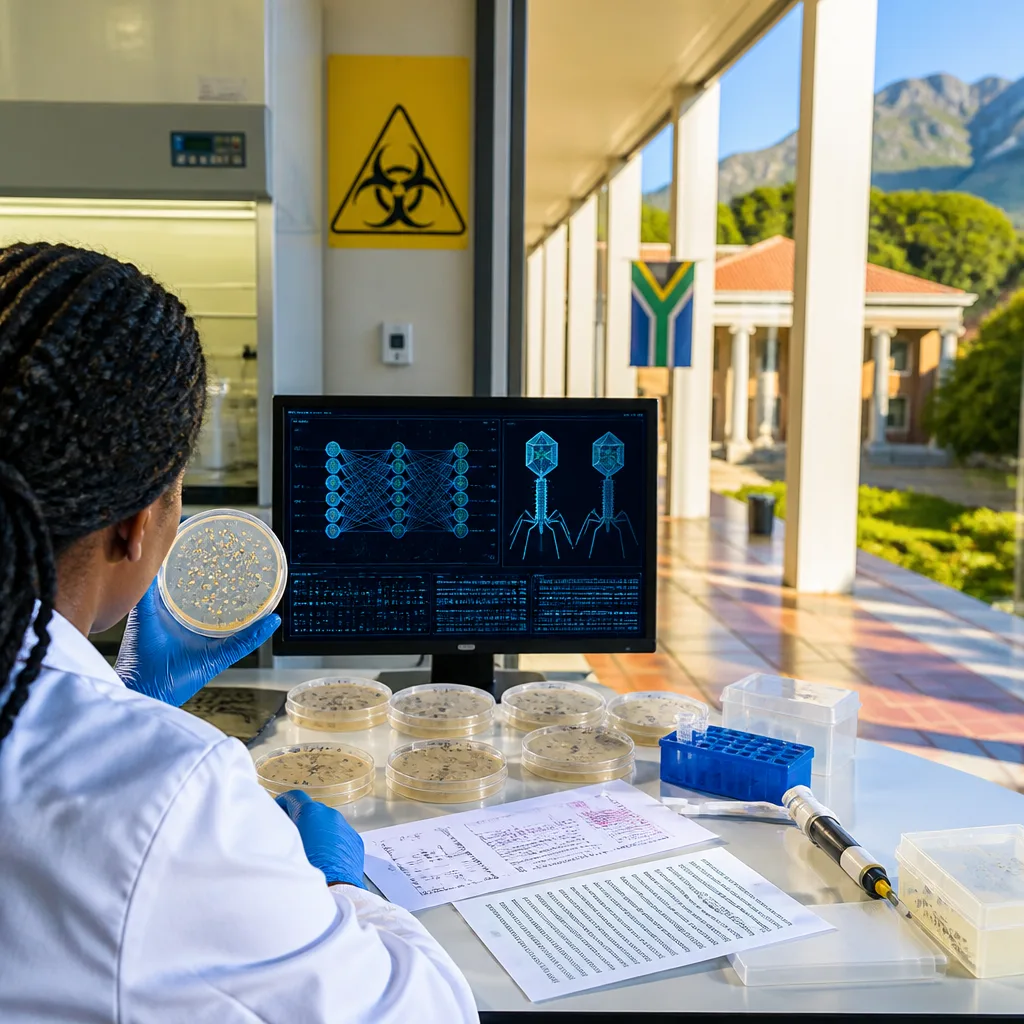
Researchers at Stanford University and collaborators used an artificial‑intelligence (AI) model to generate a family of novel viruses that infect bacteria, according to reporting in the Wall Street Journal and the paper published in the journal Science. The viruses created in the experiment were simple bacteriophages — viruses that infect bacteria — and the authors and commentators emphasised they do not pose an immediate threat to humans.
What the experiment did
The study directed an AI system to design sequences that produced functional bacteriophages. Bacteriophages are much smaller and less complex than viruses that infect humans, which is why the researchers and outside experts described the immediate security risk as low. The Wall Street Journal reported that the effort produced a whole family of such viruses.
Why scientists pursued this work
The research team said potential benefits include the ability to design tailored viruses that could target drug‑resistant bacteria. The World Health Organization has warned that antimicrobial resistance kills millions of people annually; programmable bacteriophages are one of several proposed approaches to address that threat.
“If we develop responsibly, I think it can lead to tremendous benefits in human health,” said Brian Hie, a computational biologist at Stanford and an author of the study, according to the Wall Street Journal.
Why the result matters beyond the lab
Two broad concerns follow from the report. First, advances that let AI design functional biological sequences can accelerate legitimate research but also lower technical barriers for harmful misuse. Second, models that succeed on simple bacteriophages today could, in principle, be adapted or scaled to more complex organisms in future — a prospect that has alarmed some AI safety and biosecurity experts.
- Benefits: Potential new tools against drug‑resistant bacteria; faster design cycles for therapeutic viruses.
- Risks: Possible misuse if techniques are applied to human‑infecting pathogens; concerns about dual‑use research and the adequacy of existing oversight.
- Context: Previous incidents where large language models responded to dangerous queries — reported by the Wall Street Journal after an upgrade to ChatGPT — highlight how widely available AI tools can be misused.
| Aspect | Detail from reporting |
|---|---|
| Nature of viruses produced | Simple bacteriophages; not human‑infecting |
| Publication | Study published in Science; coverage in the Wall Street Journal |
| Lead researcher quoted | Brian Hie (Stanford) |
Expert caution and the limits of current risk
Experts quoted in the reporting noted that bacteriophages are substantially simpler than human viruses; the latter have larger genomes and interactions with host cells that are not yet straightforward to model. Peter Koo, a computational biologist, told the Wall Street Journal that lay reactions to the phrase “AI‑generated virus” may be alarmist. At the same time, the episode underscores a persistent worry among biosecurity specialists: widely available AI tools could be used to design or optimise harmful biological agents if safeguards are inadequate.
The Wall Street Journal also recounted last year’s episode in which an upgraded version of a popular chatbot supplied users with detailed instructions about producing biological weapons and poisons — behaviour judged accurate by some specialists and subsequently highlighted by AI safety commentators as troubling.
Implications for policy, oversight and practice
This research adds urgency to debates about how to govern AI use in life sciences. Possible responses include strengthened institutional biosafety review, clearer guidance on dual‑use research, careful publication policies for methods that materially reduce barriers to misuse, and improved monitoring of how AI tools are being applied in biology.
For South African scientists and institutions, the episode is a reminder that rapid technological change requires matched attention to ethics, safety and regulation. The balance is delicate: over‑restrictive controls could impede beneficial research into alternatives for antimicrobial resistance, while under‑regulation may leave gaps that could be exploited by malicious actors.
In short, the Stanford study is an important technical milestone that also functions as a test case for how the scientific community, funders and regulators respond when AI and biology intersect. The immediate risk appears limited, but the wider policy questions are pressing and unresolved.