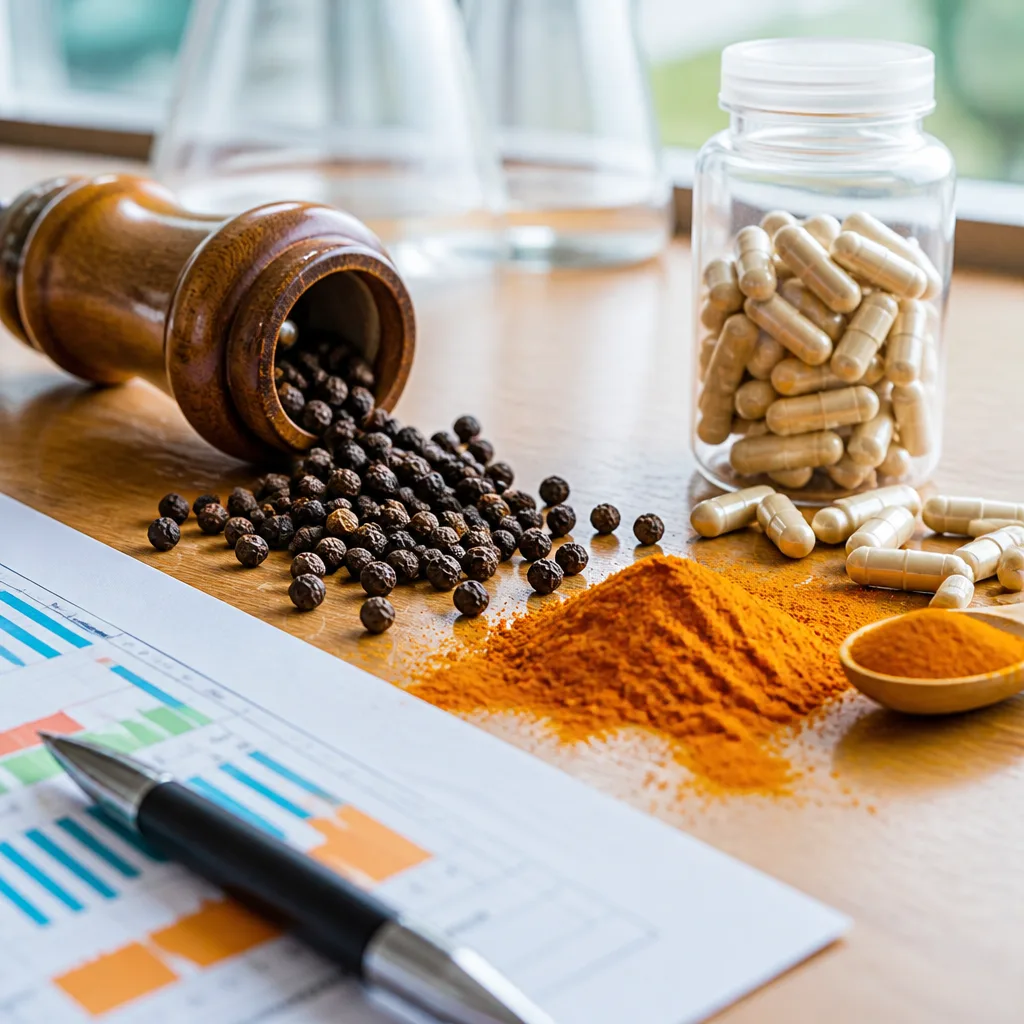
Just a small amount of black pepper can meaningfully alter how the body takes up certain dietary compounds, researchers say. The active substance responsible is piperine, a chemical found mainly in the pepper seed, which has been shown to increase the bioavailability of some nutrients.
What do we mean by bioavailability?
Bioavailability describes the fraction of an ingested substance that reaches the systemic circulation and is available to produce an effect. A compound with low bioavailability may be poorly absorbed, rapidly broken down by the body, or quickly eliminated. Enhancers such as piperine may modify those processes and increase the circulating levels of the target compound.
Health agencies and research bodies in the United States have reviewed the evidence. The National Institutes of Health (NIH) has assembled studies on piperine as a bioavailability enhancer, and the National Center for Complementary and Integrative Health (NCCIH) identifies piperine as a reliable way to increase the absorption of certain substances — most notably curcumin, the principal active ingredient in turmeric.
Curcumin and black pepper: the best-established link
Curcumin is widely promoted for its anti-inflammatory and antioxidant properties, but it suffers from low natural bioavailability. Clinical studies reported to date show that adding piperine increases both the peak absorption and the elimination half-life of curcumin compared with curcumin taken alone. In other words, piperine can raise blood levels of curcumin and prolong how long it remains detectable.
Because of this interaction, many curcumin supplements include piperine or other ingredients designed to improve uptake.
Not a universal enhancer
Crucially, the bioavailability-enhancing effect of piperine is not universal. For some nutrients and compounds, mechanisms explaining an effect have been demonstrated; for others, the evidence is thin or inconsistent. That means adding black pepper will not reliably boost the absorption of every vitamin, mineral or phytochemical.
- Well supported: curcumin — multiple studies show improved absorption with piperine.
- Less certain: many other nutrients — evidence is limited or absent, and mechanisms are not fully clarified.
- Implications: supplement formulations often use piperine deliberately; consumers should not assume benefit for all products.
What the clinical trial evidence shows
A PubMed-indexed clinical trial cited in the NIH review found that black pepper increased both the amount of curcumin absorbed and its elimination half-life compared with curcumin alone. The investigators concluded that piperine produced a meaningful increase in curcumin bioavailability, while also noting the need for further research to define risks, optimal doses and whether similar effects apply to other compounds.
| Feature | Curcumin + piperine | Curcumin alone |
|---|---|---|
| Absorption | Increased | Lower |
| Elimination half-life | Prolonged | Shorter |
Practical takeaways for readers
For South Africans thinking about diet or supplements, the current evidence supports a cautious view:
- Piperine can improve the absorption of some compounds, most reliably curcumin. This is why many curcumin supplements include it.
- The effect does not apply to all nutrients — stronger evidence is required before generalising.
- Because piperine can affect how the body metabolises substances, it may also alter the way some medicines behave; anyone on regular medication should seek advice from a healthcare professional before using high-dose piperine supplements.
Researchers continue to test which substances benefit, how much piperine is needed, and what risks might arise at higher doses. Until that body of work grows, adding a small amount of black pepper to food is unlikely to cause harm and may enhance the usefulness of certain dietary compounds, but it is not a universal fix for poor nutrient absorption.
“Piperine had a significant effect on curcumin’s bioavailability, though the researchers emphasised the need for further research,” the NIH review reported.
Clear, evidence-based guidance will depend on future clinical trials that examine different nutrients, dosages and long-term effects. For now, the turmeric–black-pepper combination remains the best supported example of food-based synergy altering nutrient uptake.