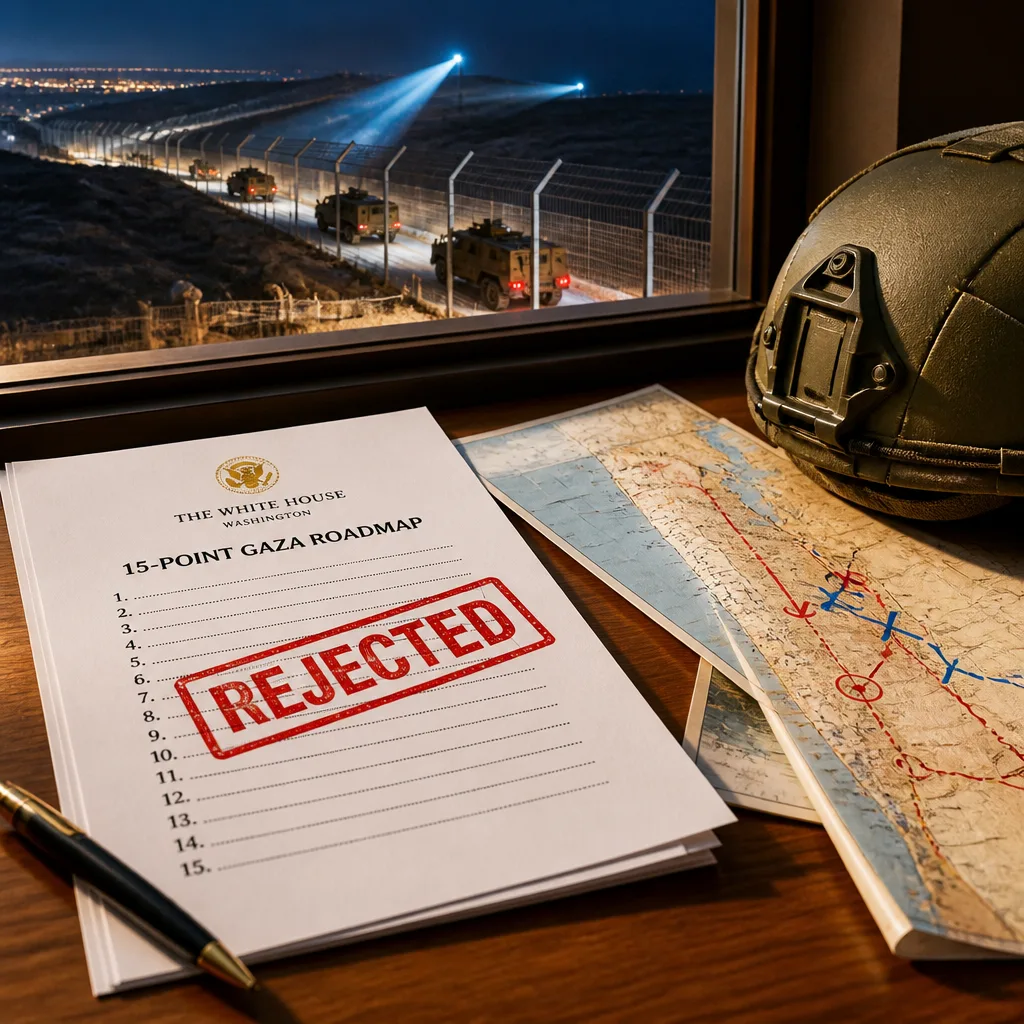
Israeli Prime Minister Benjamin Netanyahu on Sunday rejected President Donald Trump's 15-point Gaza peace roadmap, saying Israeli forces will not pull back from Gaza until the militant group Hamas is “genuinely disarmed.” The public break highlights a central impasse in efforts to convert a fragile cease-fire into a lasting agreement.
Core disagreement: sequencing and verification
Netanyahu’s statement came after the White House-backed Board of Peace said it had secured a deal under which Hamas and other armed groups would hand over weapons to an internationally vetted policing force. The Israeli leader told ministers that Israel would not accept a withdrawal that preceded verifiable and complete disarmament.
“We are talking about genuine disarmament, not fictitious disarmament,”
That position contrasts with the approach outlined in Mr. Trump’s more recent 15-point roadmap, which frames Israeli withdrawal and Hamas disarmament as phased steps rather than requiring full disarmament before any Israeli pullback. The U.S. plan, published July 31, sought to advance unresolved elements left over from an earlier deal that halted the major fighting.
Background to the standoff
Diplomacy between the parties followed an initial cease-fire in October 2025 that paused large-scale hostilities and arranged for the release of remaining hostages in return for the transfer of some 2,000 Palestinian prisoners, increased humanitarian aid and a partial Israeli withdrawal. The most contested matters — including the scale and timing of Israeli forces’ withdrawal and the disarmament of armed groups in Gaza — were deferred to later negotiations.
In late July, Mr. Trump celebrated a breakthrough via social media, saying the Board had reached an agreement for the “COMPLETE DISARMAMENT of Hamas and all other armed groups in Gaza.”
“Today, the Board of Peace reached a HISTORIC agreement for the COMPLETE DISARMAMENT of Hamas and all other armed groups in Gaza. This is a monumental step toward lasting PEACE and SECURITY,”
But a senior Hamas official had already signaled reluctance to turn over weapons before Israeli forces withdrew from parts of Gaza, underscoring the deep mistrust that continues to complicate implementation.
Immediate consequences and diplomatic friction
Netanyahu’s rejection amplifies diplomatic tensions between Jerusalem and Washington over how to sequence measures meant to secure Israeli safety while enabling Palestinian governance and humanitarian relief. The Board of Peace had publicly supported Israel’s caution, stating on Aug. 3 that Israeli forces would not retreat past the Yellow Line — a demarcation referenced in prior negotiating documents — until conditions satisfy Israeli security requirements.
The dispute has several immediate implications:
- Negotiating impasse: Differing red lines on sequencing could delay or derail next steps intended to operationalize the cease-fire.
- Verification challenges: Who vets and holds surrendered weapons remains contested between Israeli and international interlocutors.
- Humanitarian and security risks: Protracted negotiations risk interruptions to aid flows and could permit renewed violence if either side perceives an unacceptable security gap.
| Date | Event |
|---|---|
| October 2025 | Initial cease-fire; hostage releases and partial prisoner exchange |
| July 31, 2026 | U.S. publishes 15-point Gaza roadmap |
| Aug. 3, 2026 | Board of Peace backs restricted Israeli withdrawal; public debate follows |
Diplomats and analysts say the credibility of any policing or verification mechanism will be essential to moving forward. Israel’s insistence on verifiable disarmament stems from long-standing security concerns about armed groups operating in Gaza. Conversely, Hamas and its allies insist on phased steps and have conditioned major concessions on the sequence of Israeli withdrawals.
The divergent positions underscore the difficulty of converting negotiated language into enforceable, on-the-ground outcomes. While the Trump administration has framed the Board’s work as paving the way for a definitive settlement, Israeli public resistance to premature withdrawal and Hamas’s conditional approach to disarmament suggest hard bargaining remains ahead.
As talks continue, both sides face pressure from international partners to stabilize the situation and to prevent a return to large-scale violence. Whether the parties can bridge the gap on sequencing and verification will determine if the cease-fire can evolve into a durable peace or remain an uneasy pause.