
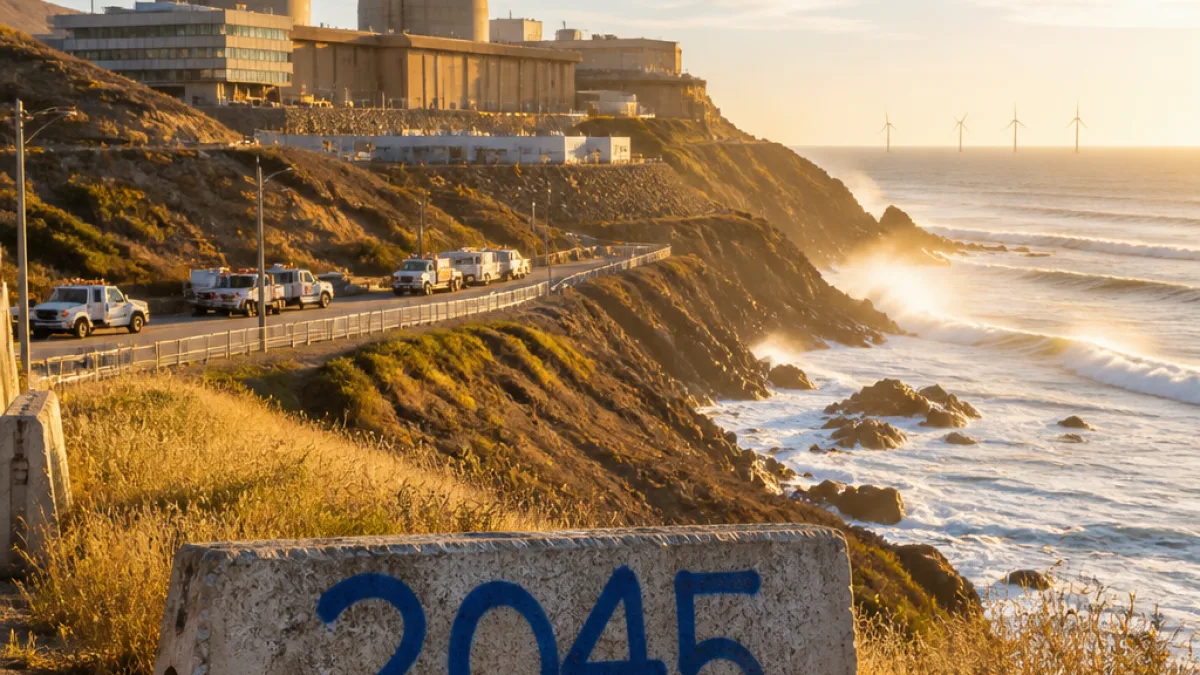
SAN LUIS OBISPO — California’s plan to retire its last operating nuclear power plant is unraveling again as a broad coalition pushes to extend Diablo Canyon’s operating life from 2030 to 2045.
Why the reversal is gaining steam
Diablo Canyon’s twin reactors, located on the Central Coast, supply a steady block of electricity that officials say is hard to replicate with intermittent wind and solar plus batteries. The plant provides roughly 2.2 gigawatts of capacity and has been credited with delivering up to 9% of the state’s electricity in some years.
After years of planning to replace its output with renewables and storage, Pacific Gas & Electric and state policymakers postponed the plant’s original 2025 closure, extending its federal license to operate through 2030. Now, nearly 50 organizations — including chambers of commerce, labor unions, nonprofits and the San Luis Obispo County Board of Supervisors — have formed a coalition arguing that continued operation through 2045 would smooth California’s transition to a cleaner grid.
Supporters say Diablo Canyon functions as a reliable, low-carbon "bridge" resource while the state scales up clean energy and expands transmission. They stress the plant’s continuous output, its role during heat-driven demand spikes and its capacity to reduce reliance on natural gas generation that emits greenhouse gases.
Local backlash and safety concerns
Opponents — including many residents who live near the facility — reacted angrily to the renewed push. Critics contend extending the life of a facility built in the 1980s will prolong the generation of nuclear waste and increase risks tied to aging equipment and seismic vulnerability.
At the plant entrance, a banner now proclaims,
"You Made This Possible"
Opponents called that sentiment emblematic of what they view as broken promises by utilities and regulators who once pledged to retire the reactors.
Broader state energy implications
The debate over Diablo Canyon reflects larger tensions in California’s energy policy. Policymakers must balance aggressive climate goals with reliability concerns amid prolonged drought, heat waves and an evolving grid that increasingly relies on variable renewable sources. Extending the plant’s life could alleviate near-term supply gaps yet complicate long-term waste management and seismic mitigation strategies.
State officials, labor leaders and economic stakeholders are weighing trade-offs: keeping a zero-emissions baseload resource versus accelerating investments in renewables, storage and transmission to meet statutory clean-energy targets.
What’s at stake locally
San Luis Obispo County officials and local labor unions emphasize jobs and tax revenue tied to the plant. Extended operations would preserve skilled positions at the site and sustain economic activity in nearby communities that have built service industries around the plant’s workforce.
Conversely, coastal residents and environmental groups cite long-term safety, waste storage and seismic concerns as reasons to conclude the plant’s operations on schedule.
Key facts at a glance
| Metric | Figure |
|---|---|
| Capacity | 2.2 GW |
| Share of state electricity (peak years) | ~9% |
| Original planned closure | 2025 |
| Current federal license | Extended through 2030 |
| Proposed extension | 2045 |
What comes next
Any formal extension of Diablo Canyon’s operating life would require regulatory approvals and likely a series of technical assessments addressing safety, maintenance and waste handling. The conversation will also pull in state energy planners weighing how best to ensure reliability while meeting ambitious carbon-reduction mandates.
For residents and businesses on the Central Coast, the outcome will determine not only the character of the local economy but also the region’s role in California’s broader clean-energy transition.
- Supporters argue extended operations provide reliable, zero-emissions power while clean resources scale up.
- Opponents warn of seismic risk, aging infrastructure and additional nuclear waste generation.
- Regulatory, technical and political hurdles remain before any long-term extension could be finalized.
As state leaders consider the debate, Diablo Canyon remains a flashpoint between competing priorities: the urgency of climate action and the practical demands of keeping the lights on in a state that is rapidly changing the way it generates electricity.
Kevin Nakamura, WE NEWS.















