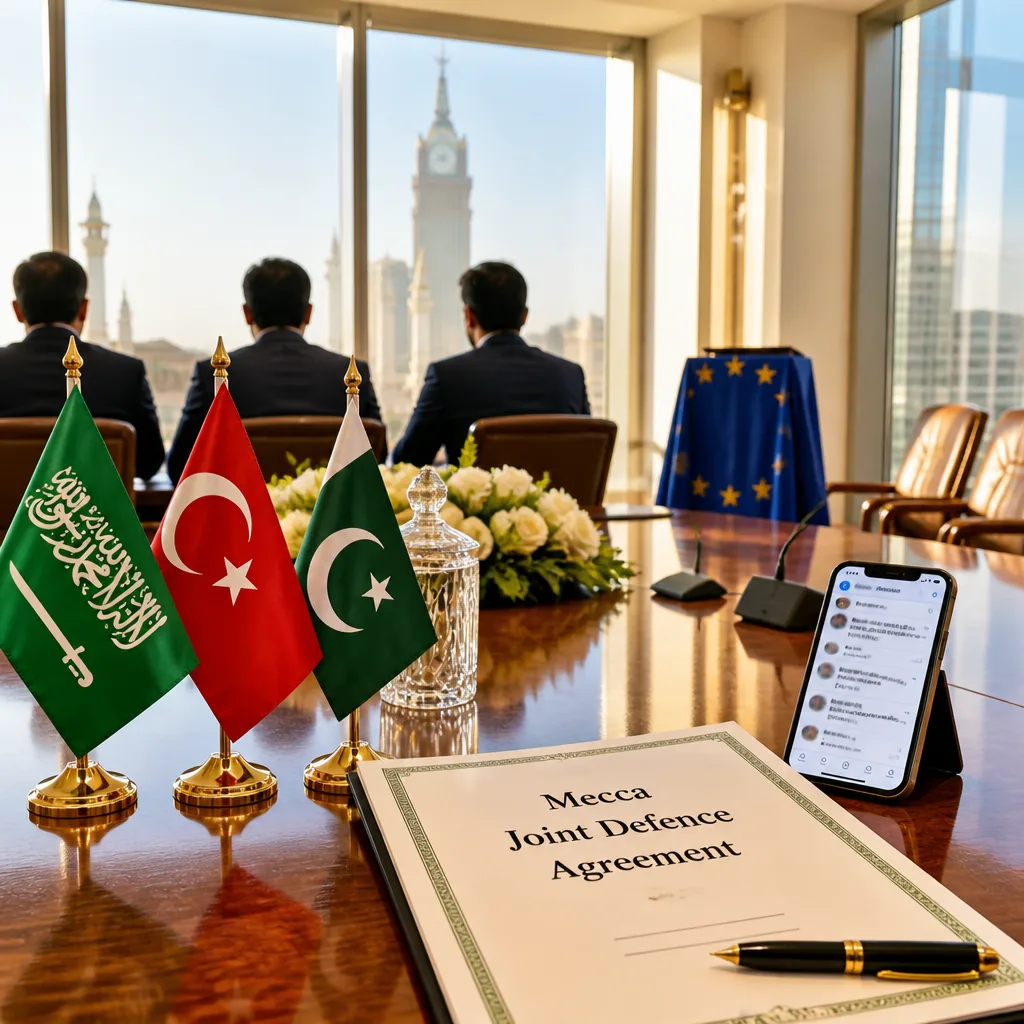
WASHINGTON — The recent public endorsement of the Mecca Joint Defence Agreement by former US President Donald Trump has highlighted a widening gulf between rhetoric about democratic values and the practical calculations that appear to be driving Western responses to new security architectures, according to an analysis of the moment.
Trump’s reaction and what it signals
On August 16, Donald Trump posted on the social platform Truth Social that he was “very happy” the Mecca Joint Defence Agreement had “finally been signed”, calling it a “BIG, BOLD, AND IMPORTANT FIRST STEP” and congratulating the “Great Leadership” of Saudi Arabia, Türkiye and Pakistan by name. Read narrowly, that reaction can be seen as approval of burden‑sharing that reduces American exposure in the Gulf. Read against the larger political moment, the post is taken to reflect a broader shift: a leader of a leading liberal‑democratic power publicly endorsing a trilateral security grouping that involves a monarchy, a military‑influenced state and a government criticised by EU institutions over press freedom and judicial independence — with no reference to democratic character.
Implications for India’s diplomatic premise
For roughly three decades, Indian foreign policy has operated with an implicit premise that democratic character carried some value in dealings with Western states — that India’s description as the “world’s largest democracy” would, at the margin, incline Western behaviour in its favour. The recent developments do not merely fail to affirm that premise; they are being read, in the analysis, as actively contradicting it: when Western leaders praise a regional security arrangement, the instinct appears to be to emphasise capability and utility, expressed enthusiastically, rather than to foreground liberal solidarity or democratic credentials, even reluctantly.
Europe’s silence
The analytical piece notes that it would be tempting to seek a democratic conscience in Europe rather than in Washington. That reading does not hold up, the piece argues: neither EU institutions nor major European capitals — London, Paris or Berlin — issued substantive statements either in favour of or critical of the Mecca pact. The clearest public engagement by the EU in that regional security space was participation in Saudi Arabia’s separate Red Sea Security Initiative meeting in July, described as a shipping‑lane forum rather than a broad security compact.
“That absence is the story,” the analysis concluded, noting the lack of any qualifying word about democratic character in the public praise.
- Shift in emphasis: The response to the Mecca pact underlines a prioritisation of strategic utility over explicit promotion of democratic norms.
- Reassessment for India: The development invites India to reconsider assumptions about the protective value of its democratic identity in relations with Western powers.
- European posture: Official European silence, coupled with selective participation in other regional initiatives, suggests cautious engagement rather than principled opposition.
Context and consequences
The analysis draws attention to broader questions about how democracies engage with illiberal partners when facing shared security concerns. If capability and burden‑sharing become the primary criteria for Western endorsements of regional security arrangements, it could reduce the leverage that democratic states have traditionally expected from shared values. For New Delhi, which has long balanced strategic ties with a claim to democratic credentials, the episode suggests the need for recalibration: democratic affinity alone may not guarantee favourable diplomatic or strategic outcomes when major powers weigh their security priorities.
At the same time, the comparative lack of public comment from Brussels and major European capitals raises questions about the limits of values‑based diplomacy. Attendance at the maritime‑focused Red Sea meeting is not the same as engagement with a land‑centred defence pact; the difference underlines how states may compartmentalise their responses to diverse security initiatives based on interests rather than on a single normative line.
Observers and policymakers will be watching whether further official statements emerge from Western capitals and whether India revises aspects of its diplomatic posture in response to what some see as a diminishing democratic alibi in international bargaining.