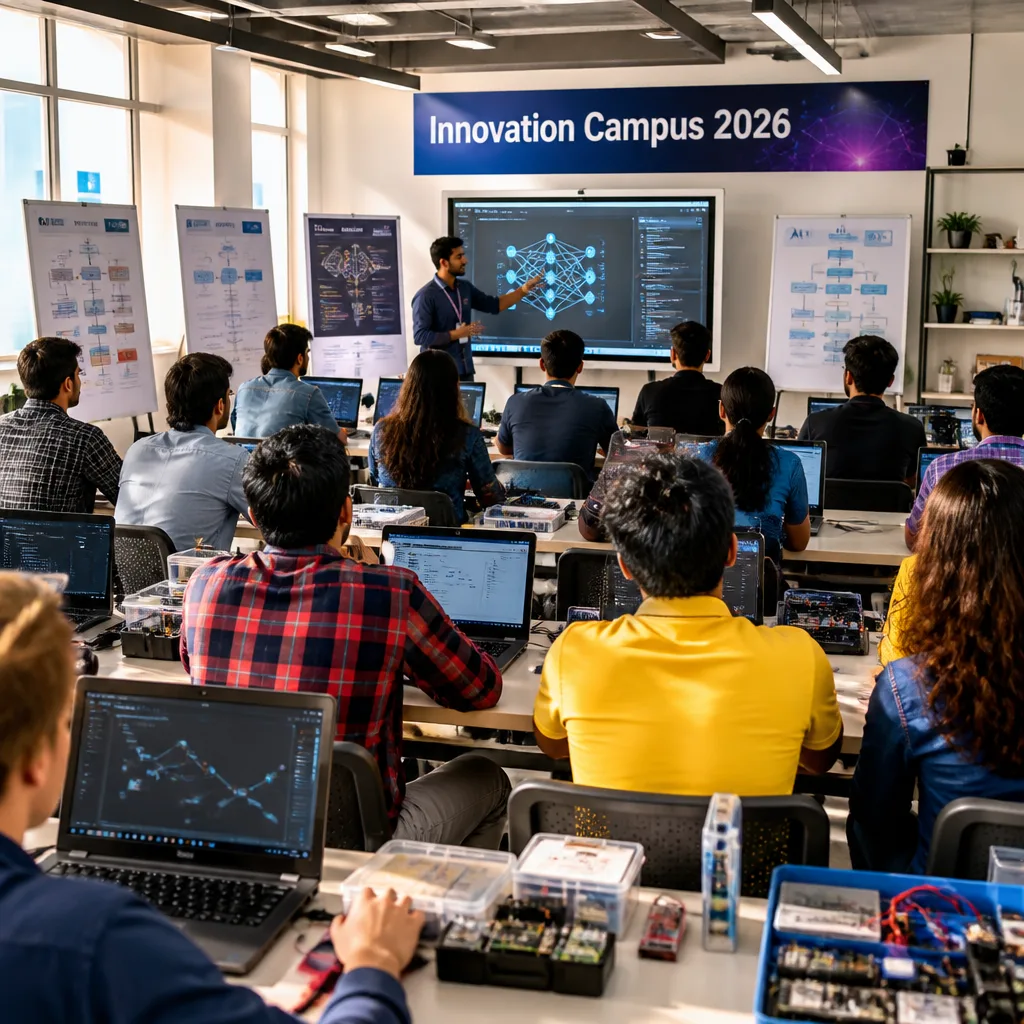
Samsung India on Monday announced the launch of the 2026 edition of its flagship corporate social responsibility programme, the Samsung Innovation Campus (SIC), with the stated aim of helping build a future-ready artificial intelligence (AI) workforce in the country.
The company said the 2026 edition will be implemented in collaboration with the Electronics Sector Skills Council of India (ESSCI) and the Telecom Sector Skill Council (TSSC). Through these partnerships, Samsung plans to train 20,000 young people in AI across 10 states, targeting youth aged 18–25.
Programme format and objectives
Now in its fourth year in India, SIC will offer hands-on AI training that includes project-based learning, mentorship and exposure to practical, real-world applications, the company said. The programme is positioned to prepare participants for careers in AI — a technology domain that Samsung described as among the fastest-growing globally.
Samsung framed the initiative as part of a wider effort to expand access to industry-relevant AI education and to strengthen India’s AI talent pipeline as the country pursues broader AI ambitions.
“AI represents one of the greatest opportunities of our time, and India is uniquely positioned to lead this transformation through the strength of its young talent. Realising that opportunity will require sustained investment in developing the right skills, encouraging innovation and making AI education more accessible to every aspiring learner, regardless of where they come from. At Samsung, we believe technology creates its greatest impact when it empowers people. Through SIC, we are investing in the next generation of AI talent, helping young Indians build the knowledge, confidence and practical experience needed to contribute to India’s innovation journey. As we celebrate 30 years in India, we remain committed to supporting the country’s vision of becoming a global AI leader by nurturing the talent that will shape its future,”
— JB Park, President and CEO, Samsung South West Asia, said in the company statement.
Why this matters for India
Artificial intelligence is being adopted across sectors such as healthcare, manufacturing and education. The shortage of suitably trained practitioners and engineers is often cited by industry and policymakers as a constraint on adoption. A programme that trains 20,000 youth at scale could contribute to easing that bottleneck, provided the training aligns with employer needs and leads to measurable employment or entrepreneurship outcomes.
Partnership with sector skill councils such as ESSCI and TSSC is significant because they are designed to align curricula with industry standards and certification frameworks. This could increase the recognisability of the training for employers, though the announcement does not specify certification details, placement guarantees or the precise geographic list of the 10 states involved.
- Scale: 20,000 trainees targeted across 10 states.
- Audience: Young people aged 18–25.
- Approach: Hands-on training, project work and mentorship.
Samsung also flagged the initiative as part of its long-term commitment to India as it marks 30 years in the country. Corporate-backed skill programmes can complement government and academic efforts, but their impact depends on curriculum quality, trainer capability and follow-through on career pathways.
The announcement does not, in the public statement, provide details on funding for the programme, how trainees will be selected, whether the training will be free to participants, or metrics for success such as placement rates or certification levels. Those details will determine how effectively the initiative converts training into sustainable careers.
As India seeks to expand its share of global AI development and deployment, scalable training partnerships that combine industry insight with recognised skills frameworks can play a useful role. The SIC 2026 edition, through its collaboration with ESSCI and TSSC, is pitched to be one such contribution — but its real-world impact will be measurable only after course delivery, participant outcomes and employer uptake are reported.
| Feature | Announced detail |
|---|---|
| Target trainees | 20,000 youth |
| Age group | 18–25 years |
| States covered | 10 states (not specified) |
| Partners | ESSCI and TSSC |
| Edition | Fourth year in India |
Further announcements from Samsung or its partners are likely to clarify eligibility, course structure, certification and how trainees can apply. Meanwhile, stakeholders in industry and education will be watching whether corporate initiatives like SIC can be sustained at scale and integrated with India’s broader skill-development plans.