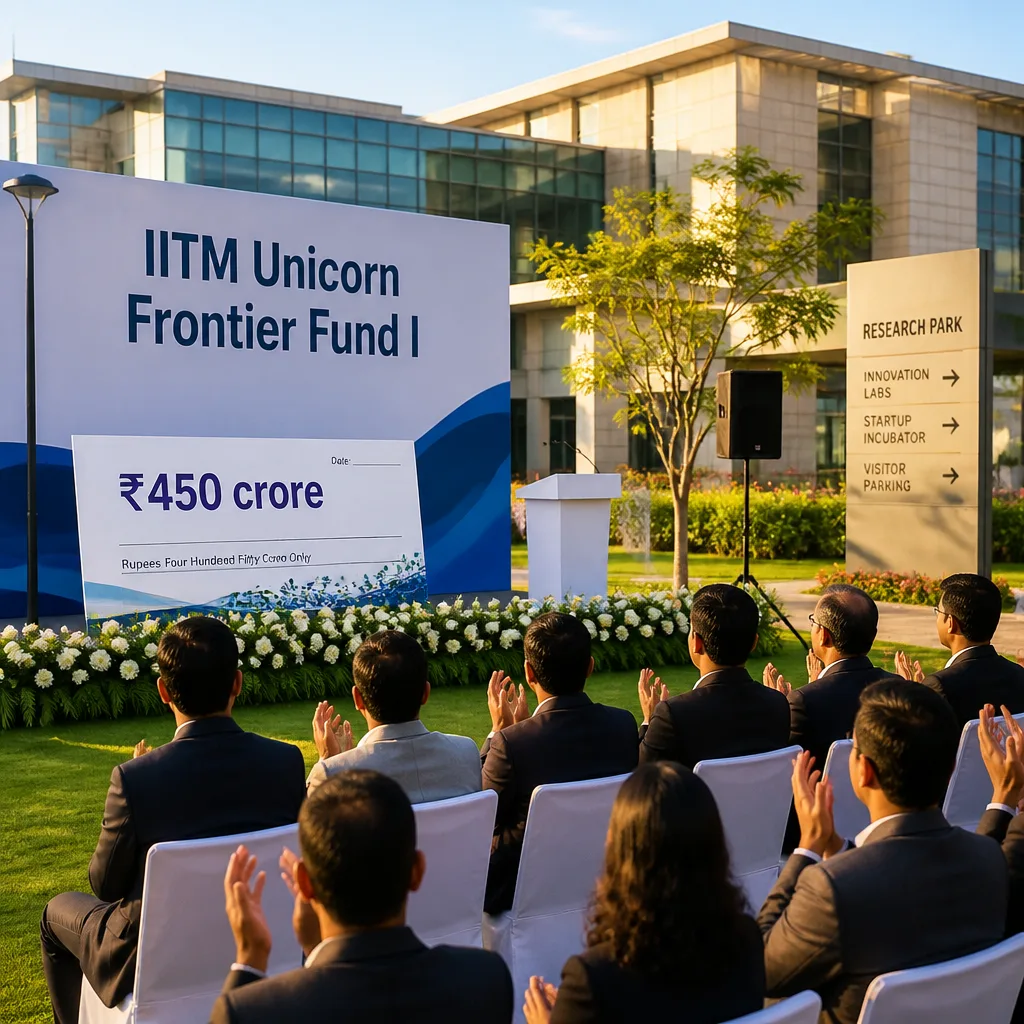
IIT Madras, its research park and Unicorn India Ventures on Sunday announced the first close of the IITM Unicorn Frontier Fund I at ₹450 crore, with the ceremony marked by the presence of the Union Finance Minister. The fund, which was unveiled in February 2026, aims to back IP-led, engineering-intensive startups in India’s deeptech ecosystem.
First close, rapid approval and early investments
The first close was achieved within three months of receiving approval from the market regulator, SEBI, the partners said. The Fund has already deployed nearly ₹55 crore across four early-stage deeptech companies as part of its initial investments.
“At IIT Madras, we have built an ecosystem that has nurtured several deep tech companies who have consistently demonstrated TRL growth and with a joint fund with best in class deep tech investors Unicorn India, we are now confident that these companies will not only get access to patient capital but also strategic growth guidance as well,” said Prof. Kamakoti Veezhinathan, Director of IIT Madras.
The fund was announced with an overall corpus target of ₹1,000 crore, which includes a ₹400 crore greenshoe option. The managers expect to reach final close by December 2026.
Strategy and portfolio focus
The vehicle will concentrate on early-stage deeptech ventures that have progressed to approximately Technology Readiness Levels (TRL) 3–4. The intention is to assemble a portfolio of about 25 startups, with an average cheque size in the range of ₹15–25 crore per company. The emphasis is on IP-led, engineering-heavy firms where patient capital and sector expertise can accelerate commercialisation.
- Fund name: IITM Unicorn Frontier Fund I
- First close: ₹450 crore (achieved in 3 months)
- Corpus target: ₹1,000 crore (including ₹400 crore greenshoe)
- Deployments announced: ~₹55 crore into four startups
- Target portfolio: 25 startups, focus TRL 3–4
The fund is backed by a mix of stakeholders, including leading alumni of IIT Madras, prominent family offices, institutions, corporates and banks, the partners said. The collaboration pairs an academic research ecosystem and a university-affiliated research park with a specialist deeptech venture investor.
Implications for India’s deeptech ecosystem
For hardware and engineering startups, access to larger cheque sizes and patient capital is often cited as a key bottleneck. By targeting companies that have moved beyond concept stage to early demonstration or prototype validation (TRL 3–4), the fund aims to bridge financing gaps that typically block commercial scale-up.
Industry observers view such university-linked funds as a pathway to translate lab research into marketable products. The involvement of alumni and family offices may also broaden the investor base for technologies that require longer development timelines compared with software startups.
| Item | Detail |
|---|---|
| First close | ₹450 crore |
| Committed deployment so far | ~₹55 crore into 4 startups |
| Target corpus | ₹1,000 crore (incl. ₹400 crore greenshoe) |
| Average cheque size | ₹15–25 crore |
| Portfolio target | 25 deeptech startups |
With a final close expected by December 2026, the fund’s progress will be watched closely by founders in sectors such as advanced materials, hardware, industrial automation, energy and other engineering-heavy areas where capital and technical mentorship are both crucial. The announcement highlights a growing trend of university-linked capital and dedicated deeptech funds looking to reduce the funding gap for such companies in India.
Further deployments and the identities of the four startups receiving the initial capital were announced by the fund managers, who said they will continue to focus on companies with clear intellectual property and demonstrable technical milestones.