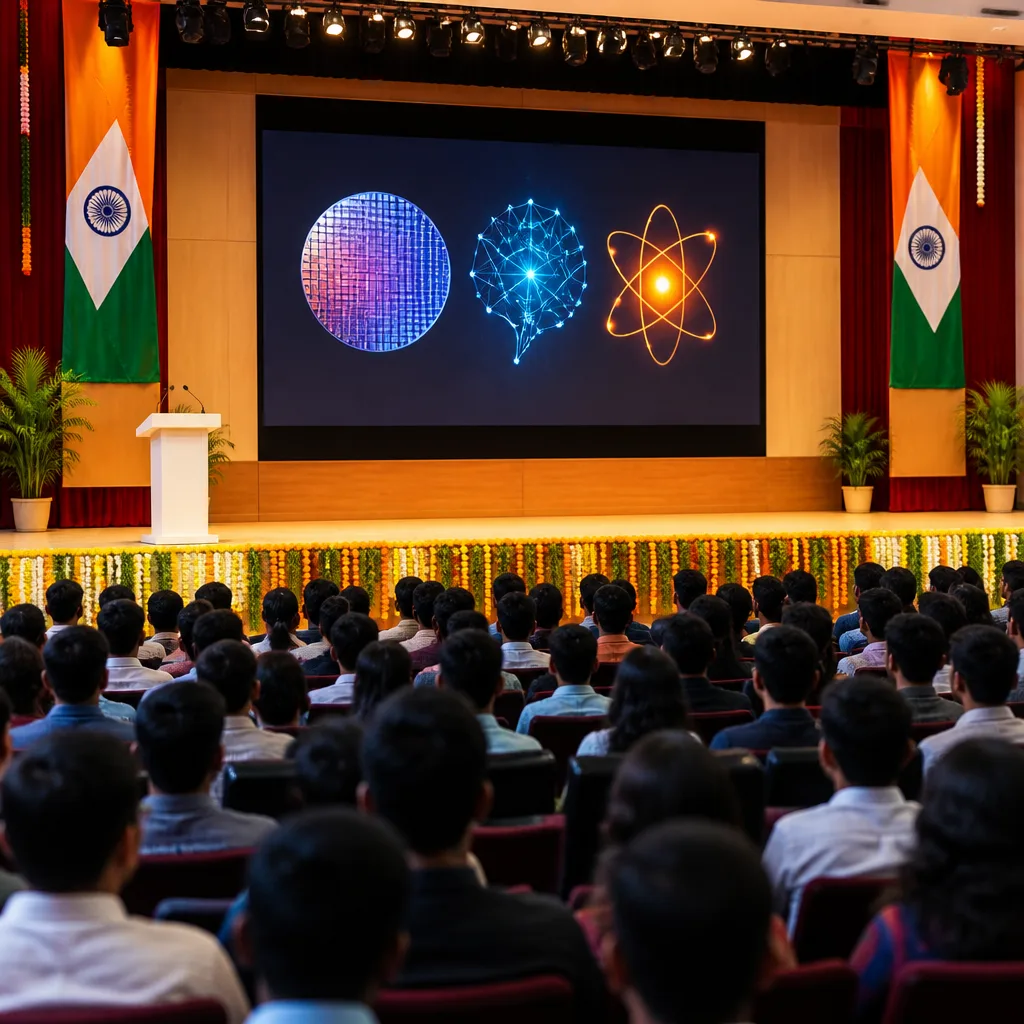
Bengaluru: Union Finance Minister Nirmala Sitharaman on Saturday urged industry and policymakers to ramp up investment in artificial intelligence (AI) infrastructure, semiconductor capacity and quantum technology, saying these areas will be the next major frontier for India. She made the remarks at a fireside chat organised by the IIT Madras Alumni Association in Bengaluru, according to PTI.
Need for hardware, skills and institutions
Sitharaman said India must accelerate efforts to build the three foundational elements needed to benefit from emerging technologies: hardware, skills and a supportive institutional ecosystem. She argued that strengthening these components is essential to harness the potential of AI, semiconductors and quantum research.
The minister noted that while visible signs of rapid AI progress are present in India, international narratives sometimes underplay the country’s activity in the space. She linked this partly to the comparatively small number of AI-focused companies listed on domestic stock exchanges, saying that listing can be one way to make the scale of the ecosystem more apparent to global observers.
“Things are happening in India in AI, but the magazines and newspapers largely from abroad — Oh, India’s missed the AI bus,” Sitharaman said.
Sitharaman pointed out that several Indian AI startups have already become unicorns or are poised to reach that status, and cautioned against using stock-market listings as the sole measure of progress. She also urged founders to consider listing, noting that despite compliance challenges, public markets can broaden visibility and funding.
Expand domestic capabilities, not just narratives
The minister urged a two-track approach: address external narratives about India’s place in advanced tech while simultaneously building domestic capability. That means investing in chip fabs and related semiconductor manufacturing, acquiring high-performance compute and other hardware needed for advanced AI workloads, and creating teaching and training capacity so institutions can update curricula and impart practical AI expertise.
Sitharaman stressed the importance of steady investment to bring in the right kind of teachers and resources to academic institutions so they can continually upgrade. She said India should not assume that slowing down the pace of innovation is an option; rather, a continued push and investment are required.
- Priority technologies: AI, semiconductors, quantum technology.
- Core needs: hardware investment, skilled workforce, institutional support for research and teaching.
- Market angle: more listings of tech firms could alter global perceptions, but listing is not the only indicator of progress.
| Technology | Immediate requirement |
|---|---|
| AI | High-performance hardware, faculty and training programmes |
| Semiconductors | Investment in fabs and manufacturing ecosystem |
| Quantum | Research infrastructure and institutional support |
Her remarks sought to reframe the discourse around India’s tech progress. By underlining the structural building blocks required — not just vibrant startup activity — the minister highlighted long-term gaps that policymakers and investors must address to keep India competitive in next‑generation technologies.
Commenting on startups’ approach to public listing, Sitharaman observed that many founders are cautious about the regulatory and compliance burden of listing. Nevertheless, she said listing has advantages and can help counter external perceptions by placing more homegrown tech companies on national exchanges.
The emphasis on hardware and institutional capacity echoes broader policy discussions in New Delhi about reducing dependence on foreign technology and building domestic ecosystems for critical technologies. While the minister did not outline specific fiscal measures at the event, her call for intensified investment offers a policy signal to investors, academia and industry stakeholders to prioritise tangible capacity-building alongside innovation.
As India seeks to position itself as a hub for advanced technology, the balance between nurturing startups and creating durable infrastructure — from fabs to faculty — will determine how effectively the country converts innovation into industrial and strategic strength.