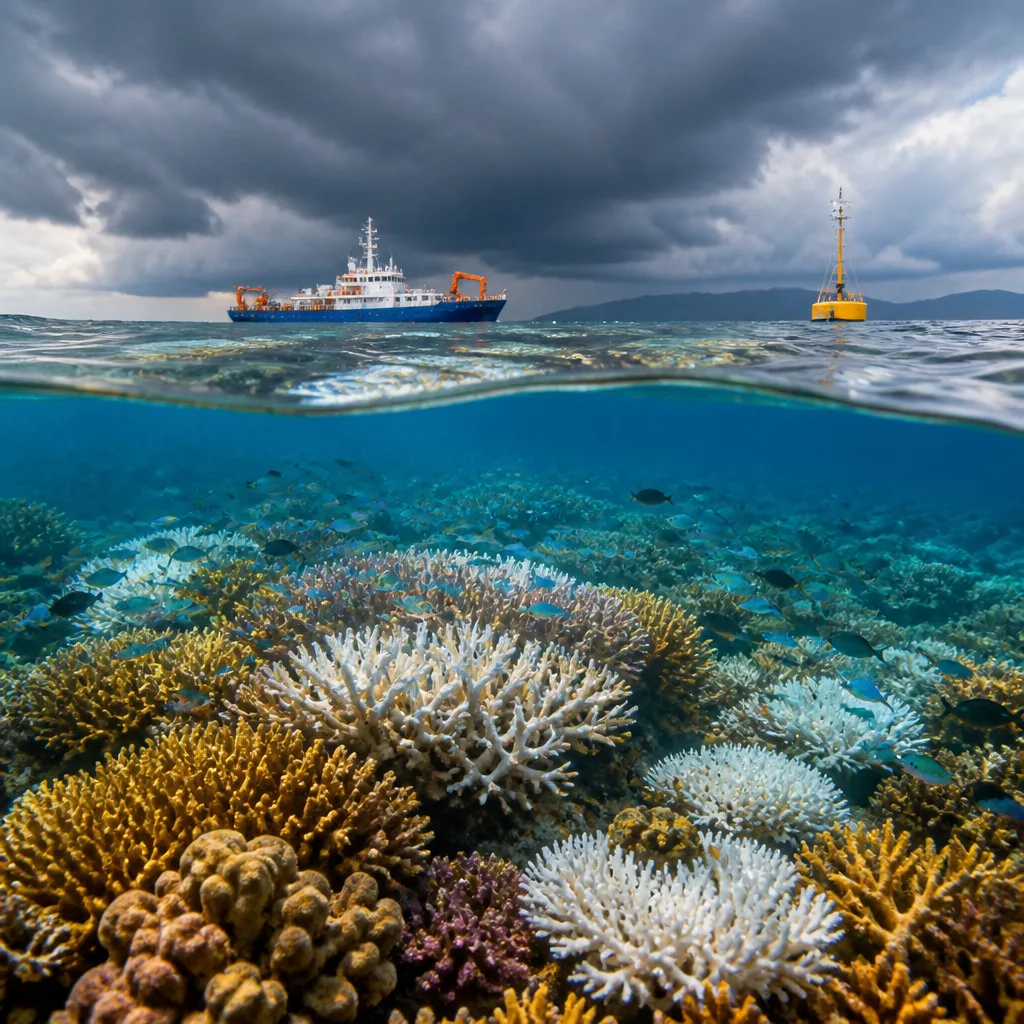
Late-summer monsoon conditions likely limited coral bleaching on the Great Barrier Reef, the Australian Institute of Marine Science (AIMS) said after its 2025–26 monitoring season, reporting modest increases or stability in coral cover across most regions of the world’s largest coral reef system.
Survey results and regional changes
AIMS surveyed 121 reefs as part of its Long-Term Monitoring Program. The institute reported that coral cover either rose slightly or remained broadly stable across much of the reef, following a sequence of severe bleaching events between 2016 and 2025.
- Northern region: coral cover increased from 30.0% in 2025 to 35.1% in 2026.
- Central region: coral cover rose from 28.6% to 31.6%.
- Southern region: coral cover recorded a marginal decline from 26.9% to 26.4%, within the margin of error.
Overall, AIMS reported that 28% of surveyed reefs showed an increase in coral cover, 56% showed no significant change, and 16% recorded declines.
| Region | Coral cover 2025 | Coral cover 2026 |
|---|---|---|
| Northern | 30.0% | 35.1% |
| Central | 28.6% | 31.6% |
| Southern | 26.9% | 26.4% |
Monsoon influence and the science behind relief
AIMS scientists concluded that unusually strong late-summer monsoon activity in the region likely increased cloud cover and reduced sea-surface temperatures, thereby easing thermal stress on corals and limiting the extent and severity of bleaching during the monitoring year.
“The Reef experienced a summer of above average sea temperatures once again, but the late summer monsoon activity...likely limited the severity and extent of bleaching,” said Dr Mike Emslie, leader of AIMS’ Long-Term Monitoring Program.
The survey findings provide a degree of short-term relief after six mass bleaching events between 2016 and 2025, including major events in 2024 and 2025. However, AIMS and participating researchers emphasised that this should not be taken as evidence of recovery to pre-disturbance conditions.
Limits to recovery and caveats
Scientists caution that increased coral cover in a monitoring season does not equate to full ecological recovery. Bleaching events can reduce the abundance of large, reef-building coral species and change reef community structure over years to decades. Localised increases in coral cover may reflect regrowth by fast-recruiting species or surviving fragments rather than restoration of historical assemblages.
The AIMS release noted that while some regions showed gains, other parts of the reef remain vulnerable. The southern region’s slight decline was within sampling error, and overall proportional gains were not uniform across reef zones or species.
Implications for management and climate context
The report underscores two key lessons for reef managers and policymakers: first, short-term atmospheric and oceanic variability such as monsoon-driven cloudiness can modulate bleaching risk; second, long-term warming trends continue to raise baseline sea temperatures, increasing the likelihood and intensity of future mass bleaching events.
For nations such as India, where the monsoon is central to national life, the finding reinforces the interconnectedness of regional climate dynamics and distant marine ecosystems. The interplay between monsoon systems and ocean temperatures may offer episodic respite for coral systems, but this does not remove the overarching threat posed by global warming, ocean acidification and local stresses such as water quality and fishing pressure.
AIMS’ annual survey provides empirical monitoring that helps distinguish temporary gains from sustained recovery. Continued long-term observation, combined with reduced greenhouse gas emissions and local reef protection measures, remains essential to improve the prospects for coral reefs globally.