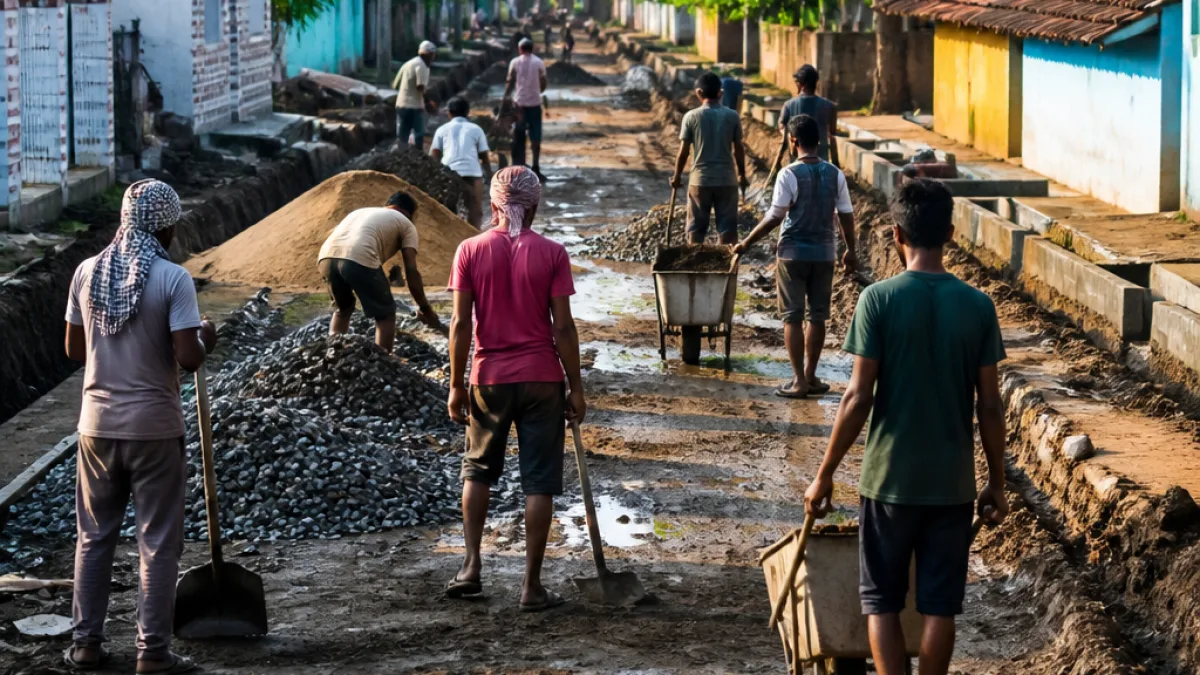
Villagers mobilise to restore basic connectivity
Residents of Durganagar, a village in Shahpura tehsil about 55 kilometres from Jabalpur headquarters, have taken up manual labour to construct and consolidate a roughly 2-km stretch of the village's main road after repeated appeals to administration failed to produce action, local reporting said.
More than 100 families, with a population of around 1,500, live in Durganagar, which was resettled for the Bargi Dam project nearly four decades ago. Villagers said the main route turns to deep mud during the monsoon and becomes virtually impassable for several days, disrupting access to education, healthcare and daily wage work.
Work driven by community, at personal cost
According to local accounts, more than 100 people — including women, men, children and persons with disabilities — are volunteering every day to improve the pathway. They are bringing murum soil and stones at their own expense to make the route usable during rains. Labourers said they contribute two to three hours of voluntary work daily before leaving for wage employment.
- Community members reported that ambulances and 108 emergency vehicles cannot reach the village during monsoon.
- Pregnant women have been forced to relocate temporarily to other villages as delivery time approaches because ambulances cannot access Durganagar.
- Schoolchildren face frequent disruption owing to the impassable road.
Repeated petitions, limited official response
Villagers told reporters they have submitted applications to the administration several times without action. The matter, according to local accounts, has been raised in the Zila Panchayat on multiple occasions but the route remains unpaved.
"The need for a road was so great that we now felt we would have to build it ourselves,"
The self-help effort has focused on making the surface passable during the monsoon, not on long-term metalling or drainage works, which require departmental machinery and funds.
Local consequences and wider context
The situation in Durganagar illustrates persistent post-resettlement infrastructure shortfalls in areas affected by large projects. Though the Bargi Dam project dates back around 40 years, residents' accounts suggest basic civic amenities — notably road connectivity linking the village to health centres, markets and schools — remain incomplete or degraded.
| Metric | Reported figure |
|---|---|
| Distance from Jabalpur headquarters | 55 km |
| Village population (approx.) | 1,500 |
| Number of families | 100+ |
| Length of road under repair | ~2 km |
Immediate measures required to convert the villagers' work into a lasting solution include grading, metalling and construction of drainage to prevent the track from reverting to mud each year. Those interventions typically require funds, plant and coordination between the district administration, panchayat bodies and public works departments.
For residents of Durganagar, the challenge is not merely convenience: disrupted connectivity directly affects maternal healthcare access, emergency response times and consistent school attendance. The villagers' move to shoulder labour and material costs underscores both the urgency felt locally and the gap between community needs and delivered public services in some resettled areas surrounding Jabalpur.
Officials at the district administration were not quoted in the local report. The situation highlights the need for an administrative response to convert temporary community repairs into durable infrastructure that restores year-round access for Durganagar and similar oustee settlements.