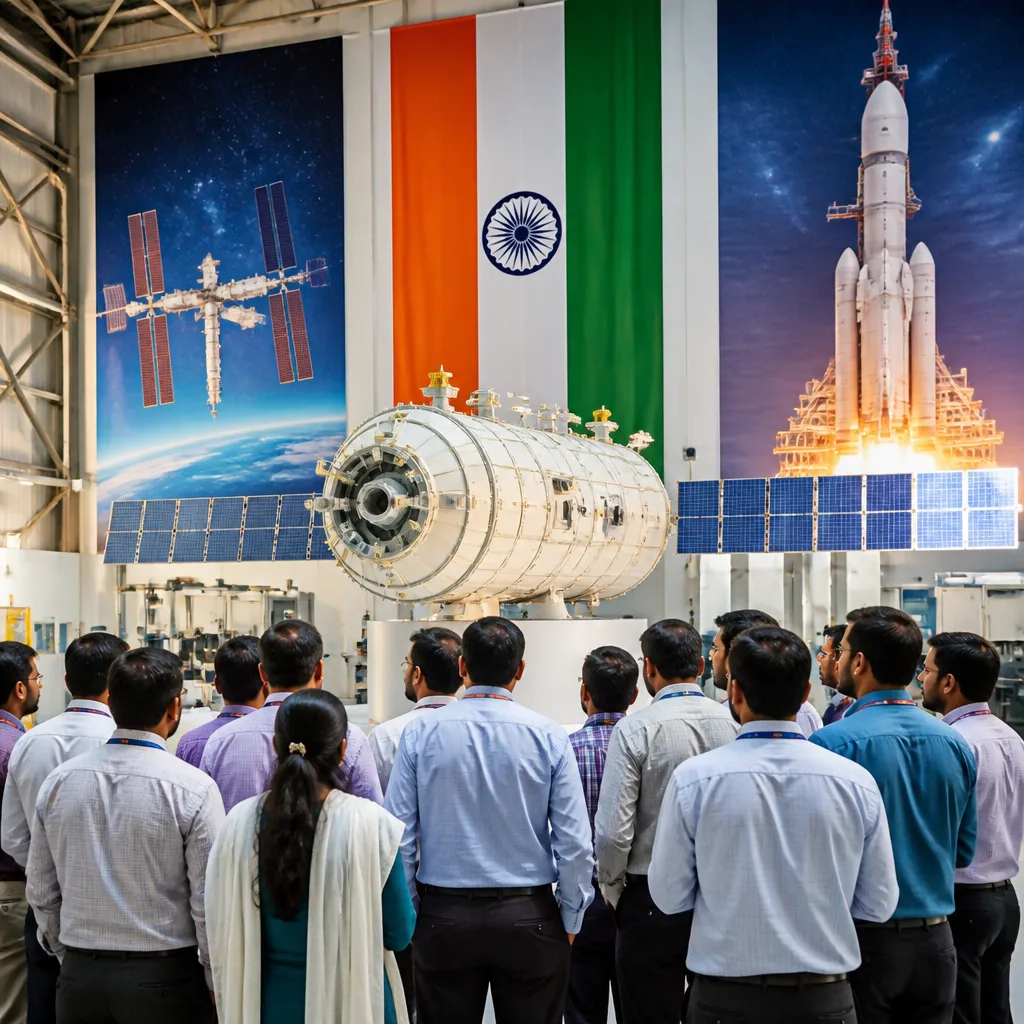
Ahmedabad: The Indian Space Research Organisation (ISRO) has approved the first module of a planned national space station and aims to establish the facility by 2035, ISRO Chairman Dr V Narayanan said on Sunday during the third National Space Day celebrations.
A national space station and expanding capabilities
Dr Narayanan outlined the development while highlighting how India’s space programme, now 64 years old, has progressively expanded its services for citizens. He said India uses space-based applications in more than 50 areas, naming Earth observation, remote sensing, telecommunications, television broadcasting, tele-education, disaster warning and mitigation, navigation, real-time monitoring and tracking, and roles linked to safety and security.
"The first module has already been approved, and we aim to establish the space station by 2035," Dr V Narayanan said.
The ISRO chief also reiterated work on the Gaganyaan human spaceflight programme alongside the space station initiative, and placed the projects within a broader policy emphasis on innovation, collaboration and global leadership in the space sector.
What the announcement means for India
The approval of a first module signals a formal step from concept to system development for a national orbital facility. A government-endorsed space station would place India among a small number of nations or blocs pursuing permanent or semi-permanent human-tended infrastructure in low Earth orbit, and would have implications for scientific research, technology development, training of human resources and international collaboration.
- Formal approval: First module of the Bharatiya Antariksha Station cleared, per ISRO chair.
- Target date: Full establishment aimed by 2035.
- Parallel efforts: Gaganyaan human spaceflight programme remains on ISRO’s active agenda.
Union Minister Gajendra Singh Shekhawat also addressed the National Space Day event. Dr Narayanan framed the developments as part of a trajectory that has broadened India’s space role beyond launch vehicles to operational services used by the public and government agencies.
Context and constraints
The chairman’s statements outline ambitions and an approved first step; they do not provide technical specifications, budgetary allocations or an explicit development schedule for the modules, docking systems, crew capabilities or international partnerships. Establishing a functional space station typically requires long lead times, systems for human habitation and life support, cargo and crew transfer capabilities, ground infrastructure for mission support, and sustained funding.
| Aspect | What ISRO announced |
|---|---|
| Module approval | First module of Bharatiya Antariksha Station approved |
| Target operational year | 2035 |
| Related programme | Gaganyaan human spaceflight |
| Service areas cited | More than 50, including remote sensing, telecom, navigation, disaster warning |
For Indian users and stakeholders, a national space station could broaden domestic research opportunities in microgravity science, test flight systems for future exploration, and support industry in creating payloads and services. It would also be a signal for deeper strategic autonomy in space capabilities.
At the same time, the practical realisation of a station by 2035 will depend on funding commitments, timely completion of module development, reliable heavy-lift launchers or commercial launch contracts, and development of crewed mission systems such as Gaganyaan. It will also require attention to astronaut health, long-duration life-support systems and orbital maintenance — areas where ISRO has accumulating experience but which carry significant technical complexity.
Dr Narayanan placed the announcement in the framework of National Space Day and described the theme as centred on innovation, collaboration and the aspiration for global leadership. The comments reflect a continuing shift in India’s civil space policy from a launch-service focus to a more diversified portfolio of human spaceflight, infrastructure and operational services.
Further technical and financial details, schedules for module construction and launch, and plans for international cooperation or commercial participation were not disclosed in the statements released at the event.