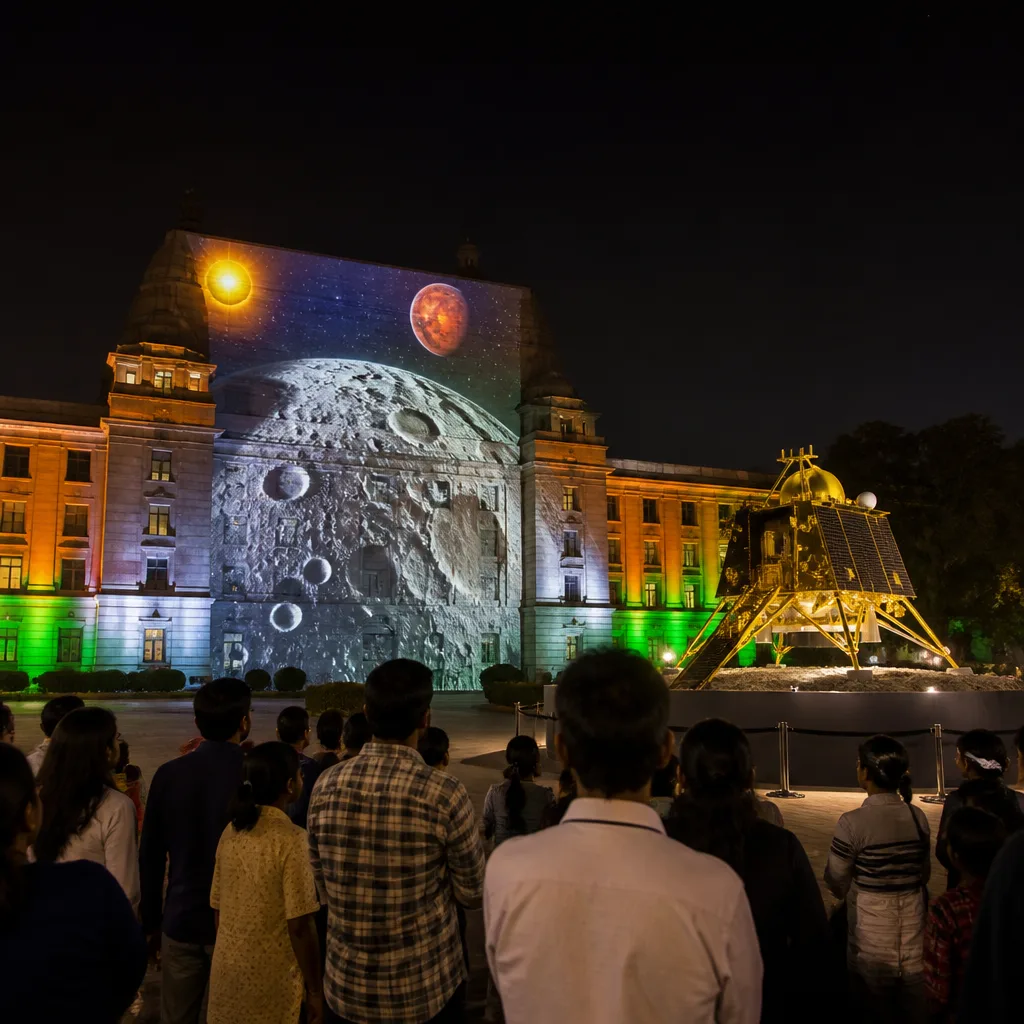
New Delhi, 23 August: India observes National Space Day on August 23 to mark the successful soft landing of Chandrayaan‑3 on the lunar south pole, a mission carried out at a cost of around ₹600 crore. The achievement made India the first country to reach the Moon’s south pole and the fourth nation to achieve a soft‑lunar landing, following the United States, the USSR/Russia and China.
From a lunar landing to a Moon base invitation
The 2023 touchdown, designated the 'Shiv Shakti' Point by the Prime Minister, has catalysed fresh international engagement. The US embassy said on August 11 that NASA formally invited ISRO to participate in its effort to build a permanent base near the Moon's south pole, noting the partnership under the Artemis Accords. NASA posted on X that it reaffirmed interest in ISRO joining the Moon base effort, adding, “We're going back to the moon to stay — and we're bringing our partners with us.”
"On August 23rd, India hoisted the flag on the Moon. From now onwards, that day will be known as National Space Day in India," Prime Minister Narendra Modi said in 2023.
India’s expanding portfolio: Sun, Mars and reusable ambitions
Chandrayaan‑3 is one milestone in a growing portfolio of Indian missions that combine scientific goals with cost‑conscious engineering. The government highlighted other major efforts that extend India’s exploration beyond the Moon:
- Aditya‑L1: India’s first dedicated solar mission, positioned about 1.5 million km from Earth, has shared more than 27 TB of solar data and is contributing to studies of the Sun while developing national capabilities in solar research.
- Mangalyaan (Mars Orbiter Mission): Launched earlier, Mangalyaan reached Mars orbit in 2014 on its first attempt, making India the first nation to reach Mars on a maiden mission. The government notes the mission cost was approximately ₹450 crore, illustrating a low‑cost approach to deep‑space exploration.
Context and consequences
Observers say India’s achievements demonstrate an emphasis on affordability and iterative capability building. Low mission costs have been widely cited as evidence of innovative engineering and prudent use of resources; Chandrayaan‑3 and Mangalyaan are frequently referenced as cost‑efficient successes. The NASA invitation, if realised, could expand India’s role in lunar surface logistics, long‑duration operations near the lunar south pole and international cooperative science under the framework of Artemis.
At the same time, participation in a permanent Moon base would require addressing technical, logistical and political challenges, including systems for sustained human presence, shared governance frameworks and interoperability with partner hardware and standards. India’s current strengths in robotic and probe missions set a foundation, but crewed or long‑duration surface activities represent a different set of requirements.
Mission data and national capability
India’s space programme now spans a mix of planetary, heliophysics and Earth observation work. The cumulative scientific output — such as the terabytes of solar observations from Aditya‑L1 — strengthens national research capacity, enables international collaborations and supports applied uses like space weather forecasting.
| Mission | Primary objective | Noted cost / data |
|---|---|---|
| Chandrayaan‑3 | Soft landing on lunar south pole | ~₹600 crore |
| Mangalyaan (Mars Orbiter) | Mars orbit insertion and remote sensing | ~₹450 crore |
| Aditya‑L1 | Solar observations from L1 | 27 TB of data shared |
These missions collectively underline a strategic trajectory that blends science, technology demonstration and international partnership. For India, the combination of demonstrable mission success and invitations to multilateral projects could accelerate the country’s involvement in sustained lunar operations, while continuing to expand solar and planetary science capabilities.
As National Space Day is observed, policymakers, scientists and industry stakeholders are likely to weigh the ambitions of a broader “Space Vision” alongside practical questions of funding, technology transfer and mission timelines. The invitation from NASA is a diplomatic and technical opening; converting it into a sustained role at the lunar south pole will require careful planning, capability upgrades and clear agreements with international partners.