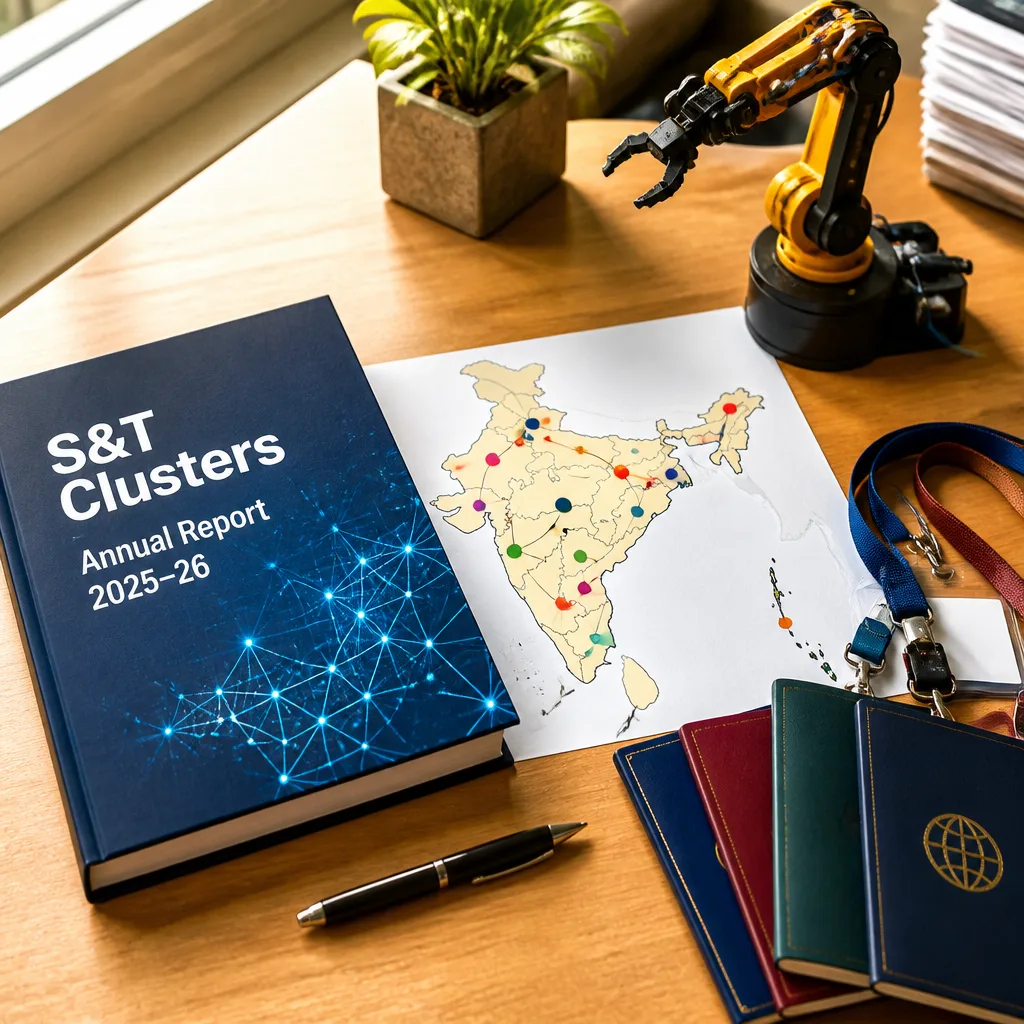
The Office of the Principal Scientific Adviser (PSA) to the Government of India on Thursday released the Science & Technology (S&T) Clusters Annual Report 2025–26, saying the clusters have evolved into regional innovation ecosystems and “National Technology Accelerators” that help move laboratory research into field deployment and commercial use.
From pilot projects to field deployment
The report documents multiple pathways by which cluster networks provide shared infrastructure, regulatory support, mentorship and industry linkages that shorten the journey from prototype to market. It lists several initiatives that have progressed from research and pilot validation to operational deployment or commercialisation, including:
- E‑Yantram (robotics and automation applications)
- AI‑enabled Digital Podiatry Clinics
- AI‑enabled agriculture and weather intelligence
- Indigenous components for pacemakers and patient‑specific 3D‑printed implants
- Public‑health and environmental efforts such as ChemAmaze and One Health
- National platforms including Kalaanubhav.in and i‑Passport.
The report highlights how shared facilities and coordinated support across clusters have enabled faster testing, regulatory processing and partnerships with industry that are essential for scaling technologies.
Growing international engagement and collaboration
According to the report, the S&T Clusters have expanded their global footprint. The First International Conference on S&T Clusters, held in December 2025, drew participants from more than 35 countries and led to 12 international memoranda of understanding (MoUs). Subsequent collaborations are reported with the University of Western Australia, the India‑Australia Smart Farm Network and the UK Catapult Network on topics spanning health, advanced technologies and net‑zero solutions.
Details in the report indicate ongoing cross‑border work in areas such as healthcare, advanced manufacturing, smart agriculture, sustainable mobility, climate resilience and capacity building. The clusters are also fostering inter‑cluster exchange within India to replicate and scale successful solutions: for example, the Digital Podiatry Clinic initially described under one cluster has been expanded to another, and the Kalaanubhav.in initiative is being adopted beyond its origin.
"National Technology Accelerators"
Scaling infrastructure and access
The report underscores programmes that improve access to scientific infrastructure. Notable among these are I‑RISE, run by I‑STEM, which seeks to broaden access to advanced facilities through the S&T Clusters, and the i‑Passport initiative from AMTZ, which is under consideration for national scale‑up to give innovators testing facilities, mentorship and regulatory navigation.
By pooling resources and harmonising support across regions, the report says, clusters reduce duplication and lower the cost and time required for product validation and market entry. Inter‑cluster collaboration is presented as central to replicating technologies across diverse state contexts.
Implications and caveats
While the Annual Report catalogues progress and partnerships, it also indirectly highlights persistent challenges in innovation systems: bridging early‑stage research to commercial models, sustaining funding beyond pilot phases, and aligning regulatory pathways with rapid technological change. The document positions clusters as a practical mechanism to address these gaps by concentrating expertise, infrastructure and industry links at the regional level.
The report’s account of international MoUs and formal collaborations signals a strategic push to integrate Indian cluster activity with global research and market networks. How quickly such agreements translate into measurable economic or health outcomes will depend on implementation timelines, financing and private‑sector uptake, variables the report notes in outline but does not quantify with long‑term outcome data.
Overall, the PSA office presents S&T Clusters as growing nodes in India’s innovation architecture that combine shared infrastructure, public‑private engagement and targeted programmes to accelerate translation of technologies in sectors that include health, agriculture and manufacturing.