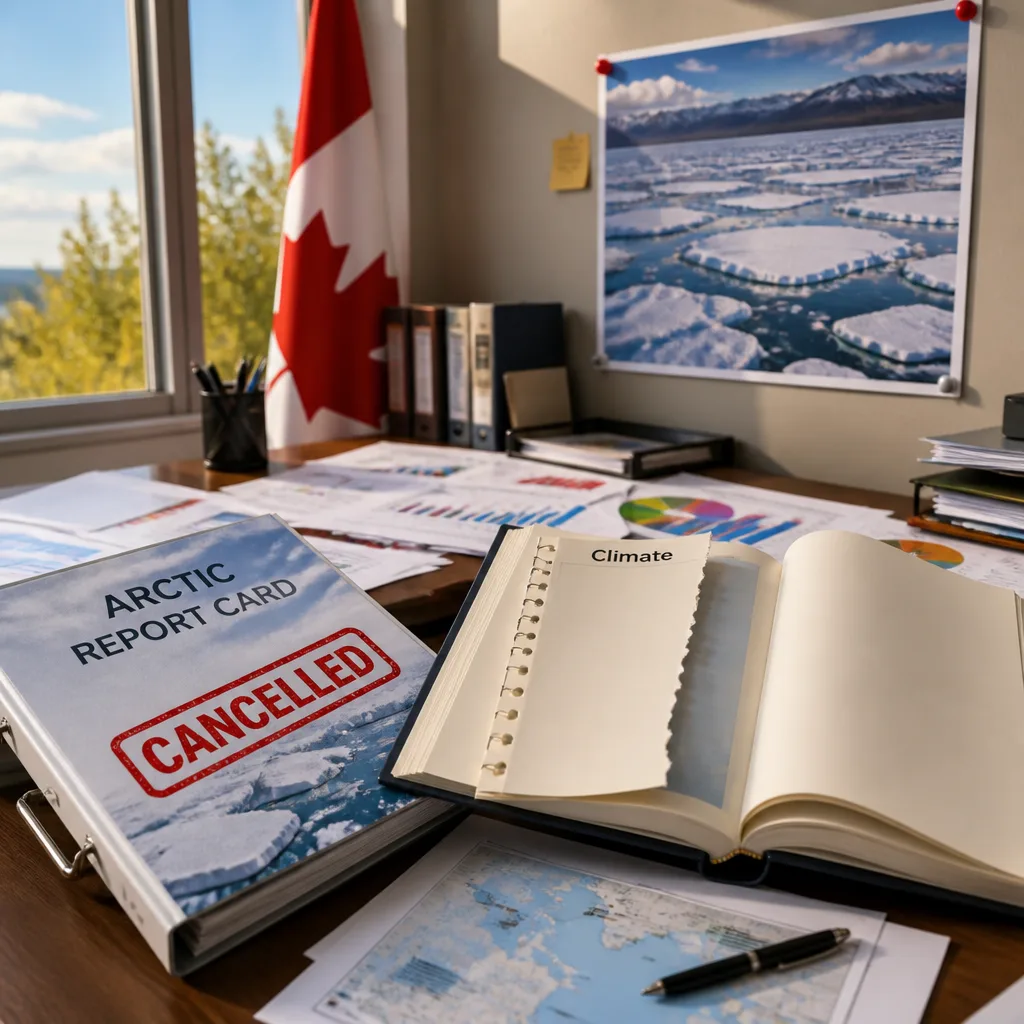
The U.S. government has abruptly halted publication of a long-running assessment of Arctic conditions and removed a chapter on climate science from a judicial reference manual, steps that have alarmed scientists who say the actions undermine public access to critical information about a region warming several times faster than the global average.
Arctic monitoring disrupted
The Arctic Report Card, an annual assessment published by the U.S. National Oceanic and Atmospheric Administration (NOAA) since 2006, will not be coordinated through NOAA for 2026, the agency said. The 2025 instalment of the report, released earlier, recorded the Arctic’s hottest year on record and documented cascading effects ranging from melting glaciers and sea ice to a shift toward greener landscapes and broader disruptions in weather patterns.
NOAA offered no detailed public explanation for ending its role in coordinating the 2026 report, noting only that existing data would remain publicly available. The move comes after a period of job cuts and budget reductions in the early days of President Donald Trump’s second term and follows other actions viewed by many scientists as a rollback of federal engagement with climate research.
Why the Arctic matters beyond the pole
Scientists emphasise that changes in the Arctic have consequences far beyond its latitudes. The region is subject to Arctic amplification, a phenomenon in which warming proceeds several times more rapidly than the planetary average. That accelerated warming alters sea ice extent and the volume of freshwater entering the North Atlantic, with potential knock-on effects for ocean circulation.
One pathway of concern is the effect on the Atlantic Meridional Overturning Circulation (AMOC), a system of currents whose strength is influenced by the density and salinity of surface waters. Freshwater input from melting ice can reduce surface-water density, hindering the sinking required to drive the circulation that helps moderate Europe’s winters and affects global climate patterns.
Broader pattern of federal actions
Observers say the cancellation of the report fits a broader pattern of actions that have limited the federal government’s visible role in documenting human-caused climate change. In a separate development, the National Academy of Sciences removed a chapter on climate science from a reference manual intended for judges after President Trump publicly denounced the chapter on his social media platform as "fraudulent, biased and misleading."
"They're imposing ignorance on the system in the hopes that that will address the challenges that are real associated with climate change."
The quotation above is from Rick Spinrad, a former NOAA administrator, speaking to AFP about the implications of recent shifts in federal priorities for climate science.
- 2006 — NOAA begins publishing the annual Arctic Report Card.
- 2025 — The Arctic Report Card records the region’s hottest year since records began.
- 2026 — NOAA states it will not coordinate the Arctic Report Card for 2026; prior data will remain available.
| Item | Status |
|---|---|
| Arctic Report Card (coordination) | Not facilitated through NOAA for 2026 |
| Judges' manual climate chapter | Removed from National Academy website |
Scientists warn that reductions in regular, government-supported assessments make it harder for policymakers, courts and the public to access vetted, synthesised information about fast-changing systems. The Arctic Report Card has served as a consolidated source summarising peer-reviewed findings, long-term observations and indicators such as air and ocean temperature, sea-ice extent, glacier mass balance and ecological shifts.
Without a clear federal coordinator, researchers worry about fragmentation of monitoring efforts and the risk that longer-term time series could be disrupted. Even where raw data remain available, the synthesis and contextual analysis that annual assessments provide are valuable for identifying trends and informing adaptation strategies for communities and ecosystems.
For Canada and other nations with Arctic interests, continuity in monitoring is particularly important. The polar North is a critical arena for understanding global climate feedbacks and for anticipating impacts on sea level, storm tracks and ocean circulation that do not respect national boundaries.
As governments decide how to manage scientific outputs and advisory materials, researchers and science-policy observers will be watching whether alternative mechanisms arise to sustain synthesis and public access to the knowledge that underpins climate decisions.