
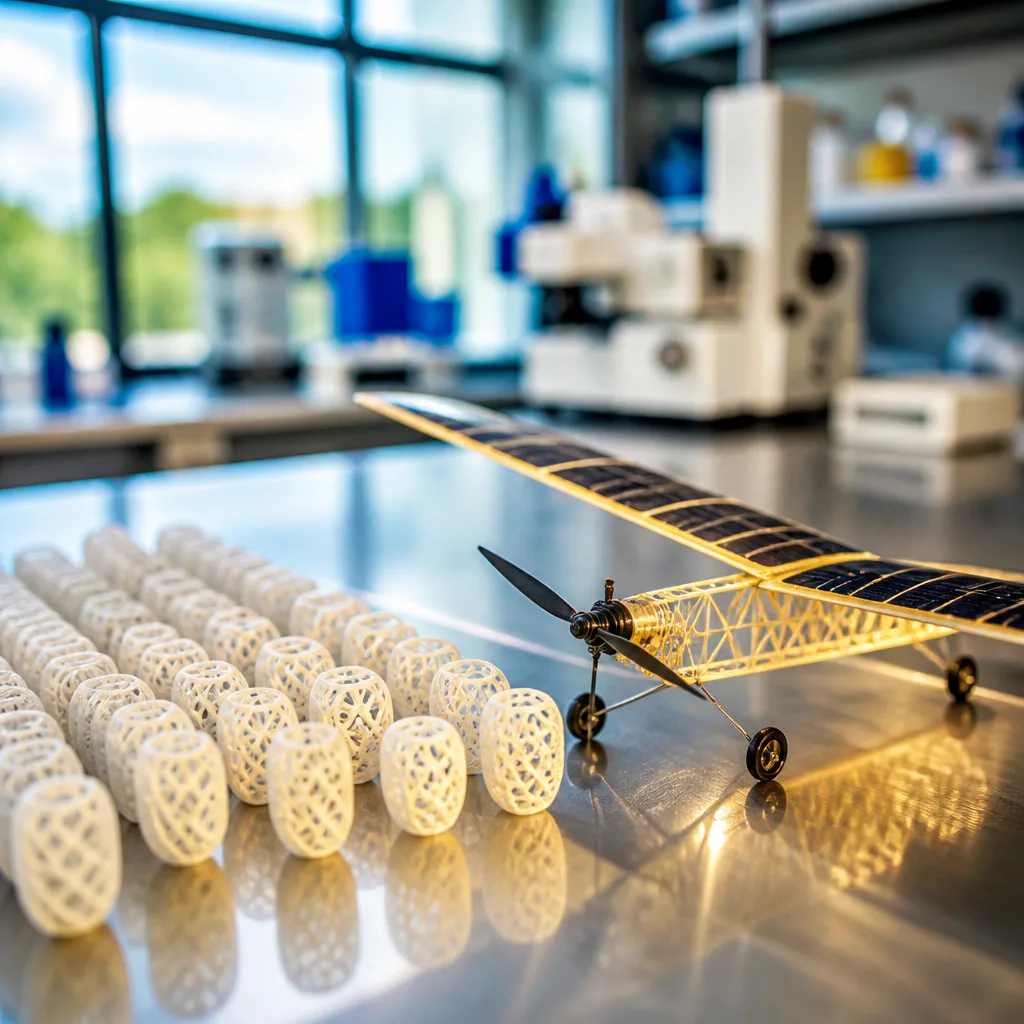
Researchers at the École polytechnique fédérale de Lausanne (EPFL) have demonstrated that carefully shaped hollow structures can convert sound into directional thrust, launching ultralight microfliers and propelling centimetre‑scale boats without motors, gears or onboard electronics. The work points to a novel way to actuate robots at sizes where conventional hardware becomes impractical.
How sound becomes thrust
The team built small resonant cavities—some round, some bell‑shaped—with narrow openings or "necks." When an external acoustic field drives the cavities at their resonant frequency, the air inside oscillates strongly. On egress, the air jets out in a concentrated flow while the return airflow is more diffuse. That asymmetry produces a net force: directional thrust.
“Instead of pushing devices around with sound waves, we have created acoustic resonators that are tuned to harness sound at specific frequencies to generate directional thrust and controlled motion,” said Selman Sakar, head of EPFL’s MICROBS Lab.
The resonators were manufactured from ordinary 3D‑printing plastics, rubbery polymers and glass. Devices ranged from centimetre to micrometre scales, with resonant frequencies spanning roughly 200 hertz to 40 kilohertz. Larger cavities generated more thrust overall, while the geometry of the neck had a strong influence on performance; the researchers report that cavity scale and neck design mattered more than the precise overall shape.
Demonstrations and performance
At the centimetre scale the group placed up to three resonators on tiny boats and controlled motion by changing the acoustic pitch delivered to each cavity. At smaller scales, the team made hollow micrometre‑sized structures that responded to ultrasound frequencies. The study shows that the same design principle can be applied across many size scales, offering a unified concept for acoustic actuation.
- Scales tested: centimetre to micrometre.
- Frequency range: about 200 Hz to 40 kHz.
- Materials: 3D‑printed plastics, rubbery polymers and glass.
The researchers emphasise that their approach does not rely on onboard power sources or moving mechanical parts such as motors or gears. Instead, a remotely supplied acoustic field provides both the energy and the control inputs, with different resonators tuned to distinct frequencies for steering and manoeuvring.
| Characteristic | Observed range |
|---|---|
| Resonator scale | Centimetre to micrometre |
| Resonant frequency | ~200 Hz to 40 kHz |
| Materials | Plastics, polymers, glass |
Potential and limitations
The work suggests a path for robotic systems at scales where batteries, motors and conventional actuators are cumbersome or impossible to integrate. Acoustic actuation could be useful for micro‑assembly, environmental sensors, or medical devices that operate at small scales and need remote control without onboard electronics.
However, practical deployment would face constraints. Acoustic fields strong enough to power motion must be supplied externally, which limits the operational range and requires suitable transducers. The technique also depends on maintaining resonance and controlling interactions between multiple cavities in cluttered environments. The EPFL team reports cavity geometry and neck design as critical variables, signalling that robust, application‑ready devices will require further engineering.
The EPFL study reframes an everyday acoustic phenomenon—Helmholtz resonance, the same effect that makes a bottle hum when you blow across it—into a compact, directional thruster. By exploiting resonant amplification and asymmetric airflow through a neck, the researchers have engineered a mechanical element that converts sound into useful propulsive force at scales that challenge conventional robotics.
As the field of tiny robots continues to grow, acoustic resonators add a new design option: control and propulsion delivered remotely through sound, rather than carried onboard. Future research will need to quantify efficiency, scaling limits, and real‑world performance, but this demonstration expands the toolbox for actuation where size and weight are at a premium.