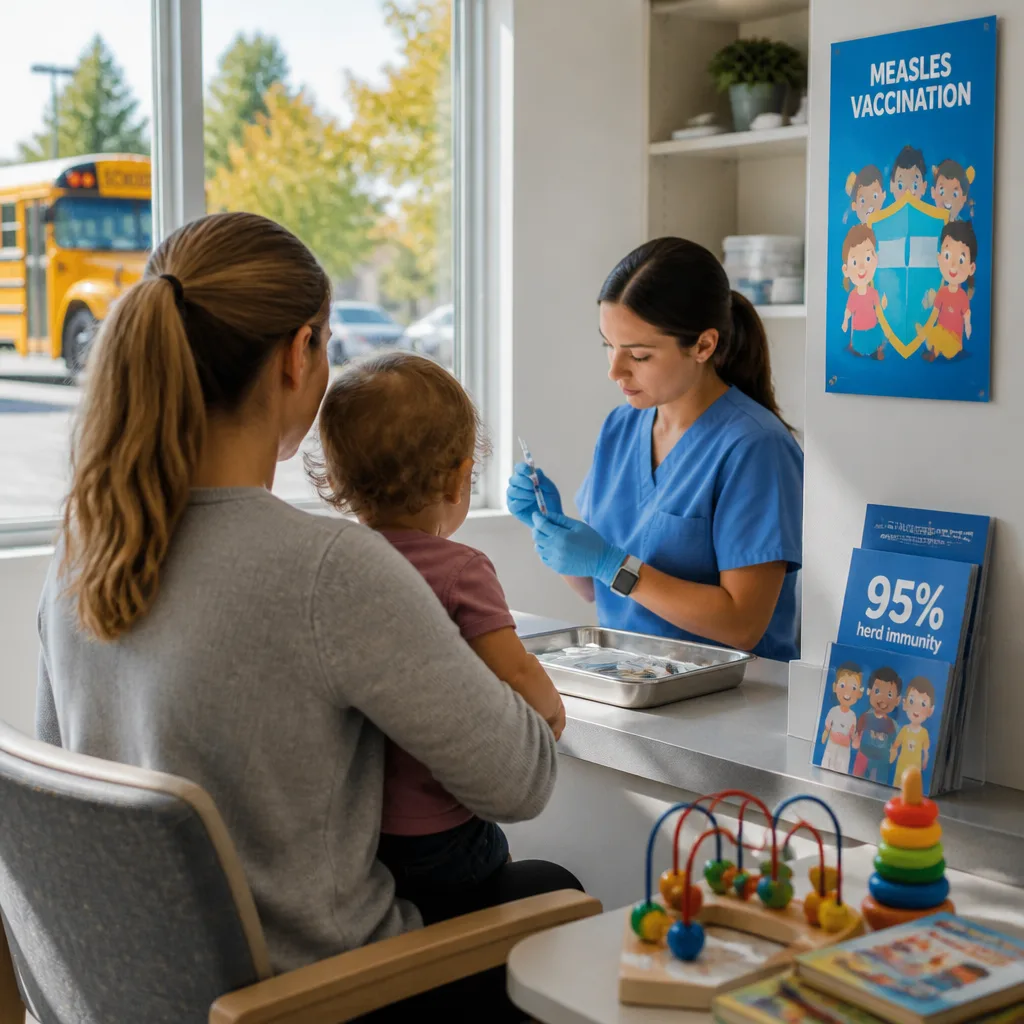
National Institutes of Health director Dr. Jay Bhattacharya said parents should vaccinate their children against measles and other routine childhood diseases as the United States experiences its highest measles case counts in decades. Speaking on CBS News’s Face the Nation, Bhattacharya — who has also served as acting director of the Centers for Disease Control and Prevention in recent months — framed vaccination as both a personal and public good while cautioning against rhetoric that discourages school attendance.
Vaccination recommendation and public trust
Bhattacharya made clear that he supports the standard childhood immunisation schedule and that he has personally vaccinated his children. He emphasised that for most children the routine vaccines, including measles and DTP (diphtheria, tetanus and pertussis), are important protections.
"I think that parents, for most kids, especially for the measles vaccines, the DTP, all the standard childhood vaccines, it's very important that parents vaccinate their kids,"
At the same time, Bhattacharya warned that public-health messaging which creates fear about sending children to school can undermine trust in health institutions. He said such fearmongering was a serious error during the COVID‑19 pandemic and urged balanced communications that encourage vaccination without deterring attendance at school.
Context: measles resurgence and coverage shortfalls
Health authorities have reported that measles cases have reached their highest levels in roughly 35 years. The Centers for Disease Control and Prevention found that during the 2024–25 school year only a minority of U.S. states met the 95 per cent measles vaccination threshold commonly cited as necessary for herd immunity among kindergarteners.
Bhattacharya referenced efforts within the Department of Health and Human Services to amplify pro‑vaccination messages. He noted that HHS Secretary Robert F. Kennedy Jr. had urged parents to get children vaccinated on national television, and said he has tried to echo that advice whenever asked.
What the numbers show
Available federal data points to uneven measles coverage across the United States. For the 2024–25 school year, only a small number of jurisdictions reached the 95 per cent vaccination rate considered desirable for community protection.
| Metric | 2024–25 school year |
|---|---|
| States with measles coverage ≥95% among kindergarteners | 10 states |
| Reported measles intensity | Highest in roughly 35 years |
Policy and communication implications
Bhattacharya’s comments touch on two persistent challenges for public health in the post‑pandemic era: restoring trust in institutions and correcting misperceptions about risk. His dual message — that vaccination is important and that parents should not be deterred from sending children to school — seeks to balance individual protection with the societal benefits of in‑person education.
- Personal endorsement: Bhattacharya said he vaccinated his own children and publicly recommends routine immunisations.
- Concerns about messaging: He criticised approaches that might scare parents away from school attendance, calling such tactics a mistake.
- Government communications: Bhattacharya said he has attempted to reinforce pro‑vaccination messages promoted by HHS leadership.
The remarks arrive as public‑health officials grapple with how to raise immunisation rates without reigniting the polarisation that marked parts of the COVID‑19 response. Increasing vaccination coverage among young children is the immediate technical goal; regaining confidence in health authorities is the longer‑term policy challenge.
Bhattacharya’s office declined additional comment beyond his television appearance, and the CDC has continued to track measles outbreaks and vaccination coverage by state. As school terms approach across the United States, public‑health agencies and school administrators will be watching the interplay between vaccine uptake and attendance decisions closely.
The director’s position — urging routine vaccination while warning against alarmist school‑avoidance messaging — underscores the tightrope health officials must walk: promoting interventions that prevent disease while avoiding messages that could unintentionally deepen public scepticism.