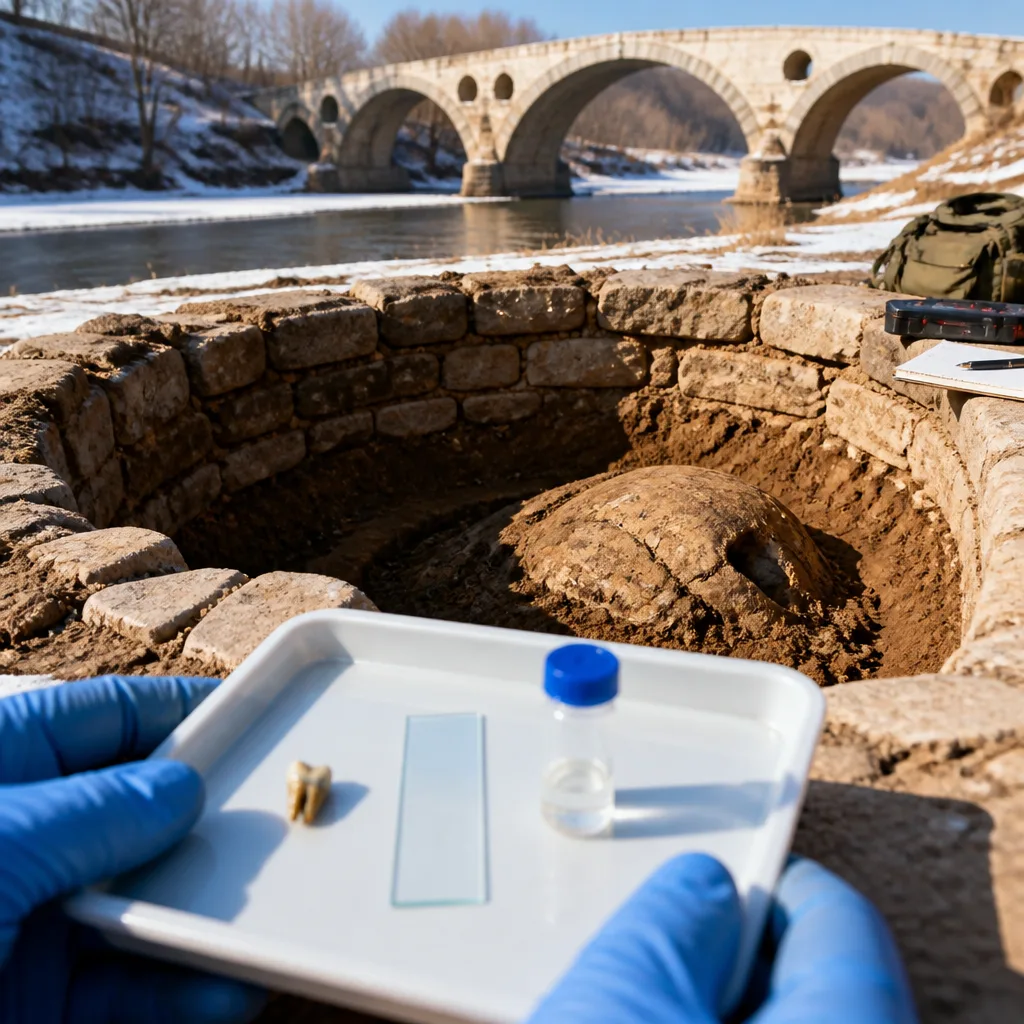
A fossilized human skull unearthed in 1933 during bridge construction near Harbin in northeast China and concealed in a well for more than eight decades has been identified as the first known skull of the mysterious archaic humans called Denisovans. Researchers say the skull was confirmed using DNA recovered from just 0.3 milligrams of dental plaque on a single tooth, and uranium-series dating of the bone itself places the specimen at a minimum of 146,000 years old.
From a well to a scientific puzzle
The skull was discovered by a labourer building the Dongjiang Bridge over the Songhua River in 1933. Concerned about the political climate — northern China was under Japanese occupation — he buried the heavy, unusually thick cranial piece in the bottom of an abandoned water well and kept its existence secret for the rest of his life. Only in 2018, on his deathbed, did he reveal the location to his family, who retrieved the fossil and later donated it to scientists.
Palaeoanthropologist Qiang Ji of Hebei GEO University examined the specimen and concluded it did not match any known modern human or previously described archaic human species. In 2021, Ji and colleagues published a description and proposed the name Homo longi, or “Dragon Man,” in reference to the Long Jiang (Dragon River) region where the skull was found. The naming immediately prompted debate among experts.
Why the identification matters
Until now, Denisovans were known primarily from limited genetic and fragmentary fossil evidence. The group was first identified in 2010 from DNA extracted from a finger bone in Siberia’s Denisova Cave. Subsequent finds included teeth, small bone fragments and a jaw from the Tibetan Plateau, as well as isolated pieces recovered in Laos and Taiwan. No complete skull had been securely attributed to Denisovans until the Harbin specimen’s genetic confirmation.
- 2010: Denisovans first recognised from DNA in a Siberian finger bone.
- Later finds: teeth, finger and toe bones; a jaw fragment from Tibet; other small fragments from Laos and Taiwan.
- Harbin skull: now the first cranial specimen linked to Denisovans by DNA from dental plaque.
Geneticists were able to retrieve and sequence DNA from the minuscule dental plaque sample — a demonstration of how ancient biomolecules preserved in dental calculus can resolve taxonomic questions where traditional bone or sediment DNA might fail. That molecular evidence tipped the balance of the ongoing debate about the Harbin cranium’s affinities.
Anatomy that puzzled researchers
The skull is notable for its robust features: an oversized braincase, pronounced brow ridges, a wide, low face and relatively square eye sockets. These attributes contributed to its initial classification as a potentially new species. But the genetic identification as Denisovan now links those anatomical traits to a known archaic human lineage that inhabited parts of Asia during the Middle Pleistocene.
| Feature | Harbin skull | Previous Denisovan remains |
|---|---|---|
| Age (minimum) | 146,000 years | Varied; Middle Pleistocene |
| Material used to ID | 0.3 mg dental plaque DNA | Bone and tooth fragments; some DNA from cave remains |
| Anatomy | Large braincase, thick brows, wide low face | Largely unknown—few cranial elements |
The confirmation reshapes a central problem in palaeoanthropology: how to map morphological diversity onto the genetic lineages that interbred with and occasionally replaced one another during the Pleistocene. Denisovans are of particular interest because their DNA survives in modern human populations — especially in parts of Oceania and Southeast Asia — suggesting complex episodes of admixture.
Broader consequences and caution
The Harbin find demonstrates the value of re-examining old or privately held specimens with modern molecular methods. At the same time, it underlines why naming new species in the absence of genetic data can be contentious: morphology alone may not reflect lineage boundaries revealed by DNA.
Researchers caution against overinterpretation. While the Harbin skull provides the first cranial window into Denisovan anatomy, it represents a single individual. Understanding the full range of Denisovan variation will require more fossils and more molecular analyses across Asia.
The specimen’s journey—from a construction site in 1933 to a scientific milestone nearly a century later—also highlights ethical and practical questions about stewardship of palaeontological finds, the role of private discoveries, and the importance of timely reporting to museums and research institutions.
For now, the Harbin cranium offers the clearest face yet of a lost branch of the human family tree.