
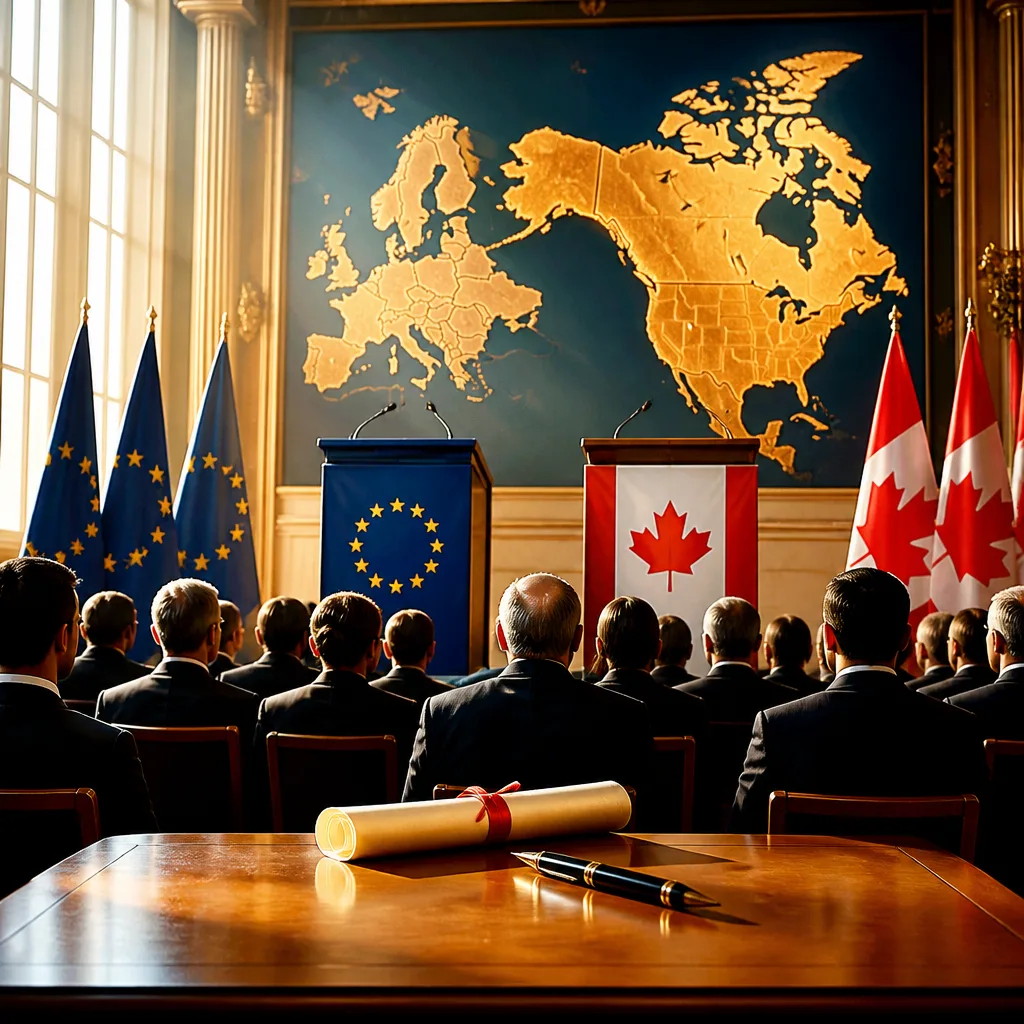
European Commission President Ursula von der Leyen told Prime Minister Mark Carney the European Union would like Canada to become the bloc’s first-ever “associate member,” a proposal intended to elevate ties beyond the existing free-trade framework and deepen cooperation on economic and security matters.
From CETA to an ‘Alliance for the Future’
Von der Leyen made the offer during her annual State of the Union address in Strasbourg, telling Carney she wanted to "open the door for Canada to be the first associate member of the EU." The move would be framed as an effort to “urgently reimagine” transatlantic partnerships and to build what she described as a shared future based on common values.
The European Commission president pointed to the growth in commercial ties since the Canada-European Union Comprehensive Economic and Trade Agreement (CETA) was signed, saying trade between the two has increased by roughly 75 per cent in less than a decade. The current relationship is provisionally implemented under CETA but not yet fully ratified by all EU member states.
“Dear Mark, I said we must urgently reimagine our partnerships. So, I would like to work with you on opening the door for Canada to be the first associate member of the EU,”
Practical and legal hurdles
Any move to change the formal relationship would face legal and political obstacles. CETA itself remains pending ratification in a number of EU national legislatures. According to the material released alongside von der Leyen’s remarks, several member states have not yet completed their ratification processes.
A list of countries that had not ratified CETA at the time the European Commission outlined the state of play includes:
- Belgium
- Bulgaria
- Cyprus
- France
- Greece
- Hungary
- Ireland
- Italy
- Poland
- Slovenia
| Item | Detail |
|---|---|
| Trade growth since CETA | ~75% increase in under a decade (as stated by EU) |
| Ratification status | Provisionally implemented; multiple EU states yet to ratify |
Canadian response and next steps
Following von der Leyen’s address, Mr. Carney — who attended the speech — issued a statement saying he “welcomed” the proposal and supported moving toward a “far stronger, more ambitious alliance in the future.” The Canadian response underscores Ottawa’s interest in expanding ties with like-minded partners on trade, security and sovereignty matters.
The proposal to create an upgraded relationship — described by the European Commission as moving from CETA to an “Alliance for the Future” — would require detailed negotiations to define the legal form, competencies and scope of such an arrangement. Both sides would need to clarify whether associate membership implies formal participation in EU institutions, privileged market access, security cooperation or legislative harmonization, and how such arrangements would comply with domestic constitutional rules on sovereignty.
Implications for Canada
If pursued, an enhanced relationship could deepen market access for Canadian exporters, align regulatory approaches, and broaden cooperation on defence, critical supply chains and digital governance. But it would also raise questions about the limits of national autonomy and the political feasibility of a new status within a union of 27 member states, each with its own constitutional and parliamentary constraints.
For now, the announcement is an invitation to enter talks. The EU’s proposal signals a strategic pivot toward strengthening alliances with democratic partners outside the bloc, while offering Canada a potentially unique role in transatlantic architecture. How Ottawa responds and how EU capitals react in their parliaments will determine whether the idea remains a diplomatic overture or becomes a formal negotiating agenda.
The coming weeks are likely to feature focused discussions between EU and Canadian officials as they assess the legal mechanics and political appetite for elevating the relationship beyond the current trade agreement.