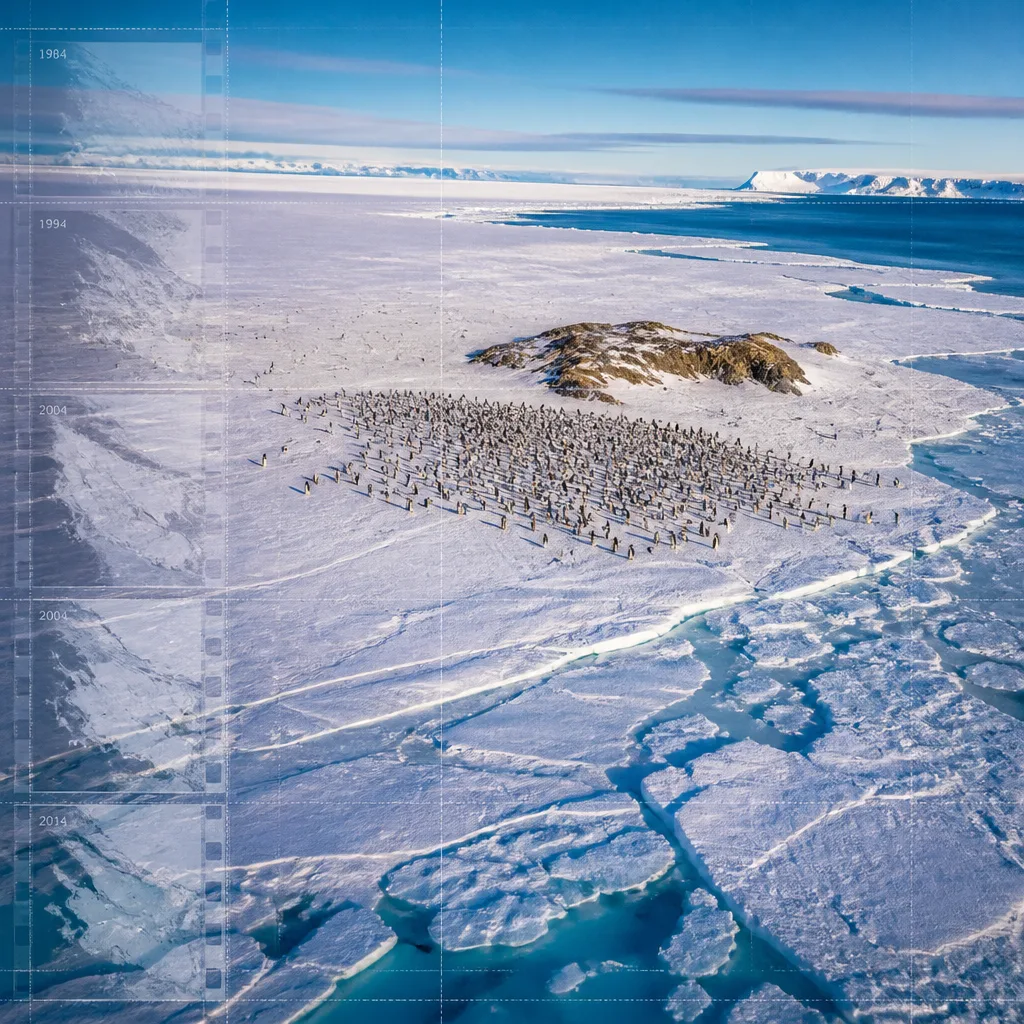
Analysts studying decades of images from NASA–USGS Landsat satellites say the future for emperor penguins remains uncertain even as many colonies have shown resilience over long time spans. The birds—estimated at hundreds of thousands across 66 colonies around Antarctica—depend on landfast sea ice to breed, rear chicks and undergo their annual moult, and recent shifts in ice conditions are changing the calculus for survival.
Satellite records extend the view of penguin habitats
Landsat observations, which stretch back to the late 1970s, provide a continuous record of coastline conditions in otherwise inaccessible parts of Antarctica. For decades the overall Antarctic sea-ice cover was relatively stable until a turning point around 2016, followed by a general decline. Scientists have used the imagery to examine how landfast ice — the firm, shoreline-attached ice that emperor penguins require for reproductive success — has varied by region, revealing a complex pattern of losses and gains.
According to the analysis, landfast ice has fallen in parts of West Antarctica and the Weddell Sea, while other areas such as the Bellingshausen Sea and portions of East Antarctica have shown an upward trend. The spatial heterogeneity complicates projections about the species' long-term survival because local breeding success depends on conditions that can differ markedly from continental averages.
Recent events and conservation status
Alarm has grown over the past decade. Antarctic sea ice reached a record low in 2022, and researchers from the British Antarctic Survey reported what they described as
"catastrophic" breeding failuresamong colonies in the Bellingshausen Sea that year. Those events highlighted the vulnerability of colonies to sudden ice loss during critical breeding windows.
Policy bodies have responded: the U.S. Fish and Wildlife Service listed emperor penguins as threatened in 2022, and the International Union for Conservation of Nature classified the species as endangered in 2026. Some model projections, based on expected warming and ice retreat, suggest emperor penguins could face local extirpation in some areas or even disappear from large parts of their current range by the end of the century.
Why Landsat data matter
Before the satellite era, most emperor penguin colonies were poorly studied because of their remote locations and the logistical challenges of on-the-ground surveys. The continuous, decades-long Landsat archive fills that gap by allowing scientists to map colony presence, track changes in breeding sites, and infer population persistence over time.
Key advantages of the satellite approach include:
- Consistency of imagery over many years, enabling long-term trend detection.
- Coverage of remote coastal areas that are otherwise seldom visited.
- The ability to pair habitat changes with known breeding failures to assess sensitivity.
The new research indicates that, contrary to a simple narrative of universal decline, many colonies have persisted for decades and may be more flexible about breeding locations than previously thought. That plasticity could offer some buffer against environmental change, but it does not remove the risk posed by continued warming and ice loss.
Implications for conservation and future study
Persistence of colonies in some regions suggests conservation strategies must be targeted and regionally informed. Broad classifications of continental sea-ice trends do not fully capture the local conditions that govern colony success. Continued satellite monitoring, combined with targeted field studies, will be essential to:
- Identify colonies that are at highest immediate risk from changing landfast ice.
- Monitor shifts in breeding sites that could indicate adaptive responses.
- Inform international conservation measures and management of Antarctic ecosystems.
For now, the Landsat record offers both warning and a sliver of hope: while some colonies have suffered dramatic breeding failures when ice conditions failed, many have endured through decades of variability. The critical question is whether that endurance can continue as climate models project further warming and continued changes to Antarctic sea ice.