Researchers in Germany have turned a liquid-filled optical fibre into a frozen laboratory and found that the change of state dramatically intensifies how light and sound interact inside the guide. By cooling the liquid core to −196 °C, the team converted the core into a solid while maintaining the fibre’s ability to carry light, and observed light–sound coupling more than 1,000 times stronger than in ordinary fibres.
Freezing the core without losing guidance
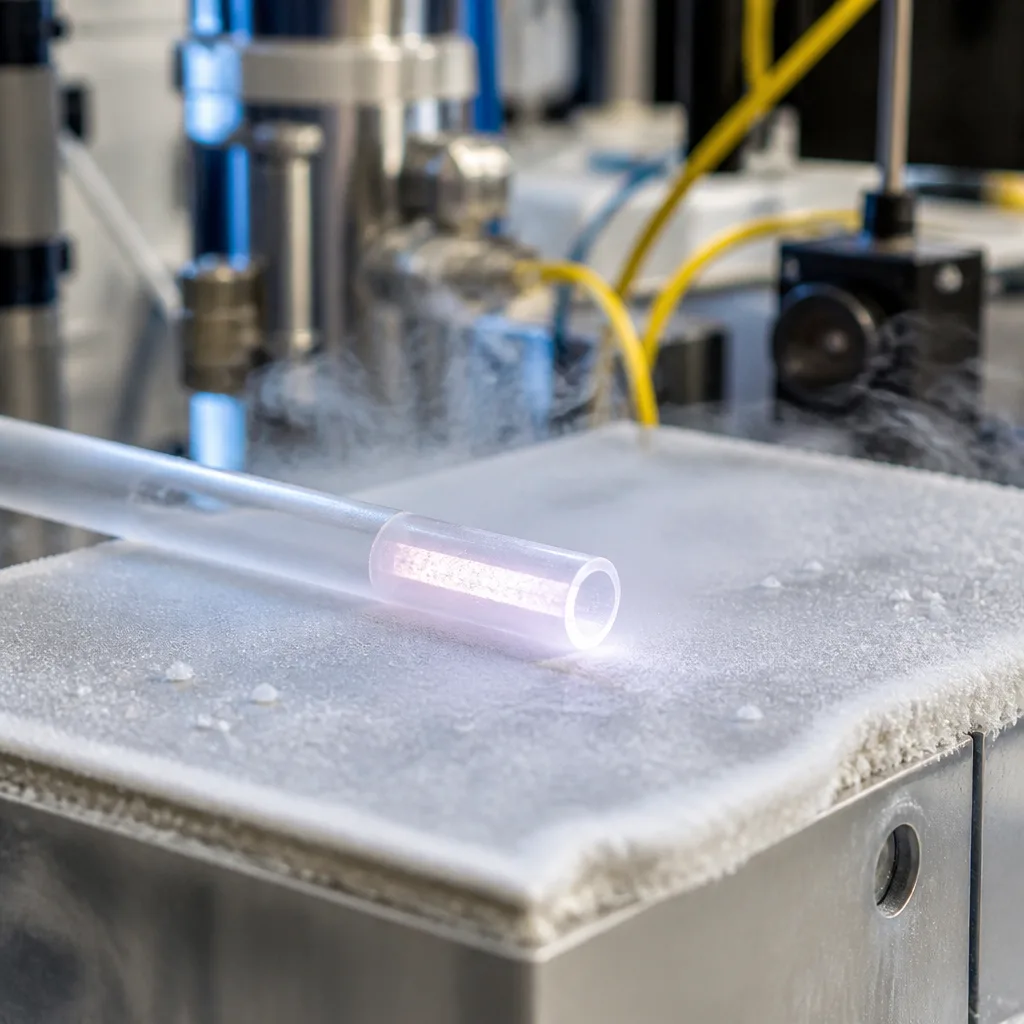
The experiment used liquid-core optical fibres (LiCOF) — hollow waveguides that can be filled with gases or liquids — and subjected the core material to cryogenic temperatures using nitrogen. Contrary to what one might expect, the frozen region continued to guide optical modes. The team also found that both the original liquid section and the newly frozen segment supported propagation of hypersonic acoustic waves.
"The key point is, that the frozen section of the LiCOF retains its ability to guide light. Not only that, but both the liquid and the frozen section of the fibre also guide hypersonic sound waves," said Simon Seiderer, one of the lead authors and a researcher in the Quantum Optoacoustics group.
Enhanced Brillouin–Mandelstam scattering and an optoacoustic memory
The intensified interaction the researchers exploited is a form of stimulated scattering between light and acoustic waves, often described under the umbrella of Brillouin–Mandelstam scattering. In the frozen-core environment this coupling became exceptionally strong, allowing the team to demonstrate a form of optoacoustic memory — a transient storage mechanism that encodes optical information in an acoustic excitation inside the fibre.
Because acoustic waves travel more slowly than light and can retain energy for short intervals, optoacoustic schemes are of interest for photonic information processing and for potential low-energy computing elements. The experiment shows that altering material phases inside waveguides can be a powerful knob to tune photonic–phononic interactions.
- What was changed: the liquid core was frozen with liquid nitrogen to −196 °C.
- Key observations: preserved optical guidance, support for hypersonic sound, and light–sound coupling boosted by >1,000×.
- Result demonstrated: an optoacoustic memory effect in the frozen LiCOF.
Who did the work and why it matters
The work was carried out by researchers at the Max Planck Institute for the Science of Light in Erlangen, Leibniz University Hannover and the Leibniz Institute for Photonic Technologies in Jena. By intentionally changing the mechanical and optical properties of the waveguide core through a phase transition, the group created an environment in which photons and phonons couple far more strongly than in conventional solid-core or liquid-core fibres.
That enhanced coupling is not just a laboratory curiosity. Increased photon–phonon interaction strength can enable devices that manipulate light with lower energy, store optical information briefly for synchronisation tasks, or implement new kinds of sensors that exploit both optical and acoustic signals. Fibre-based platforms are attractive because they can be integrated with existing photonic systems and telecommunications infrastructure.
| Parameter | Value / Observation |
|---|---|
| Core temperature | −196 °C |
| Interaction enhancement | >1,000× |
| Institutions | Max Planck Institute for the Science of Light; Leibniz University Hannover; Leibniz Institute for Photonic Technologies |
Open questions remain about how robust the frozen-core approach will be in practical devices. The experiments show that a frozen core can still guide light and acoustic waves, but implementing cryogenically cooled fibres in real-world systems would introduce engineering challenges. Still, the result points to a new design paradigm: engineering phase transitions inside waveguides to tailor light–matter and light–sound interactions.
For researchers developing photonic computing or sensing, the frozen LiCOF demonstrates a striking route to boost optoacoustic effects. If the approach can be adapted to stable, scalable platforms, it may help reduce energy consumption in photonic operations or enable compact devices that exploit tightly coupled photon–phonon dynamics.
The work underscores how revisiting basic material states inside familiar components — such as the core of an optical fibre — can reveal unexpected physical regimes with technological potential.