
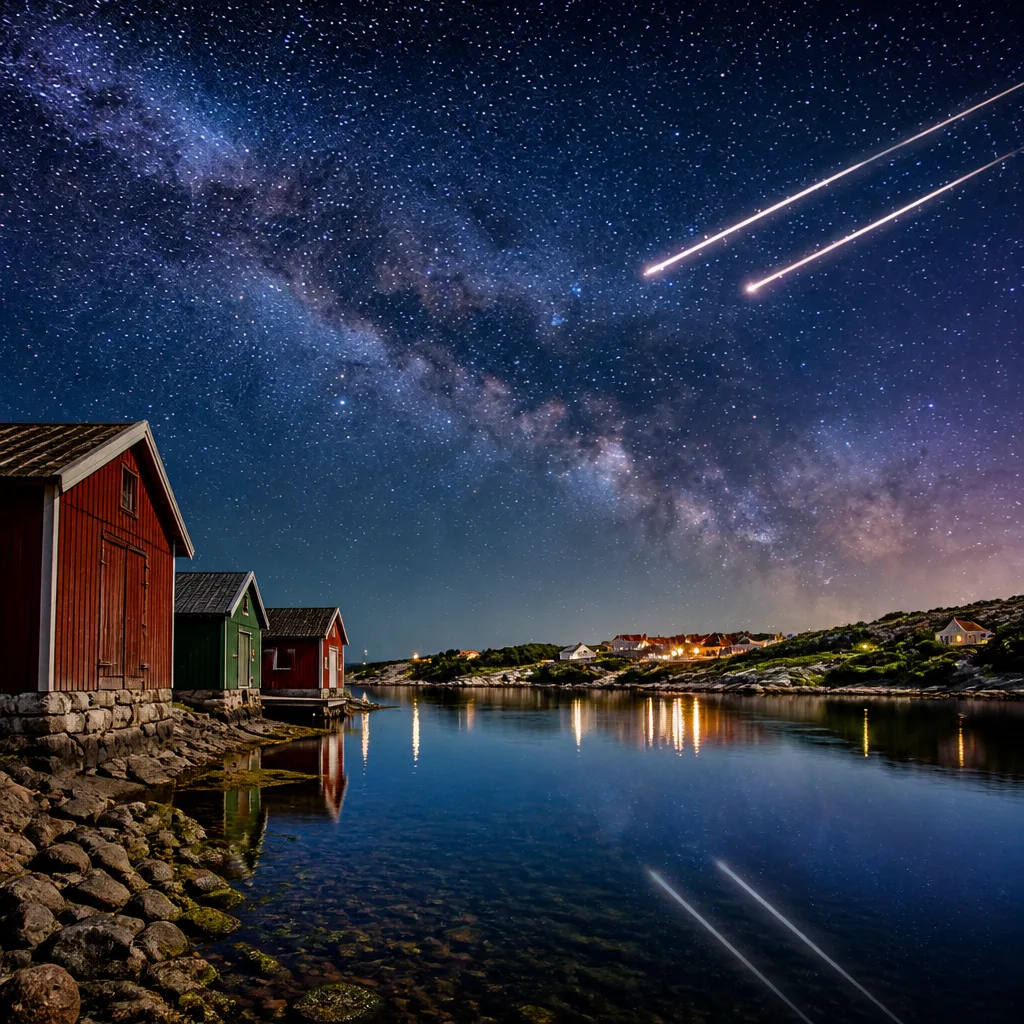
Two bright Perseid meteors and the faint glow of the Milky Way were captured in a striking composite photograph taken on the night of Aug. 12 near the coastal village of Grisslehamn, Sweden.
What produced the display
The streaking meteors are fragments shed along the orbit of comet 109P/Swift-Tuttle. As those grains of dust enter Earth’s atmosphere at high speed they heat and vaporize, leaving brief luminous traces visible to observers on the ground. The Perseid shower, which appears to radiate from the constellation Perseus, is among the most reliable and vibrant annual meteor events for northern-hemisphere viewers.
Why this year was favourable
This year’s peak of Perseid activity occurred during a New Moon, a timing that greatly improved visibility by eliminating bright moonlight that can wash out fainter meteors. In the composite image released by NASA’s Astronomy Picture of the Day project, the meteors are nearly as bright as the star Altair in the same frame. The photograph also records the watery reflection of one meteor on a nearby surface, a reminder of how long-exposure and composite imaging can reveal transient events more clearly than a single snapshot.
Context: an eclipse and clear skies
For many observers, the Perseid display came directly after observations of the New Moon silhouette during the Aug. 12 solar eclipse. That coincidence of celestial events offered an extended period of interest for amateur and professional skywatchers alike. The image credit goes to P-M Hedén (Clear Skies, TWAN), and the explanatory text was prepared by the NASA APOD team.
- Event: Perseid meteor shower peak
- Date of image: Aug. 12
- Location: Near Grisslehamn, Sweden
- Contributing comet: 109P/Swift-Tuttle
- Sky condition advantage: New Moon
| Item | Detail |
|---|---|
| Photographer | P-M Hedén (Clear Skies, TWAN) |
| Featured object | Perseid meteors, Milky Way, Altair |
| Agency | NASA APOD |
Long-exposure and composite techniques are commonly used to document meteor showers. Individual meteors typically last less than a second to a few seconds, so photographers often combine multiple exposures or stack frames to create images that show several events in a single scene. The result in this case highlights both the transient meteor flashes and the static backdrop of the Milky Way, providing visual contrast between fleeting and persistent celestial features.
Viewing tips and significance
For readers hoping to catch future meteor activity, the most important practical factors are dark skies and patience. Seek out locations with minimal light pollution, allow eyes to adapt to darkness for at least 20–30 minutes, and look away from the radiant to increase the visible portion of meteor trails across the sky. While smartphone apps and star charts can help locate constellations like Perseus and bright reference stars such as Altair, naked-eye watching remains an accessible way to enjoy meteor showers.
From a scientific perspective, regular meteor showers such as the Perseids offer insight into the debris environment of the inner solar system. The parent comet's periodic passages leave streams of particles that intersect Earth’s orbit on a predictable schedule; variations in observed rates or brightness of meteors can indicate denser filaments in the debris stream or recent mass loss from the comet.
The NASA APOD entry for Aug. 15, 2026, places this image in its long-running daily gallery that pairs striking astronomical photographs with concise explanations prepared by professional astronomers and science communicators. The Perseids remain a highlight of the northern summer sky and, when conditions align as they did this year, a spectacular reminder of Earth's continuing encounter with remnants of ancient comets.