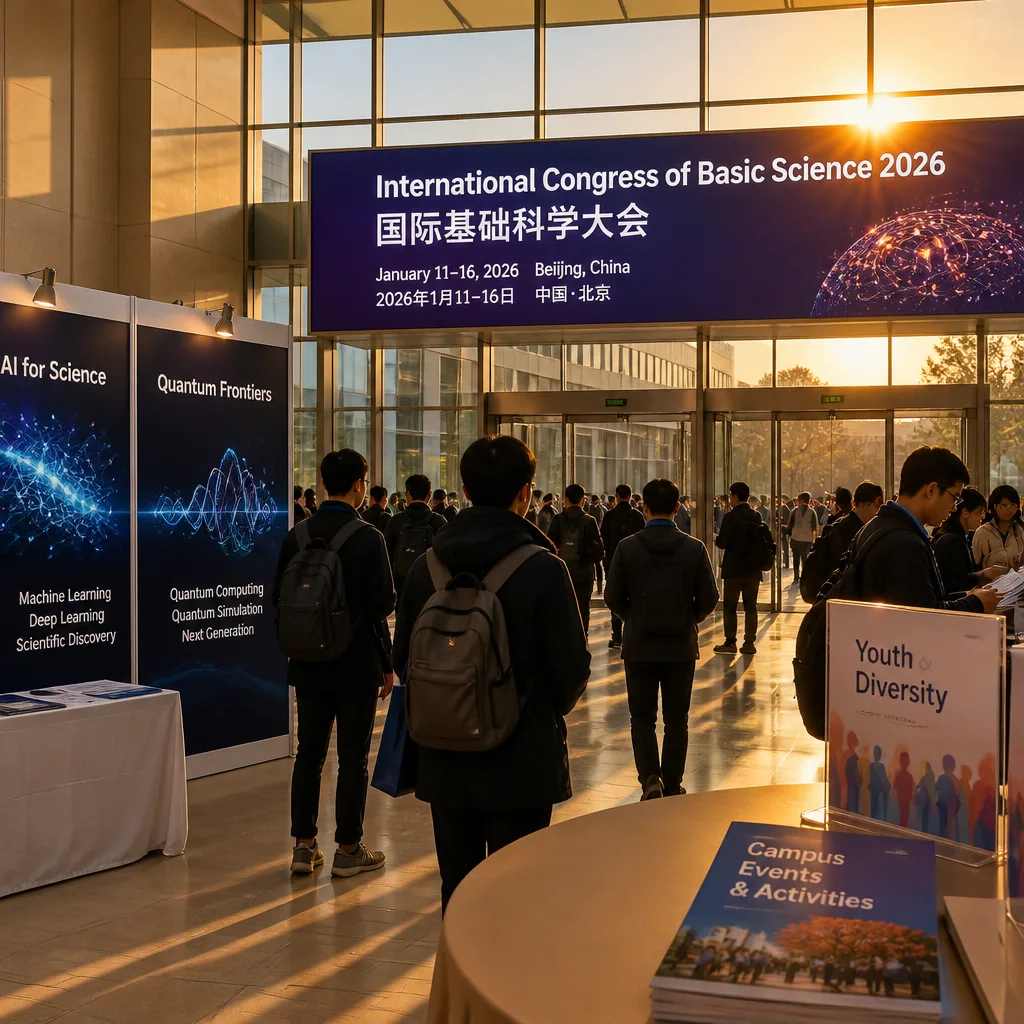
The 2026 International Congress of Basic Science opened in Beijing on Sunday, drawing a global assembly of researchers, young scholars and science leaders for a two‑week series of lectures, panels and outreach events.
"Advancing Basic Science for Humanity"
Organisers say the congress will stage more than 500 academic sessions across all branches and interdisciplinary directions of basic science. The programme highlights frontier topics such as generative large‑model reasoning, computer vision, human–computer interaction and quantum information, signalling an emphasis on the theoretical foundations behind emerging technologies.
Scale and structure of the meeting
More than 1,000 participants are expected to attend, including international scientists and early‑career researchers. The congress combines high‑level academic dialogues, award reports that present recent breakthroughs, and special sessions aimed at broadening participation in basic science.
| Item | Figure |
|---|---|
| Participants | 1,000+ |
| Academic sessions | 500+ |
| Duration | Two weeks |
Programming will include topic‑specific evenings—labelled "Mathematics Night," "Physics Night" and "Engineering Night"—that are expected to bring together recipients of prestigious awards, including Fields Medals and Turing Awards, to discuss rising trends and open questions in their fields.
Bridging disciplines and audiences
The congress organisers have placed emphasis on interdisciplinary exchange and youth engagement. A newly launched Women Scientists Forum is scheduled to invite prominent female researchers to describe career pathways and discuss the barriers and opportunities facing women in scientific research.
A dedicated Basic Science and AI Forum aims to probe the theoretical obstacles and potential breakthrough routes for artificial intelligence, tying together mathematicians, physicists and computer scientists around foundational questions rather than exclusively application‑driven debates.
- High‑profile lectures and award reports will outline recent global breakthroughs.
- Youth activities and campus events aim to inspire students to pursue basic science.
- Cultural and scientific exchanges will expose visiting scholars to local research ecosystems.
One feature of the programme, labelled "Tsinghua Day," will invite leading mathematicians and physicists to the Tsinghua University campus to engage directly with students. Officials say the intent is to encourage younger scholars to enter basic research and to cultivate long‑term interest in tackling foundational problems.
Science diplomacy and local showcase
Alongside academic sessions, organisers will host an "Explore Huairou" tour to familiarise participants with the local innovation environment. Visits will include Huairou Science City, the International Conference Resort and nearby cultural sites such as the Mutianyu section of the Great Wall, as well as technology‑oriented venues described in the programme as an animation valley and an agricultural demonstration project.
For observers outside China, the congress offers a concentrated view of how basic science and technology priorities are being framed and promoted internationally. The inclusion of forums on AI theory and quantum information aligns with a wider global interest in the foundational science that underlies rapidly developing technologies.
While the congress is chiefly a scientific meeting, it also functions as a platform for international collaboration and soft diplomacy: high‑level dialogues, cultural programming and campus exchanges create opportunities for cross‑border partnerships and for younger researchers to build networks.
The two‑week event will conclude with a series of reports from frontier science awards and a final set of dialogues intended to synthesise insights and identify collaborative avenues for future research.