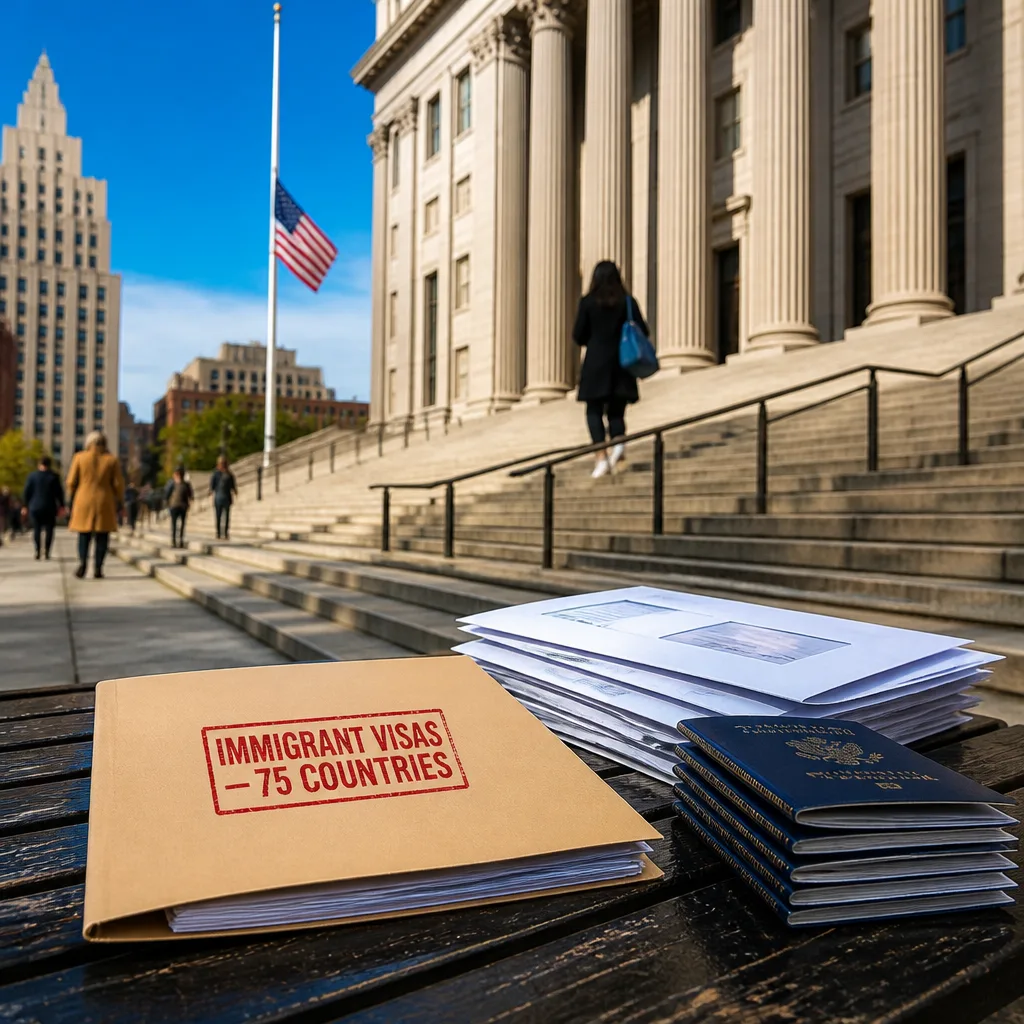
A federal judge in Manhattan on Friday struck down the Trump administration’s suspension of immigrant visas for citizens of 75 countries, saying the policy was contrary to law and exceeded the authority of Secretary of State Marco Rubio.
Judge: national-origin rule conflicts with statute
Judge Jeannette Vargas of the Federal District Court in Manhattan concluded that the State Department’s instruction to consular posts — which paused permanent-residence visas for nationals of roughly 40% of the world’s countries — improperly substituted nationality as a proxy for whether an applicant would become a “public charge.”
Under the immigration statute cited by the court, decisions about whether an immigrant is likely to depend on government support must rest on an individualised assessment — considering factors such as the applicant’s finances, age, health, skills and family circumstances. Vargas found that, in practice, consular officers had been directed to refuse visas because of the applicant’s country of origin even when evidence showed the individual could support themselves.
“The outcome is predetermined,” Vargas wrote.
The policy targeted people seeking to become lawful permanent residents — for example, those joining family members or taking up jobs in the United States — and did not apply to non‑immigrant categories such as tourist or student visas.
How the policy was applied
A cable from Secretary Rubio to every diplomatic and consular post was entered into the court record. It instructed officers to refuse applicants based on the country‑level guidance, and, the judge said, even when individuals provided additional evidence intended to rebut a public‑charge concern the directive gave officers little discretion.
Vargas held that the practice ran afoul of a 1965 law that prohibits discrimination by nationality in visa issuance, and also contravened a statutory provision that limits the secretary of state’s power to dictate how consular officers undertake individual adjudications.
Immediate and wider effects
The court reversed any visa denial that rested solely on the nationality‑based rationale; denials grounded on other legal bases remain in place even if the officer also cited the countrywide pause. The ruling therefore leaves uncertain the net number of successful reversals once consular posts implement the decision.
Most of the affected countries are non‑European and span the Caribbean, sub‑Saharan Africa, the Balkans, the Middle East, Central Asia and Southeast Asia. The source material named a sample of those countries, including Brazil, Colombia, Egypt, Haiti, Somalia and Russia.
- Visa category affected: immigrant (permanent‑residence) visas
- Visa category excluded: non‑immigrant visas such as tourist and student visas
- Legal basis challenged: nationality‑based refusals and limits on consular decision‑making
| Visa type | Effect of policy |
|---|---|
| Immigrant (permanent residence) | Issuance paused for citizens of 75 countries; now reversed where denial rested solely on that pause |
| Non‑immigrant (tourist/student) | Not affected by the pause |
Political and legal implications
The decision represents another judicial setback to the administration’s immigration measures. It underscores a tension between executive branch policy directives and statutory protections that require case‑by‑case consular assessments. By emphasising that nationality cannot be used as a standing proxy for likely dependence on public benefits, the court reasserted limits on the secretary of state’s power over visa adjudications.
The practical outcome will depend on how quickly the State Department and its posts update procedures and revisit previously denied cases. Denials that relied on other legal grounds are not disturbed by the ruling, meaning many adjudications will remain unchanged.
For applicants from the affected countries, the ruling may reopen pathways to permanent residence after months in which family reunification or employment‑based migration was halted. For policymakers and courts, it will likely frame future disputes over the scope of executive authority in immigration administration.
This report is based on the court ruling and documents entered into the record, including the cable issued by the secretary of state and the judge’s opinion. It does not attempt to catalogue every affected country beyond those named in the record.