
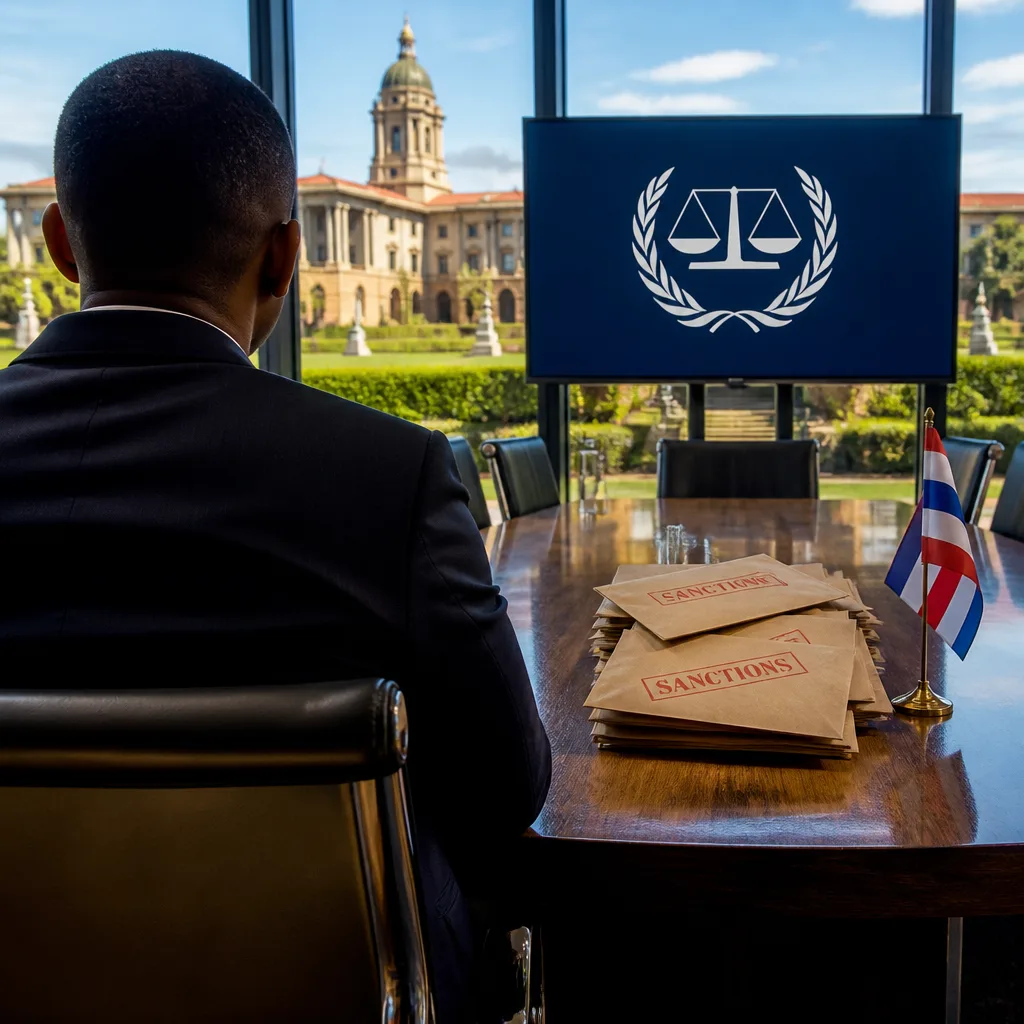
The United States has stepped up its campaign against the International Criminal Court (ICC), imposing what it calls sanctions on court judges and employees and pressing allies to avoid cooperation with the tribunal. The measures form part of a broader challenge to the international rules-based order, observers and the source material say, and have rekindled debate about the ability of international law to bind powerful states.
What Washington has done
According to the reporting, the US government has taken two complementary approaches:
- Targeted measures against ICC judges and employees described as sanctions.
- Diplomatic efforts to persuade other countries not to join or support the court.
Those moves follow a series of unilateral actions by the US and some of its close partners in recent years that, the source suggests, have undermined confidence in multilateral legal institutions.
Context: power, law and precedent
The source traces the problem to a persistent gap between international legal commitments and the behaviour of powerful states. It notes a pattern in which dominant actors pick and choose which rules to follow, undercutting the effectiveness of treaties and customary obligations. The piece argues that the idea, long held since the Treaty of Westphalia, that a balance of power would discipline hegemonic behaviour has not prevented selective compliance; instead, strategic stalemate can enable mutual disregard for legal limits.
Recent examples cited in the source include allegations that the US intervened militarily in Venezuela and detained a democratically elected leader, and that Israel and the US acted pre-emptively against Iran over its uranium-enrichment programme. Those episodes are presented as evidence of an international environment in which force and strategic choice override institutional constraints.
“preemptive strike.”
Against that backdrop, the assault on the ICC is presented not as an isolated dispute but as part of a wider erosion of the institutional frameworks designed to manage interstate behaviour and hold individuals to account.
Regional and South African relevance
South Africa is a state party to the Rome Statute and has engaged with the ICC on several occasions. While the source does not detail South African policy responses, the developments in Washington have clear consequences for Pretoria’s foreign-policy calculations and for the continent at large:
- Pressure on the ICC could complicate cooperation between the court and African states — an area already fraught with disputes over jurisdiction and perceived selective justice.
- Diplomatic alignments prompted by US pressure may force African governments to choose between strategic relations with Washington and commitments to multilateral justice mechanisms.
The source also invokes historical interactions between the US and other states over ICC accession. It notes long-standing US efforts to dissuade countries from joining the Rome Statute, referencing campaigns directed at the Philippines during earlier administrations.
Legal and political consequences
Experts and analysts outside the source have previously warned that punitive measures against an international tribunal risk deterring staff, complicating investigations and reducing cooperation from states. The source itself highlights the symbolic effect of sanctioning judges and employees: undermining the court’s perceived neutrality and operational capacity.
| Action | Reported or likely effect |
|---|---|
| Sanctions on judges and staff | Chill on court personnel, reduced cooperation, reputational damage |
| Diplomatic pressure on allies | Potential shrinkage of international support for ICC initiatives |
How South Africa and other states respond will be watched closely. Decisions over cooperation, funding and political support will test the resilience of institutions conceived to impose limits on impunity. For countries committed to multilateral law, the choice between contesting unilateral measures and managing bilateral relationships with a powerful state will be politically fraught.
The source concludes with a broader philosophical question: in an era of great-power assertiveness, what substitute exists for an effective, rules-based international order if major actors can opt out selectively? That question is at the heart of the debate provoked by the US escalation against the ICC.









