
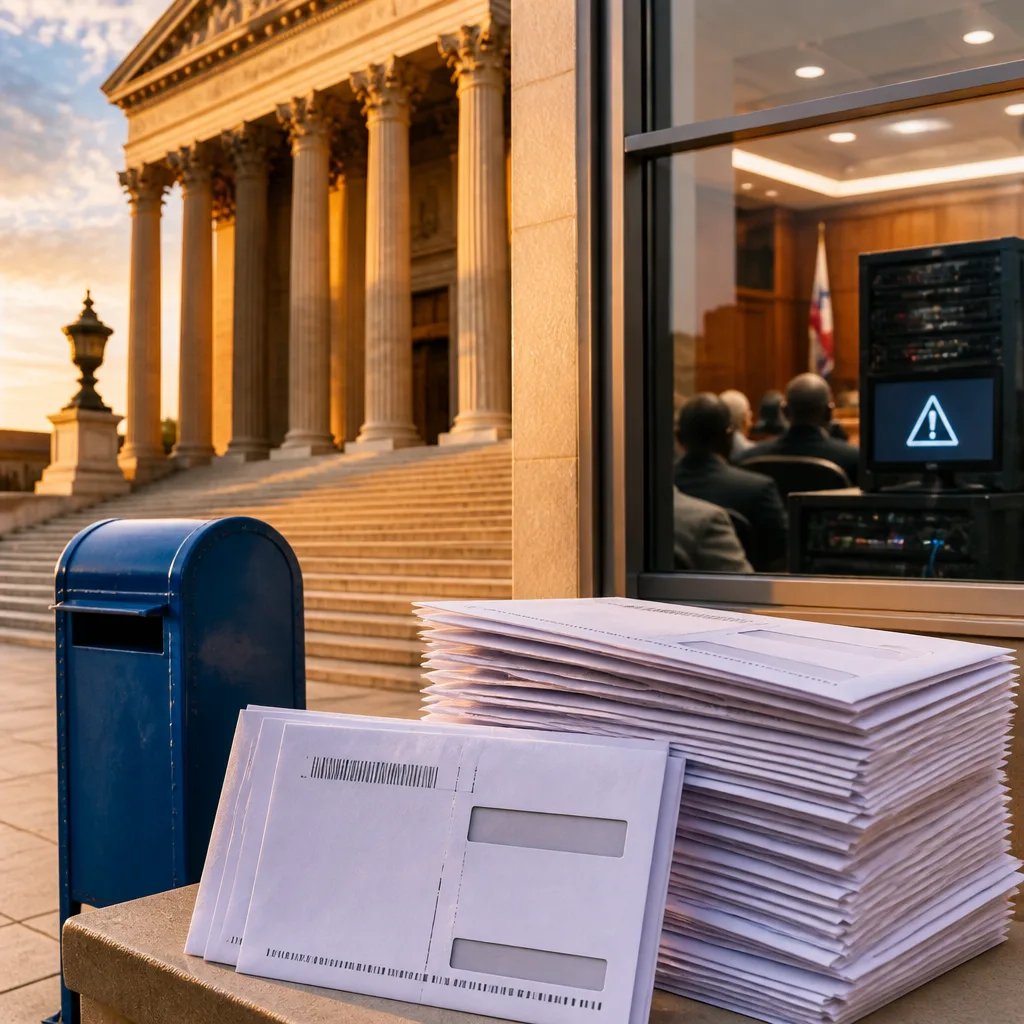
The US government on Thursday appealed to the Supreme Court to lift a federal court order that prevents implementation of a new rule governing mail ballots, hours after a judge pressed Department of Justice lawyers for details about whether the electronic system on which the plan depends was even ready, AP reported on 3 September 2026.
Last‑minute legal push ahead of ballot mail‑outs
The appeal was filed the afternoon before states were due to begin mailing ballots, with North Carolina reported to be the first to start on the coming Friday. The litigation forms part of a flurry of last‑minute court action as the federal government seeks to put in place restrictions on mail voting promulgated by President Donald Trump, the AP account said.
Under the executive order at the heart of the dispute, the US Postal Service could refuse to deliver ballots from states that do not conform to a uniform envelope style and that do not upload lists of eligible mail voters to an online portal. The administration has said the portal would be used to match envelope data with voter lists; if the information did not match, the ballot would not be delivered, according to AP.
"I don't even have a declaration from the Postal Service: 'This is how it will work.' I don't have it. I have nothing," US District Court Judge Indira Talwani told Department of Justice attorney Michael Velchik during a hearing in Boston, the AP reported.
Judge Talwani repeatedly questioned government lawyers about whether the Postal Service could actually implement the plan. At the hearing, the government was unable to confirm whether the online portal that would govern the project was operational, or to provide a declaration explaining how the system would work in practice.
What the rule would change
The dispute centres on a handful of operational and legal changes the administration seeks to impose. According to AP reporting, the core elements are:
- Uniform envelope requirement — a single envelope style for all mailed ballots, with deviation permitting non‑delivery.
- Mandatory voter lists — states would have to upload lists of eligible mail voters to a central online portal.
- Electronic matching — ballots would be checked against the portal and could be refused if the data did not match.
The administration's appeal asks the Supreme Court to allow the rule to take effect while litigation proceeds in lower courts. The high court's conservative majority has previously allowed aspects of the plan to move ahead, but has not definitively ruled on its legality, AP said.
| Element | Effect if implemented |
|---|---|
| Uniform envelope | Ballots in non‑conforming envelopes may not be delivered |
| Voter list portal | States must upload lists for delivery; matching required |
| Data matching | Mismatches could lead to ballots being rejected or undelivered |
Timing and practical questions
The government filed its appeal as states across the country prepare to begin mailing ballots for the midterm elections in November. At the Boston hearing, Judge Talwani characterised the government's position as experimental, given the absence of a clear operational declaration from the Postal Service.
The administration's reliance on a centralised portal to administer tens of millions of mail ballots drew particular scrutiny. The AP report notes that the portal would require states to submit sensitive voter data and that the timeline for setting up and testing such a system before widespread ballot mail‑outs remained uncertain at the hearing.
Legal wrangling over the executive order has played out both in federal district courts and in the Supreme Court. If the high court allows the rule to stand while litigation continues, states and the Postal Service would face a compressed window to implement technical and administrative changes ahead of mass ballot distribution.
Observers have warned that altering long‑standing procedures for mail voting so close to election day could create confusion for election officials and voters alike. The AP's reporting provides a snapshot of those concerns as judges ask pointed questions about whether the government is prepared to operate the system it has ordered.
The outcome of the appeal could determine whether the rule affects the conduct of the midterms, or whether it will be stayed pending a fuller legal review in the lower courts.












