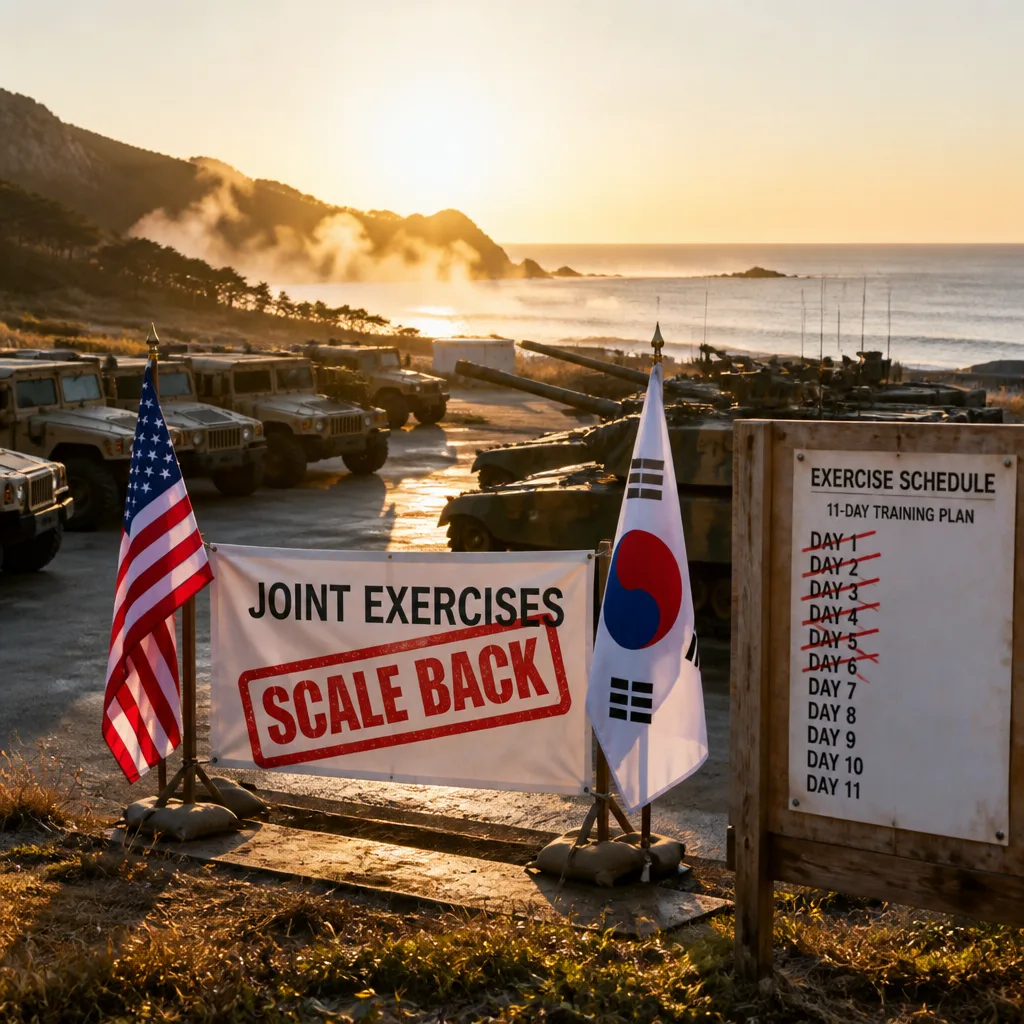
President Donald Trump has instructed the Pentagon to substantially scale back joint military exercises with South Korea that were due to begin this week, the White House said, after the president said Seoul declined to assist in an effort to denuclearise Iran.
What the order says
In a social media post, Trump described the drills as costly and said they "send a signal that is totally inappropriate and hostile" to North Korea. He added that, because it was too late to cancel, he had told his defence secretary to reduce the scope of the manoeuvres.
"Therefore, and based on the fact that it is too late to cancel, I have instructed Secretary of War, Pete Hegseth, to substantially reduce the Joint Military Exercises!"
The exercises were planned to run for 11 days and involve about 18,000 South Korean soldiers. According to US military descriptions, the training was to include a range of complex scenarios such as a live-fire exercise to test joint precision targeting and manoeuvre, a wet gap crossing and the distribution of prepositioned equipment.
Diplomatic context and reactions
The decision followed comments from Trump that South Korea had declined to help denuclearise Iran — a linkage that ties a Northeast Asian military exercise to broader Iran policy. Trump has also publicly cultivated a personal rapport with North Korea’s leader, Kim Jong Un, posting a photograph of the two together and noting they get along despite the image.
North Korea’s Foreign Ministry criticised the planned US–South Korean training, calling it "a rehearsal for an aggressive war" and warning it raises instability in the region.
"[The exercises are] a rehearsal for an aggressive war"
What the drills were meant to test
The bilateral exercises were designed to sharpen readiness against North Korean threats and practise joint operations. The planned scenarios were varied and demanding, aimed at ensuring interoperability between US and South Korean forces.
| Item | Planned detail |
|---|---|
| Duration | 11 days |
| Personnel | 18,000 South Korean soldiers |
| Key activities | Live-fire precision targeting, wet gap crossing, distribution of prepositioned equipment |
Implications
Scaling back the exercises has immediate operational and strategic consequences. On the operational side, commanders lose an opportunity to rehearse complex joint operations in the field and to validate logistics and interoperability plans. Strategically, the move signals a continuation of a presidential preference for reducing traditional, large-scale exercises that previous administrations have used to deter aggression and reassure allies.
There is also a diplomatic dimension. The president’s linking of the drills to South Korea’s stance on Iran suggests an approach that ties bilateral security cooperation to negotiating leverage on unrelated denuclearisation issues. That increases the scope for what analysts call "horse-trading" in alliance politics — where military cooperation can become a bargaining chip in broader diplomatic disputes.
North Korea, which has long denounced US–South Korea war games as provocative, is likely to frame any reduction as vindication of its objections and may use the development for propaganda to argue the alliance is less united. Allies in the region and US defence planners will be watching closely for how much of the training is trimmed, what activities are cancelled, and how quickly full-scale exercises might resume.
Trump’s previous terms in office included surprise announcements about ending or cutting exercises, and he met Kim Jong Un three times during his first term, most recently in 2019. Since returning to office, he has signalled an interest in continuing talks with the North Korean leader.
Who benefits and who pays?
- Beneficiaries: North Korea gains a public relations win if exercises are reduced, while the president portrays cost savings and diplomatic flexibility.
- Costs: The US and South Korean militaries pay in lost training opportunities and potential erosion of deterrence signalling; regional allies may worry about alliance reliability.
The Pentagon now faces the practical task of implementing the president’s instruction while balancing alliance commitments and operational readiness. How Washington and Seoul manage this adjustment will shape perceptions of deterrence and diplomacy on the Korean Peninsula in the weeks ahead.