
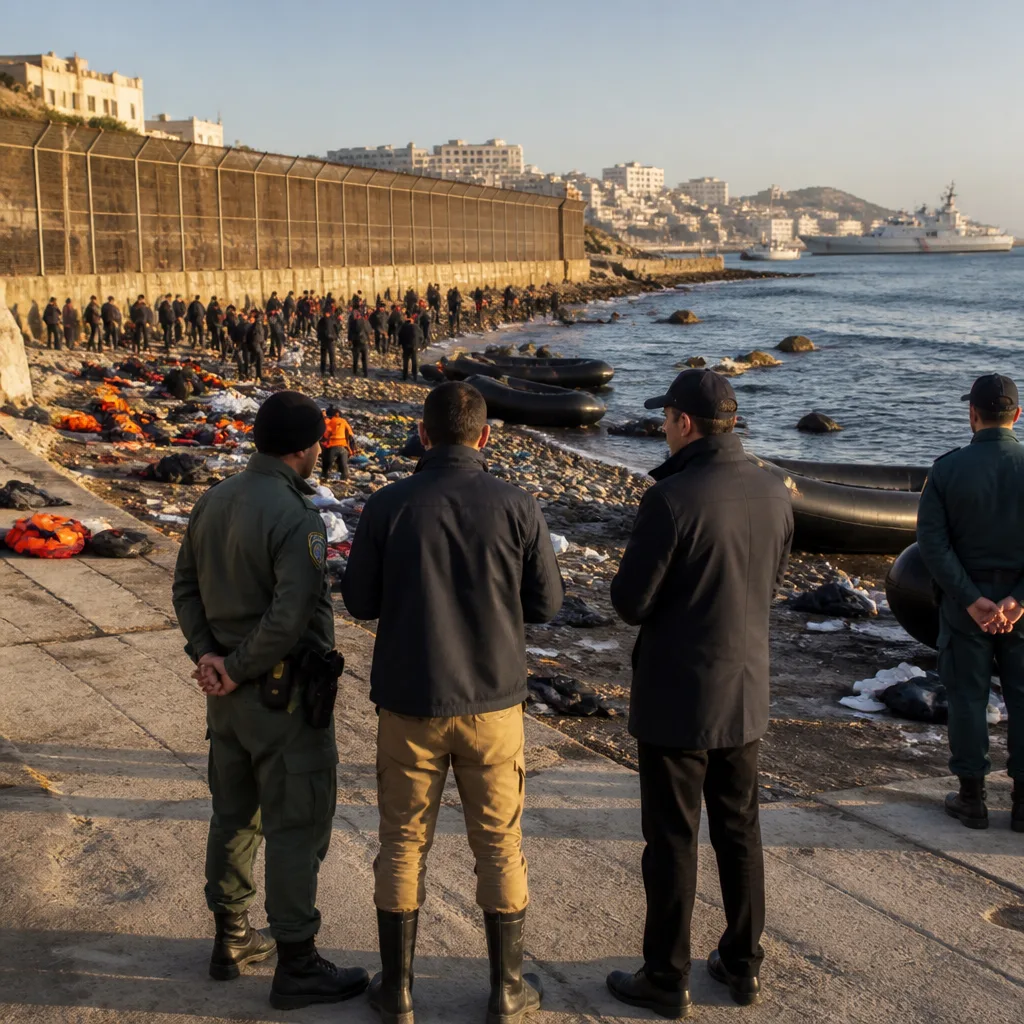
Spain’s Foreign Minister José Manuel Albares travelled to the North African exclave of Ceuta this week and publicly criticised Italy for what he described as a politically motivated reaction to the mass crossings that hit the territory in July.
Albares accuses Rome of partisan manoeuvring
During a visit in which he met local authorities and became the first Spanish foreign minister to visit Ceuta, Albares said that Italy had not shown the same spirit of solidarity as most European Union partners. He argued Rome’s response — tightening checks on flights from Spain — was driven by internal political calculations aimed at addressing electoral needs, rather than by cooperative crisis management.
“Italy has not shown the same spirit of solidarity and support towards Spain as the vast majority of EU countries,” Albares said during his visit.
The Italian measures were announced after tens of thousands of people moved into Ceuta over a short period, prompting a rapid security response from Madrid. Spain deployed the army and closed the border in its other overseas territory, Melilla, as the centre of the crisis.
Scale of the influx and contested numbers
The episode unfolded when roughly 72,000 people crossed from Morocco into Ceuta in the space of 24 hours, a surge of arrivals that Spanish authorities described as a serious challenge to territorial control. The central government in Madrid later said that about 2,000–2,500 migrants remained in Ceuta.
| Figure | Context |
|---|---|
| 72,000 | Approximate number who crossed into Ceuta over 24 hours in late July |
| 2,000–2,500 | Madrid’s estimate of migrants still in Ceuta after the initial wave |
Those official estimates have not been uniformly accepted. National police and Civil Guard figures have questioned some of the government numbers, and the Mayor of Ceuta has provided his own accounts of local conditions, underscoring a degree of uncertainty about the exact scale and duration of the influx.
Diplomatic tensions and differing narratives
The diplomatic spat intensified after Rome announced border checks on flights from Spain. The move was interpreted in Madrid as a rebuke of Prime Minister Pedro Sánchez’s government, which has taken a comparatively pro-migration stance, including measures to legalise the status of around one million undocumented migrants.
Albares countered by praising Moroccan authorities for what he called their “constant collaboration” in managing the situation and facilitating returns. He said the Moroccan position from the outset was that returns should happen immediately — a point Madrid emphasised to underline bilateral cooperation in contrast to what it portrayed as Italy’s politicised posture.
What is at stake for Europe
The episode has become a test of European solidarity on migration and border management. It highlights several tensions that resonate beyond Spain and Italy:
- Domestic politics versus collective responses — Albares accused Italy of prioritising national electoral calculations over coordinated EU action.
- Migration policy divergence — Spain’s recent regularisation measures for undocumented migrants sit uneasily with more restrictive approaches advocated elsewhere.
- Reliance on neighbouring states — Madrid underscored Morocco’s role as a partner in return operations, illustrating how migration control depends on bilateral arrangements.
For now, the narrative battle between Madrid and Rome centres on who acted responsibly and who used the crisis for political advantage. The broader consequence is that such disputes risk undermining cooperation at EU level at a moment when member states face recurring migration pressures and are being urged to develop a common response.
As Spain seeks to defend its handling of the crisis, the row with Italy will test whether EU partners can move beyond accusations and agree on shared mechanisms to handle sudden mass movements of people — or whether migration will continue to be leveraged as an electoral issue across the continent.












