
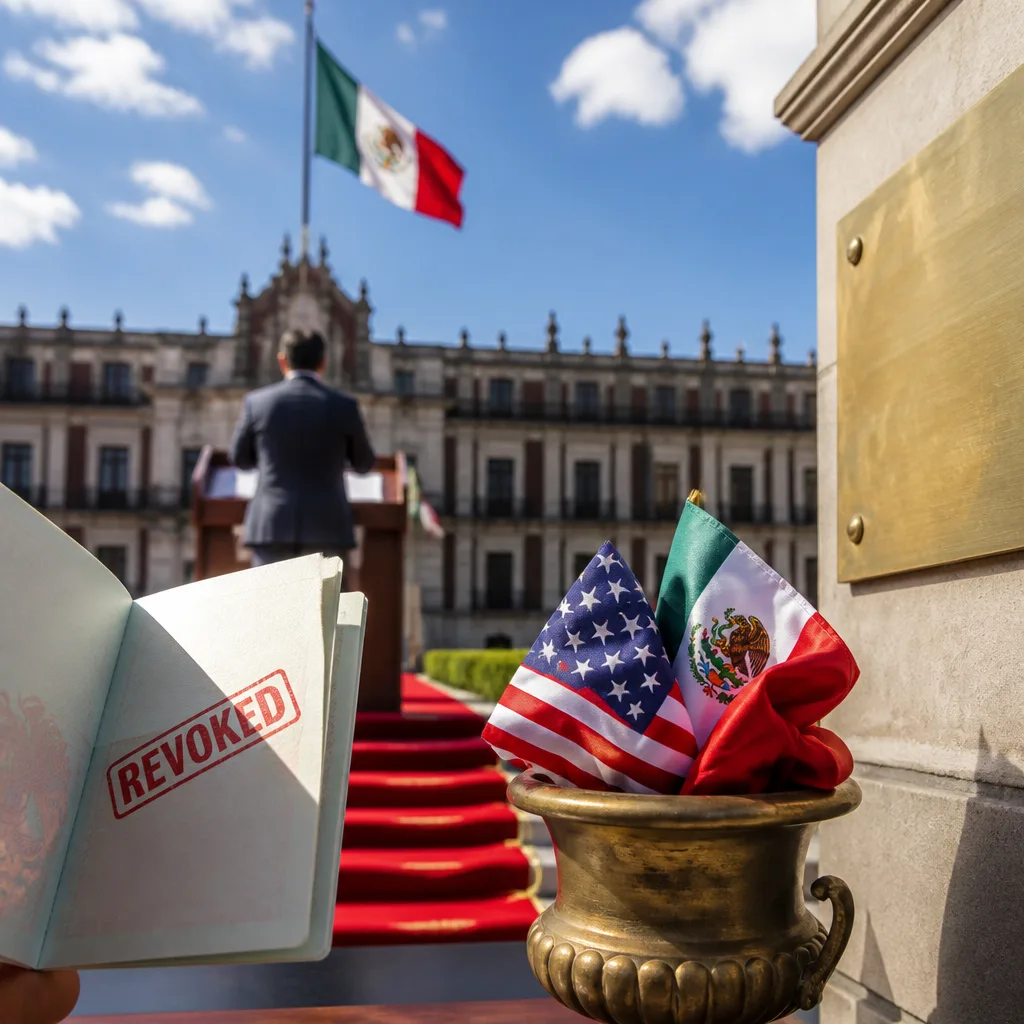
Mexico’s President Claudia Sheinbaum on Friday publicly accused the United States of seeking to interfere in Mexican politics after the US State Department revoked the visa of a leading figure tied to her ruling Morena party.
Visa cancellations spark diplomatic ire
Sheinbaum described the recent wave of visa cancellations as politically motivated, saying they were attempts “to interfere, to meddle in Mexican politics.” The action included the revocation of a visa for the son of former president Andrés Manuel López Obrador, who remains an influential figure within Morena and is seen as a potential future presidential contender.
The Mexican president singled out the pattern of cancellations affecting senior members of her political movement, noting at least one state governor had been targeted. Sheinbaum framed her reaction as one of defence of national sovereignty rather than a personal complaint.
“These are attempts to interfere, to meddle in Mexican politics,”
Sheinbaum reiterated her desire to maintain good relations with the United States while resisting what she portrayed as undue pressure. “I always look for the best relations possible with the United States. Always. ... But I’m not going to bow my head, either. It’s not a personal question. It’s a matter of defending the homeland,” she said at her regular morning briefing.
‘Coordination, not subordination’
Adopting a slogan that underlines Mexico’s stance, Sheinbaum said relations with the US should be based on “coordination, not subordination.” The phrase captures her insistence that binational cooperation — on issues such as security, migration and trade — must respect Mexico’s sovereignty.
The president’s remarks were the strongest public criticism of Washington from her administration to date. They come amid a period in which the US has increasingly used visa restrictions as a diplomatic tool, applying them to individuals in different countries whom officials deem corrupt or involved in serious misconduct.
Sheinbaum’s comments also highlight a sensitive balance: she has courted constructive ties with Washington even as her government has objected to more direct US involvement in Mexico’s internal security responses, particularly operations against organised crime.
Political context and consequences
Observers will watch whether the visa revocations influence cooperation on cross-border issues. President Sheinbaum has previously resisted calls for more overt US participation in anti-cartel operations, an area that has drawn criticism from Washington and domestic opponents alike.
Her rhetorical pushback does several political jobs at once:
- Domestic signalling: It positions Sheinbaum as a defender of national sovereignty to Morena supporters and to the wider electorate that values independence from US pressure.
- Diplomatic pressure: It constrains Washington by making any escalation politically costly, particularly if further visa measures are portrayed in Mexico as direct interference.
- Strategic posture: By insisting on coordination, she keeps open avenues for cooperation while rejecting overt US direction of Mexican policy.
Sheinbaum’s criticism also touched on personal attacks reportedly levelled by the US president, who has on occasion described her in mixed terms — praising her in public remarks while also questioning her approach to cartel-related violence. The Mexican leader pushed back against this duality and warned against attempts to influence Mexican domestic politics.
| Actor | Position |
|---|---|
| Claudia Sheinbaum | Mexican President, defending sovereignty and demanding coordination |
| US State Department | Revoked visas of several Morena figures, citing policy grounds |
| Andrés Manuel López Obrador’s son | Visa reportedly revoked; described as a prominent Morena figure |
The immediate diplomatic fallout remains uncertain. Washington often frames visa restrictions as targeted measures intended to uphold standards of rule of law and accountability. Mexico’s response, blending firm public rhetoric with a continued openness to cooperation, suggests both sides will seek to avoid an outright rupture while jockeying for political advantage.
For Pretoria readers, the episode is a reminder that visa policy can be used as an instrument of foreign policy, and that even well-established neighbours must negotiate carefully when sovereign sensitivities and security concerns collide.












