Scientists are accelerating efforts to identify the enormous variety of life in the world’s oceans, warning that limited knowledge of marine species is weakening attempts to protect them. Marine environments remain difficult for people to reach, particularly in deep water, leaving large parts of ocean biodiversity undocumented.
Ocean Census, an international collaboration involving scientists and non-profit organisations, estimates that researchers have recorded fewer than 10% of the approximately 2.2 million fish, marine mammals, shellfish, plankton, squid, jellyfish and other species thought to live in the oceans. The estimate illustrates the scale of the task: even though marine research has advanced, most ocean species may still be unknown or insufficiently documented.
“It’s very difficult to protect what you don’t know,” said Michelle Taylor, head of science at Ocean Census.
New species from deep water
Recent discoveries show what can emerge when researchers use specialised equipment to explore areas beyond the reach of ordinary diving. An Ocean Census expedition off Argentina last year resulted in 57 species being announced and identified in October.
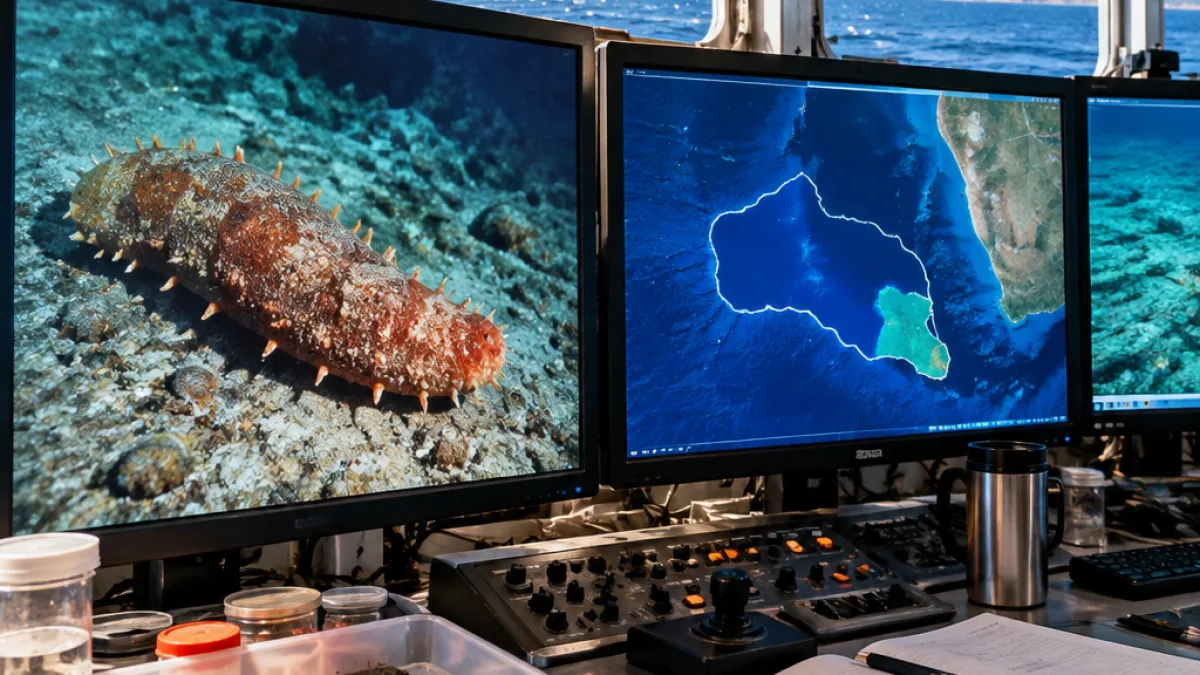
Among them was a sea cucumber with prominent horn-like appendages. Researchers gave it the nickname Loki, a reference to the figure from Norse mythology, because of the shape of those features. The animal was found in the Mar del Plata submarine canyon, an underwater canyon off Argentina.
The same expedition also recorded a vivid red-orange octocoral almost 2,000 metres below the ocean surface. Octocorals are corals whose structures are associated with eight-part body patterns. The expedition used SuBastian, a remotely operated vehicle, or ROV. An ROV is an uncrewed underwater machine controlled from the surface, allowing scientists to observe and collect information from depths that would otherwise be extremely difficult to reach.
- A sea cucumber nicknamed Loki was found in the Mar del Plata submarine canyon.
- A red-orange octocoral was photographed at nearly 2,000 metres below the surface.
- The Argentine expedition produced 57 newly identified species.
Why identification matters
Knowing which species live in a particular area is not simply an exercise in naming unfamiliar animals. It helps researchers determine where marine biodiversity is concentrated. Biodiversity refers to the variety of living organisms in an environment, including the different species and the communities they form.
That information is important when governments and conservation organisations decide which parts of the ocean should receive protection. Claire Goodwin, a research scientist at the Huntsman Marine Science Centre in St Andrew’s, New Brunswick, said the objective was to protect areas with high biodiversity. However, she said this could not be done reliably if surveys had not established what marine life was present.
| Measure | Figure |
|---|---|
| Estimated ocean species | About 2.2 million |
| Estimated share documented in some groups | Less than 10% |
| Global protection ambition for land and sea by 2030 | 30% |
| Oceans expected to be protected by 2030 | 12% |
A conservation target still out of reach
A United Nations biodiversity agreement adopted in 2022 committed countries to protecting 30% of the world’s land, water and marine areas by 2030. Progress has been uneven. The current figure cited for oceans is 12%, compared with 27% for land, meaning marine protection is still further from the shared target.
Canada has so far protected 15.5% of its ocean territory, according to the Canadian Parks and Wilderness Society. That figure is above the reported global ocean position but remains below the 30% ambition for 2030. The comparison also shows why maps of protected areas alone do not provide the full picture: the effectiveness of protection depends on whether the areas selected contain important and well-understood marine ecosystems.
The discoveries off Argentina therefore add to more than a catalogue of unusual-looking animals. They provide information about life in deep marine environments and about the places where that life occurs. Researchers say the continuing shortage of knowledge makes further surveys necessary, particularly in parts of the ocean that are difficult for humans to access. Until more species and habitats are recorded, conservation planners will be making decisions with an incomplete view of what needs to be protected.