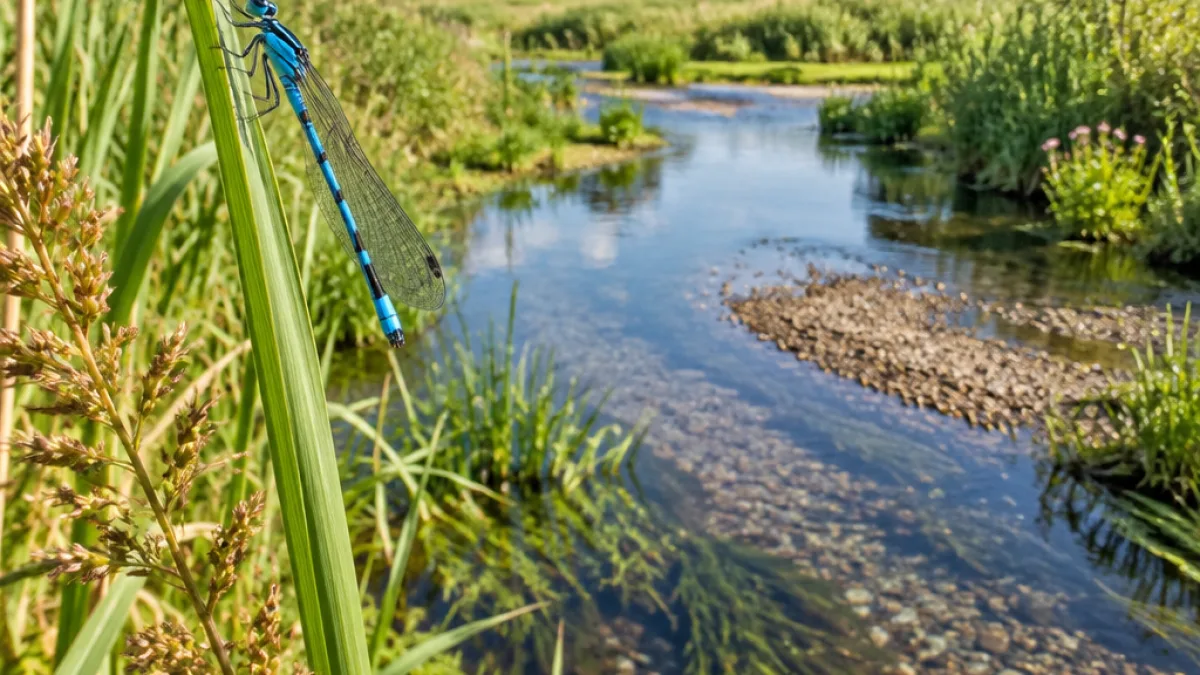
An endangered damselfly has been recorded beside a restored section of the River Ash near Hertford in Britain, providing an early indication that rebuilt river habitat can be used by a species under increasing pressure.
The scarce blue-tailed damselfly was found at two nearby monitoring sites during late summer. The sites are part of wetlands created through a project at the Easneye Estate, where about 7km of the River Ash was returned to its original course.
The finding is significant because the insect has recently been placed in a higher-risk category. A review by the British Dragonfly Society moved the scarce blue-tailed damselfly from Near Threatened to Endangered. In conservation assessments, these categories are used to indicate the level of pressure facing a species and the urgency of protecting its habitat.
A river put back on its course
The restoration involved reshaping parts of the waterway and adding new gravel beds. The Herts and Middlesex Wildlife Trust said brown trout were already spawning on the newly created areas, suggesting that the changes were being used by aquatic life beyond the damselfly itself.
Monitoring conducted before and after the work also recorded an increase in river invertebrates, including mayflies and stoneflies. These are small animals without backbones that live in or around the water. Their presence provides an indication of changes in the river environment, although the available findings do not establish how long the improvement will last or whether it has benefited every species in the area.
| Measure | Reported finding |
|---|---|
| Restored river section | About 7km |
| Damselfly monitoring sites | Two nearby locations |
| Dragonfly and damselfly species now classed as endangered | Eight |
| Previous assessment | 2008 |
| Chalk rivers worldwide | About 260 |
An encouraging record, not proof of recovery
The sighting should nevertheless be interpreted carefully. A record from two close-together sites shows that the damselfly was present in the restored area, but it does not demonstrate that the wider population is growing. It also cannot, on its own, establish that the river project caused the species to return.
That distinction matters in conservation science. A single observation may show that conditions are suitable at a particular time, while a recovery requires repeated surveys over a longer period. Researchers would need continued monitoring to determine whether the damselflies remain in the area, reproduce there and spread to other parts of the river system.
Wider pressure on flying insects
The River Ash record comes against a broader decline in the status of Britain’s dragonflies and damselflies. The latest Red List review places eight species in the endangered category, twice the number recorded in the previous assessment in 2008.
These insects belong to one of the oldest flying lineages. Their changing risk status is therefore both a warning about the species themselves and an indication of the pressure affecting the wetland habitats on which they depend.
The review’s wider message is that protecting existing habitat may not be enough where rivers and wetlands have already been altered. The wildlife trust said creating and restoring suitable places is important if declines are to be reversed. In this case, the rebuilt river channel, fresh gravel beds and associated wetlands have produced several early signs of ecological activity, while the damselfly sighting offers a reason to continue watching the site.
- The finding confirms the insect’s presence at two nearby restored sites.
- It does not yet show that the species is recovering.
- Long-term monitoring will be needed to assess breeding, persistence and population change.