Carolina, Mpumalanga — Archaeologists have identified what they say are the first stencilled rock paintings documented in southern Africa. The faint motifs appear in a shelter called La Rochelle, near the town of Carolina, and were described by David Pearce of the University of the Witwatersrand and Kiah Johnson of the University of Cambridge in the South African Archaeological Bulletin.
What was found
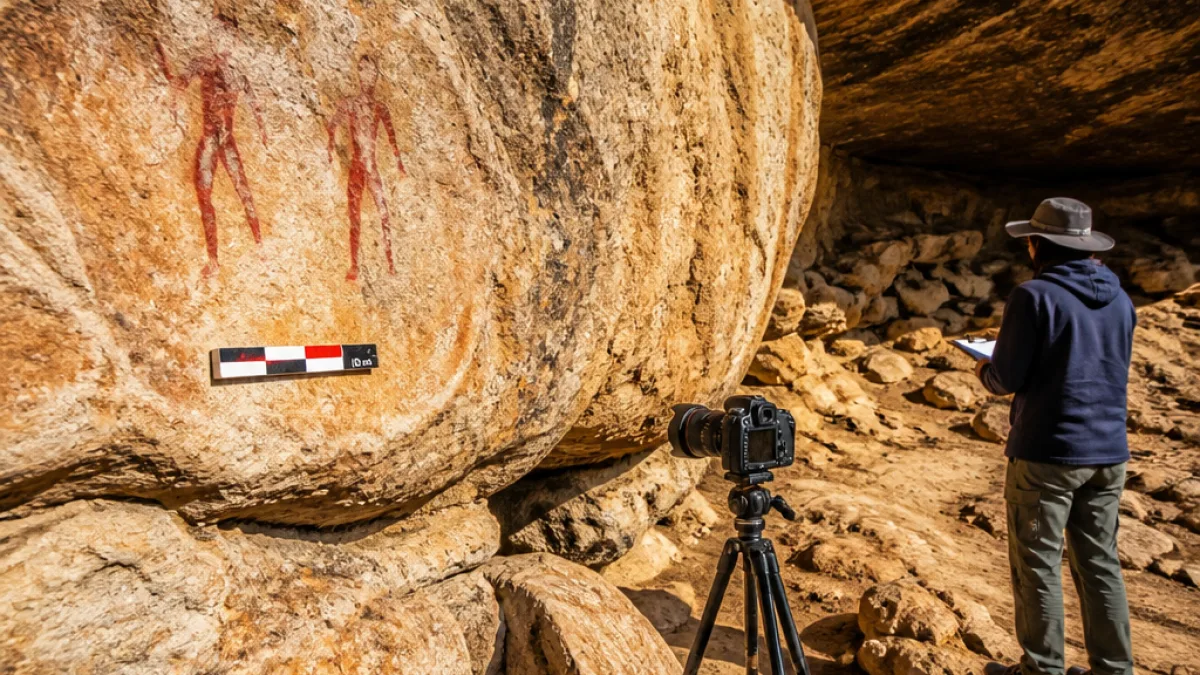
The newly reported marks consist of two small, crude humanoid figures, each about 9 centimetres tall, represented as line-like torsos with unjointed limbs and vague heads. The interior of each figure shows bare rock surrounded by red paint, suggesting paint was applied around a template rather than directly onto the surface with a brush or finger.
Photographs enhanced with D-stretch imaging software revealed the faint motifs, which were not recorded during earlier site visits by Anna Steyn in 1995 and Mduduzi Maseko in 2020. The paint is thickest between the two figures and thins outward, with a halo of minute specks beyond the denser areas — features the authors interpret as consistent with the use of liquid paint applied by blowing or splashing over a template in a single event.
"A made object must have served, since the shape points to a template rather than a brush or finger technique," the researchers report in the journal.
Why this matters
Rock-art in the Highveld and surrounding parts of southern Africa is typically executed with brushes or fingers. Stencilling — where paint is applied around an object, leaving the object's outline in reserve — has been widely documented elsewhere in the world, including Ice Age European caves, China, Indonesia, Papua New Guinea and Australia, but had not previously been recorded in southern Africa. The La Rochelle find therefore expands the known technical repertoire of prehistoric artists in the region.
The discovery prompts fresh questions about cultural connections, local innovation and the range of materials and methods used by past peoples in the area now known as Mpumalanga. It also highlights the potential for faint or weathered motifs to be overlooked without targeted image enhancement and close re-examination.
About the site
La Rochelle is unusually large for the Highlands tradition: roughly 30 metres long and 5 metres deep. Most shelters in the region are shallower and carry much more faded and sparse paintwork. The shelter’s walls also display fine-line brush paintings of eland, hartebeest, small antelope and human-like figures scattered across the rock face.
| Feature | Detail |
|---|---|
| Site name | La Rochelle |
| Nearest town | Carolina, Mpumalanga |
| Shelter size | ~30 m long × 5 m deep |
| Stencilled figures | Two humanoid figures, ~9 cm tall, red pigment |
| Previously recorded | Anna Steyn (1995); Mduduzi Maseko (2020) |
Broader context and cautions
Stencilling elsewhere has included hand stencils and small scaled-down templates, and in some contexts apparently non-human shapes have been stencilled (for example, lizard forelimbs in Egypt were once mistaken for infant hands). The authors caution that the exact nature of the La Rochelle templates is unknown: they can only say the marks are consistent with paint applied around a made object. The faintness of the images likely accounts for their earlier omission from site records.
From a heritage management perspective, the report underscores the importance of detailed documentation and non-invasive imaging techniques for rock-art research. It also reinforces the need to protect such shelters from physical damage, graffiti and erosion so fragile pigments remain available for study.
Implications for Mpumalanga
The find places Carolina and the broader Highveld on the map for an unexpected first in southern African archaeology. For local communities, heritage practitioners and tourism planners, the discovery may prompt renewed interest in cataloguing and protecting rock-art sites in the province.
- Visitors and researchers should avoid touching painted surfaces — oils from skin can accelerate deterioration.
- Conservation-friendly documentation (high-resolution photography and non-invasive enhancement) can reveal faint motifs without physical sampling.
- Local authorities and heritage bodies are best placed to advise on access and protection of sensitive sites.
The identification of stencilling at La Rochelle does not in itself offer firm dates or cultural attribution; it opens lines of inquiry about technique, materials and whether similar, as-yet-unrecognised examples exist elsewhere in the region. The full account appears in the South African Archaeological Bulletin, where Pearce and Johnson set out the evidence and urge further investigation of Highlands shelters with modern imaging methods.
As researchers re-examine old sites with new tools, Mpumalanga’s rock-art landscapes may still hold surprises that reshape our understanding of the artistic choices and technical knowledge of past peoples in southern Africa.