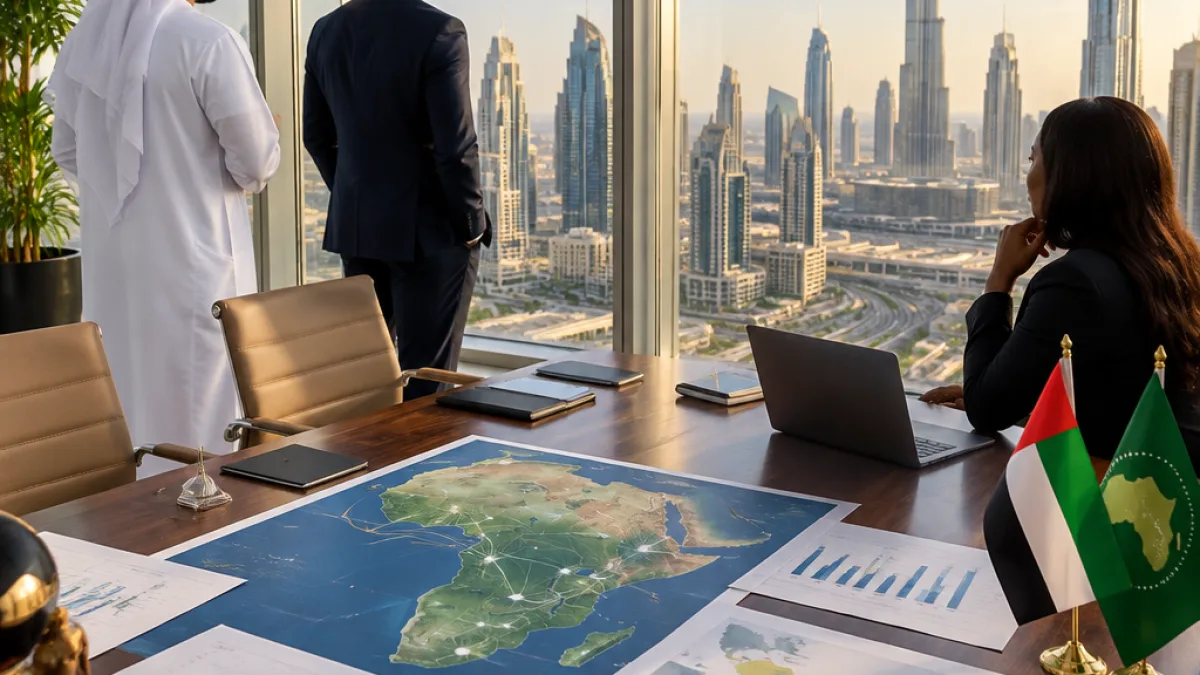
Absa Group has opened its first office in the Gulf, establishing a base in Dubai to connect investors, corporates and financial institutions in the Middle East with trade and investment opportunities across Africa.
The branch operates from the Dubai International Financial Centre under Absa Bank Limited and received a Category 4 licence from the Dubai Financial Services Authority in July. Its mandate allows it to arrange investment transactions, provide advice on financial products, and arrange or advise on credit.
It will not advance money from its own balance sheet. Instead, the Dubai operation will identify potential transactions among Gulf-based businesses, investors and financial institutions, while Absa’s existing operations in 16 African markets will manage funding, execution and ordinary banking services.
A growing trade corridor
The decision comes as commercial ties between the United Arab Emirates and Africa expand rapidly. UAE government figures show that non-oil trade between the Emirates and Africa increased by about 41% to $158 billion, or approximately R2.6 trillion, in 2025. The comparable figure for 2024 was about $112 billion, equivalent to R1.85 trillion.
South Africa is now the UAE’s second-largest trading partner on the continent, according to UAE Minister of Foreign Trade Thani bin Ahmed Al Zeyoudi. Bilateral non-oil trade reached $8.6 billion, or about R141 billion, in 2025, more than double the 2019 level.
| Indicator | 2025 value |
|---|---|
| UAE-Africa non-oil trade | $158bn (R2.6trn) |
| South Africa-UAE non-oil trade | $8.6bn (R141bn) |
| South African exports to the UAE | $3.17bn (R52bn) |
| South African imports from the UAE | $2.76bn (R46bn) |
South African exports to the UAE rose by 6.2% in 2025. The main products included precious metals, diamonds, coal, vehicles and fresh produce. Imports from the Emirates, by contrast, declined by 25.8% during the year. The figures show both the size of the commercial relationship and the potential for financial institutions to support companies operating across the corridor.
Focus on infrastructure and energy
Absa said interest from clients is strongest in infrastructure, energy, logistics and agriculture. These are sectors where projects often require substantial capital, long-term planning and cross-border financial arrangements. A Dubai presence gives the bank a location from which to engage Gulf investors while drawing on its African network for local execution.
Gulf capital is already playing a larger role in African infrastructure. Infinity Power, which has Emirati backing, acquired Lekela Power, including more than 600 megawatts of operating wind capacity in South Africa. Al Zeyoudi described that transaction as the largest renewable-energy deal in Africa’s history.
Absa’s move places it alongside South African financial groups including Investec, Standard Bank Group, Nedbank Group and Rand Merchant Bank, which already have operations in Dubai. The bank is South Africa’s third-largest lender by assets, and its new office is intended to support transactions rather than operate as a conventional lending branch.
For South African companies, greater access to Gulf capital could create opportunities to expand projects, secure trade finance and build commercial links in sectors such as renewable energy, transport and food production. The benefits will depend on whether prospective deals reach financial close and translate into investment, procurement and employment in African markets.
- Absa’s Dubai branch will arrange and advise on transactions but will not lend from its own balance sheet.
- The bank will use its presence in 16 African markets to support funding and execution.
- UAE-Africa non-oil trade reached about R2.6 trillion in 2025.
The expansion also reflects stronger competition among South African banks for international corporate business. Dubai offers a gateway to investors based in the Gulf, while Absa’s African footprint provides a platform for deploying capital into projects on the continent. The available figures indicate a sizeable opportunity, although they do not guarantee returns for any individual investor or business. This article is for information only and does not constitute financial advice.