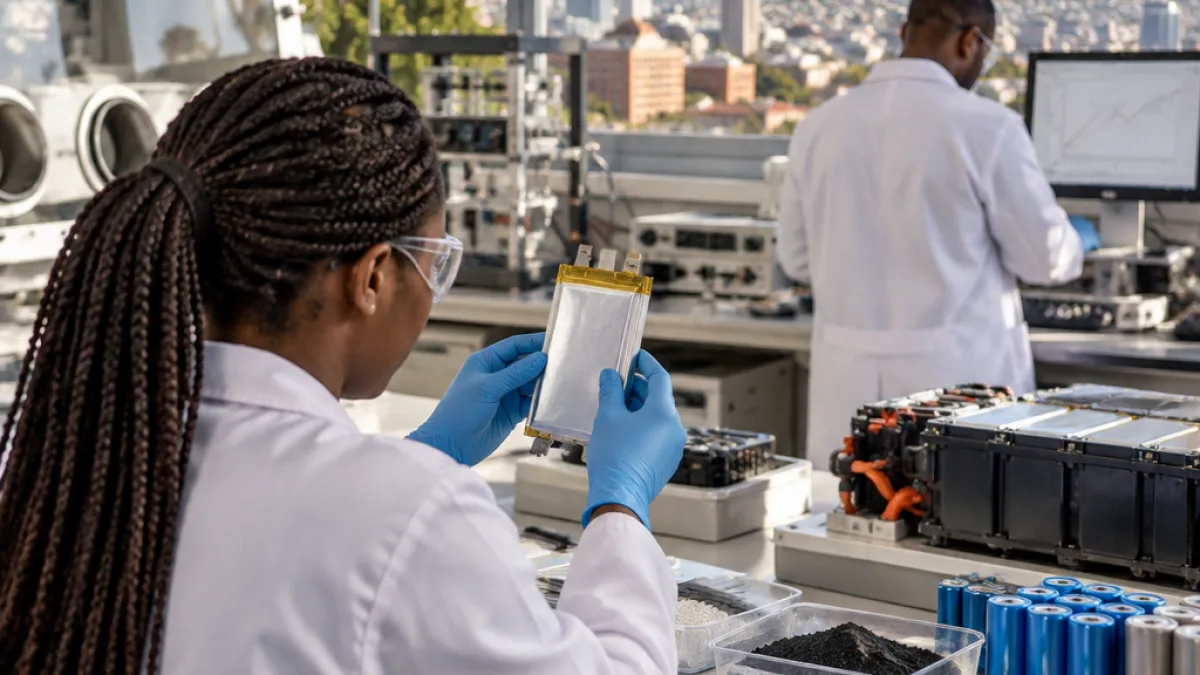
South Africa is advancing work to develop local battery research, production and testing capabilities as it seeks to strengthen its position in energy storage technology. The programme is being driven by the South African National Energy Development Institute (SANEDI) and the Department of Science, Technology and Innovation’s Energy Secretariat.
The initiative centres on the Battery Energy Storage Consortium, which receives support from the Department of Science, Technology and Innovation. Its work covers the development of materials used in lithium-ion batteries, as well as the manufacture and assessment of battery cells.
Research across the battery value chain
Research is focused on both the anode and cathode materials that form part of a battery, while the consortium is also working on lithium-ion cell production. The cells are tested at the University of the Western Cape, giving the research programme a dedicated facility for assessing the technology it is developing.
The work brings together several South African institutions, including SANEDI, the South African Nuclear Energy Corporation (NECSA), the Council for Scientific and Industrial Research (CSIR) and the University of Limpopo. Their involvement spans research and development, institutional collaboration and battery testing.
| Area | Institutions or partners identified |
|---|---|
| Energy storage research | SANEDI and the DSTI Energy Secretariat |
| Battery materials and cell development | Battery Energy Storage Consortium |
| Research collaboration | NECSA, the CSIR and the University of Limpopo |
| Cell testing | University of the Western Cape |
| International cooperation | Partners including China |
Localisation and industrial development
The programme is not limited to laboratory research. SANEDI and the DSTI are also pursuing localisation and industrialisation across the lithium-ion battery value chain. This includes cooperation with international partners, among them China, as South Africa works to build its domestic research and manufacturing base.
For South Africa, the significance of the project lies in the attempt to connect scientific research with industrial capability. Developing knowledge of battery materials, producing cells and testing their performance are separate parts of the same technology chain. The consortium’s structure brings these areas together through work involving public research institutions and universities.
Why energy storage matters
Battery energy storage is a key technology in efforts to create a more flexible and sustainable energy system. The South African initiative is intended to support the country’s ability to develop and manufacture technologies locally, rather than relying only on imported products and expertise. The available information does not set out a production target, commercial launch date or the expected scale of any future manufacturing operation.
According to SANEDI, the work is aimed at strengthening local research and manufacturing, opening industrial opportunities and contributing to a more secure and sustainable energy future. The emphasis on a complete value chain is important: research into battery components is being pursued alongside cell production and testing, while international collaboration is being used as part of the localisation effort.
- Research: development of battery anode and cathode materials.
- Production: work on lithium-ion battery cell manufacturing.
- Testing: cells are assessed at the University of the Western Cape.
- Industrialisation: SANEDI and the DSTI are seeking to expand local capability across the value chain.
The next significance of the programme will depend on how effectively this research is translated into reliable production capacity and wider industrial participation. For now, the consortium represents a coordinated national effort to establish expertise in one of the central technologies associated with energy storage, while keeping localisation and partnerships at the centre of the strategy.