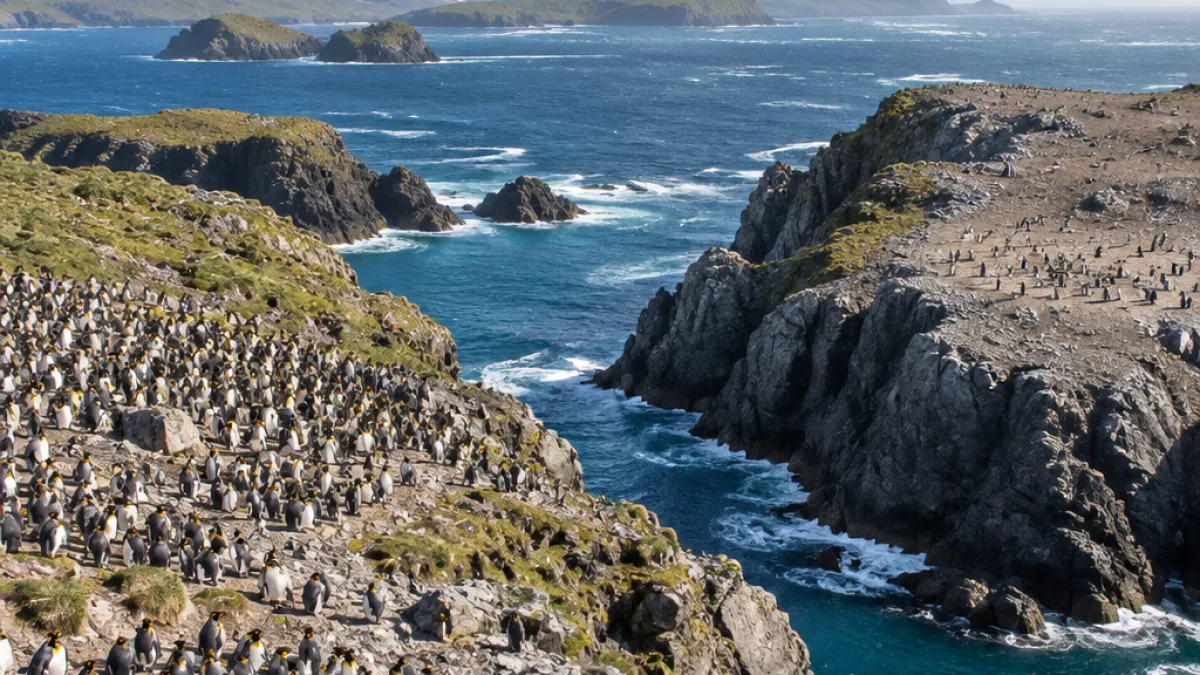
A comprehensive drone survey has revealed a sharp divide in the fortunes of New Zealand’s endangered Erect-crested penguins. The species breeds only on the remote Bounty and Antipodes island groups, yet the two populations have followed markedly different paths.
Researchers found that the population on the tiny Bounty Islands has remained broadly stable for at least 25 years. On the much larger Antipodes Islands, however, the number of breeding penguins has fallen by more than 40 percent since 1995.
The findings come from a University of Otago study led by Dr Thomas Mattern of the Tawaki Project. The project brings together researchers from the university’s Departments of Zoology and Marine Science, with collaboration from the Antarctic Research Trust and the Global Penguin Society.
A complete count across two remote island groups
Between 2022 and 2024, researchers used drones to photograph and count every breeding colony across both island groups. This produced the first comprehensive population survey covering the entire species.
Drone surveys are particularly useful in remote and difficult terrain. They allow researchers to record large colonies from above, while reducing the need for people to move through breeding areas. In this case, the method made it possible to compare current numbers with historical records stretching back to the mid-1990s.
The survey also challenged an established assumption about where most of the species lives. The Antipodes Islands have traditionally been regarded as the main stronghold because they are much larger. Yet the results showed that the smaller Bounty Islands support almost as many breeding pairs.
| Island group | Estimated breeding pairs | Population trend |
|---|---|---|
| Bounty Islands | About 27,800 | Broadly stable for at least 25 years |
| Antipodes Islands | About 29,800 | Down by more than 40% since 1995 |
The contrast is notable because the Bounty Islands cover only about 50 hectares, while the Antipodes Islands are about 40 times larger. Population size, therefore, does not appear to be explained simply by the amount of land available. The smaller island group supports nearly as many breeding pairs as the larger one.
“The results overturn a long-standing assumption.”
That conclusion does not mean that the Bounty population is free from risk. It does, however, show why conservation planning needs to examine individual colonies and island groups rather than treating a species as one uniform population.
Why the two populations may be diverging
The researchers linked the decline on the Antipodes Islands to a combination of pressures, including predators, worsening storms and changing environmental conditions. The study’s results point to a complex problem rather than a single cause that can be addressed in isolation.
These pressures may affect penguins at different stages of their lives. Predators can reduce survival, while severe storms may damage breeding areas or disrupt the period when adults care for chicks. Environmental changes can also alter conditions around colonies. The available findings identify these factors as part of the explanation, but do not present one simple cause for the decline.
- The Bounty Islands population has remained essentially unchanged for at least 25 years.
- The Antipodes Islands population has declined by more than 40 percent since 1995.
- The two island groups together hold roughly similar numbers of breeding pairs.
- The results show the value of repeated, colony-by-colony monitoring.
Erect-crested penguins remain one of New Zealand’s least understood penguin species because they breed in isolated locations. The new counts establish a clearer baseline for future surveys. Later drone assessments can be compared with these results to determine whether the trends continue, improve or worsen.
For conservation authorities, the main lesson is that protection measures may need to be tailored to each island group. A strategy that is suitable for a stable population may not be enough for one experiencing a sustained decline. The survey provides the population evidence needed to identify that difference, while further research will be required to establish how much each threat contributes.
The study also illustrates why long-term records matter. A single count can show how many animals are present at one moment, but comparisons over decades reveal whether a population is stable or moving towards danger. In this case, the combination of historical records and new aerial surveys exposed a decline that might otherwise have been masked by the species’ presence on two separate island groups.