
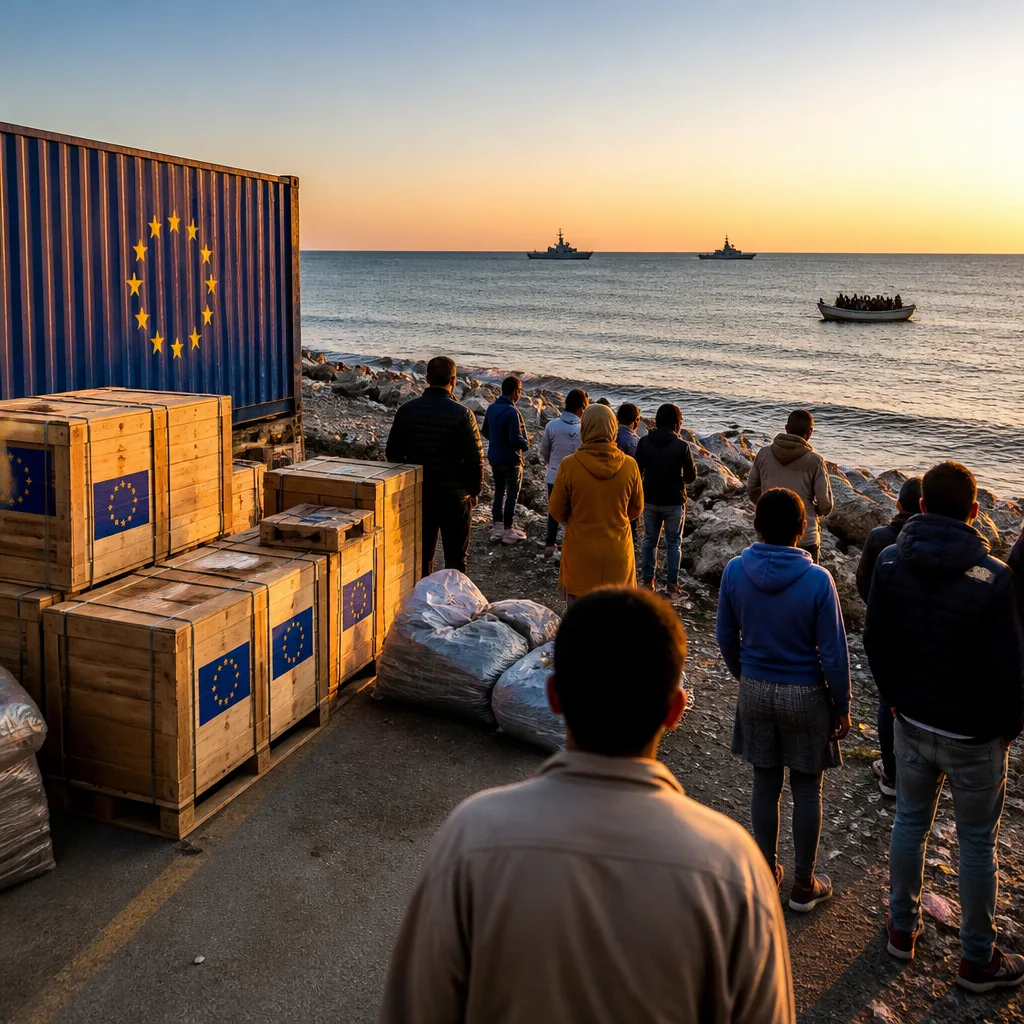
Europe has pushed a growing perimeter of migration control deep into Africa, combining funding, security cooperation and on-the-ground operations that shift the humanitarian and political costs of migration beyond its territory, a new briefing has reported.
Outsourcing the border
The Progressive International’s twenty-sixth briefing of 2026, drawing on Reactionary International research, argues that Europe’s border regime is now networked across the continent. The report highlighted a recent surge of deaths and chaotic crossings at the Spanish enclave of Ceuta, where at least 96 people died on 30 July after more than 72,000 people crossed from Morocco into the territory.
The briefing said families continued to search for missing relatives weeks later, and noted the difficulty in identifying victims because relatives in Morocco faced obstacles crossing legally into Ceuta to give DNA samples.
Payments, patrols and detention beyond Europe
Progressive International documented how European states fund and equip border control far outside EU borders. In Mauritania the briefing reported that the EU pledged more than €210 million in 2024, including support for border and migration management. The report said Spanish boats, aircraft and security personnel operate off Mauritania’s coast, and Spain has funded migrant detention centres on Mauritanian soil.
| Incident | Reported figure |
|---|---|
| Deaths at Ceuta (30 July) | At least 96 |
| Crossings into Ceuta (same event) | More than 72,000 |
| Mauritania interception (recent) | 161 people (including 17 children) |
| Shipwrecks on West Africa–Canary Islands route (2025) | 54 shipwrecks leaving 1,214 dead or missing (IOM) |
| Attack on rescue vessel (reported) | Two men fired for 20 minutes at the Ocean Viking carrying 87 people |
Violence, rescues and geopolitical tensions
The briefing also highlighted incidents of direct violence at sea. It reported that, a year earlier, two men aboard a Libyan Coast Guard patrol boat fired for twenty minutes at the rescue ship Ocean Viking, which was carrying 87 people. Such attacks underline the risks faced by people on irregular routes and the perilous conditions confronting rescue operations.
Political dynamics beyond migration policy were also flagged. The briefing linked a spike in crossings to the visit of Spanish Prime Minister Pedro Sánchez to Morocco, noting tensions between Spain and Rabat and broader diplomatic friction involving Washington and Israel over Sánchez’s stance on the war in Gaza and opposition to a military campaign on Iran, as reported in the briefing.
- Externalisation of border control: financing and operational support in third countries.
- Human toll: large numbers of deaths, missing people and dangerous crossings on Atlantic and Mediterranean routes.
- Security incidents: attacks on rescue vessels and militarised responses at sea.
For South Africa — a country that has itself contended with migration debates and regional refugee movements — the briefing’s findings are significant. They illustrate how wealthier states can export the logistical and moral burdens of migration control, shaping transit routes and local security dynamics far from their own borders. The consequences are visible in increased enforcement in states that are not EU members and in the militarisation of search-and-rescue spaces.
Progressive International said its briefing was informed by research from Reactionary International and painted a picture of a border regime that is both geographically expansive and politically fraught. It pointed to a cycle in which funding and cooperation strengthen border infrastructures in transit countries, while the humanitarian costs — deaths at sea, detention and interrupted identification — accumulate outside European territory.
The report adds to an intensifying international debate about the ethics and effectiveness of externalising border control. Advocates for migrants and rescue organisations have repeatedly warned that shifting responsibility to transit countries can increase risk and reduce transparency around violent incidents at sea. The briefing’s catalogue of incidents and funding commitments offers a case study in how those warnings are playing out in practice.
Policy responses in Europe and in transit states will determine whether the patterns the briefing describes deepen, or whether there is a shift towards approaches that prioritise safe passage, transparent rescue and accountable partnerships.