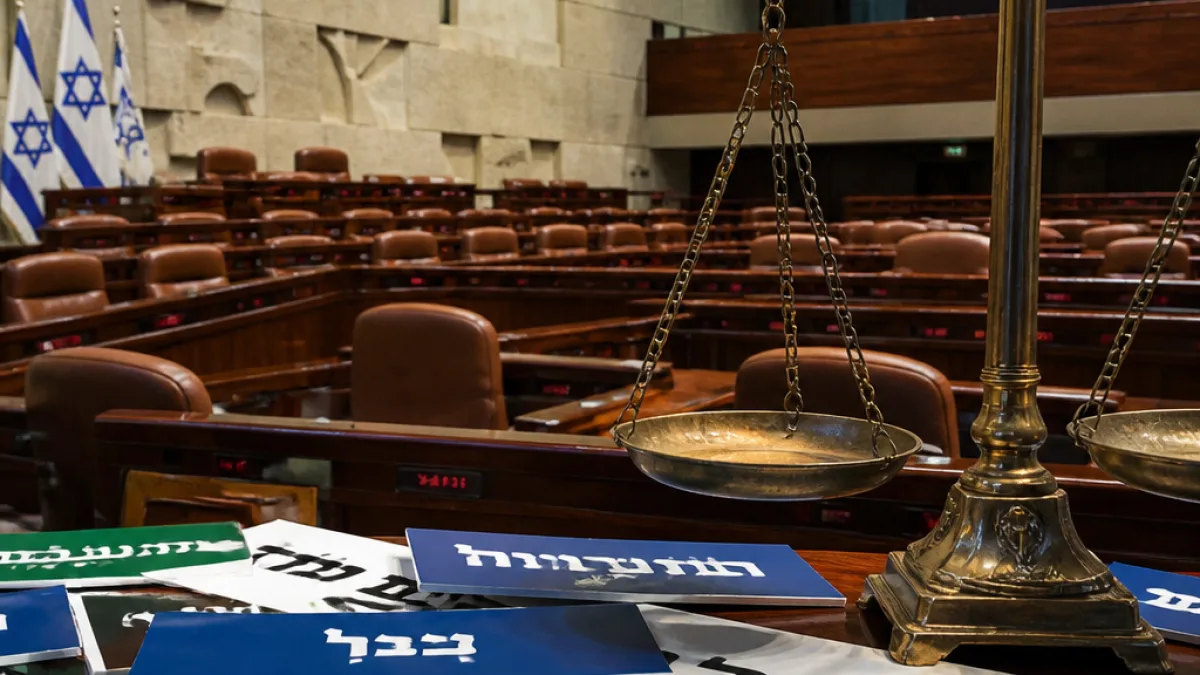
Israel faces potentially weeks of political uncertainty after an election that has challenged Prime Minister Benjamin Netanyahu’s hold on power and opened the possibility of a coalition involving Jewish and Arab parties. Final results could be available as early as Thursday evening, but the vote count is not expected to produce a clear winner.
The immediate question is whether Netanyahu can assemble enough support to remain prime minister, or whether his leading challenger, centrist former military chief Gadi Eisenkot, can bring together the parties needed to remove him. Israelis vote for parties rather than directly choosing a prime minister, making the composition of the next parliament central to the outcome.
Arab parties could hold the balance
Arab-led parties made a strong showing in the election, but their role in forming the next government remains uncertain. Opponents of Netanyahu’s far-right government could theoretically work with them to reach a parliamentary majority, although several possible partners have already rejected that option. Their positions could change if removing Netanyahu becomes the overriding political objective.
Any such arrangement would mark a major shift in Israeli coalition politics. Questions involving Palestinians and their descendants remain highly sensitive, while the possibility of Arab parties participating in a government has renewed debate about the identity of Israel, which was founded as a state for the Jewish people.
“dangerous government”
Netanyahu used that phrase on Wednesday to describe a possible administration that included Arab parties. Those parties’ constituents account for about 20% of Israel’s population. His Likud party, which was leading the count, also alleged that Tuesday’s election had been “stolen” by Arab parties and called for an investigation. The party did not present specific evidence for the allegation.
The elections committee said reports of irregularities were lower than in previous elections. That assessment does not settle the political dispute, but it provides the available official indication that claims of widespread electoral problems have not been substantiated in the information provided so far.
Three routes remain under discussion
Netanyahu is seeking to retain his position as Israel’s longest-serving prime minister. Eisenkot has not completely ruled out co-operating with Arab parties, but has attached conditions. These include recognition of Israel as a Jewish state and recognition of Hamas as an extremist group. Those requirements could narrow the field for negotiations, particularly because Eisenkot’s potential partners do not all share the same view of a coalition with Arab-led parties.
A second possibility is that parties opposed to Netanyahu reach an agreement despite their differences. The practical benefit for them would be a route to replacing his government, while the cost would be having to reconcile conflicting positions on national identity and the Palestinian issue. Arab-led parties, meanwhile, could gain decisive bargaining power if neither major bloc can govern without their support.
A third option being discussed is a unity government involving Netanyahu and Eisenkot. Such an arrangement could reduce the immediate pressure created by the fragmented result, but it would also require the two rivals to share power after campaigning against one another. The source material does not establish whether either side has formally committed to that course.
| Election factor | What is known |
|---|---|
| Final results | Could be available as early as Thursday evening |
| Vote count | With 88% counted, no clear winner was expected |
| Arab-led parties | Recorded a historic showing and may influence coalition formation |
| Possible alternatives | An anti-Netanyahu coalition, a unity government, or continued uncertainty |
For voters, the immediate consequence is uncertainty over who will govern and which political compromises will be required. For the parties, the result turns the post-election period into a negotiation over principles as well as numbers. The final balance will determine whether Netanyahu survives, whether Eisenkot can construct an alternative, or whether Israel moves towards a unity arrangement that leaves both men inside government.