Coalition turbulence and failing services strain Knysna
Knysna’s postcard vistas and busy waterfront mask a municipal reality marked by political instability and deteriorating basic services. Over five years of coalition rule the town has seen a succession of alliances, frequent changes in municipal management and the steady release of raw sewage into rivers that feed an estuary ranked among the country’s most important for conservation.
The instability follows the 2021 local government elections, when no party won an outright majority in the 21-member council. As coalitions have shifted, so too has executive control of the municipality, leaving long-term planning and maintenance in disarray, according to reporting by Marvin Charles, Storm Simpson and Soyiso Maliti.
- Seat distribution: the DA holds eight seats, the ANC seven, the Knysna Independent Movement (KIM) two, the PA two, the EFF one and Plaaslike Besorgde Inwoners one.
- Current governing alliance: ANC, EFF, PA and KIM.
- Recent mayoral turnover: Aubrey Tsengwa (ANC) became mayor after a 2022 coalition change; he was removed in February 2025 and replaced by Thando Matika (ANC). At the time of reporting there was no mayor, with local government heading into elections in two months’ time.
"Knysna is the same, started by the lack of vision and lack of planning way long before the current government," said Jan van der Westhuizen, chairperson of the Greater Knysna Business Chamber, who warned the municipality was "really in trouble".
Residents and businesses say they have reached a breaking point. The town’s estuary, internationally noted for its conservation importance, has been subject to pollution from leaking or malfunctioning sanitation infrastructure. That environmental damage compounds the wider economic and social costs for a tourism-dependent town.
Management churn and the municipal pipeline
Local reporting emphasises a revolving door of municipal managers and officials. Short tenures at senior levels make it difficult to implement long-term repair and upgrade programmes for wastewater systems, roads and other critical infrastructure. Interviewed business representatives urged urgent, sustained intervention to prevent further ecological harm and reputational damage.
Community symbols of resilience sit uneasily beside failing services. The Phoenix Rising monument, erected after the 2017 Southern Cape wildfires to mark recovery, stands over a town now struggling with a different set of civic emergencies.
What this means for residents and the vote
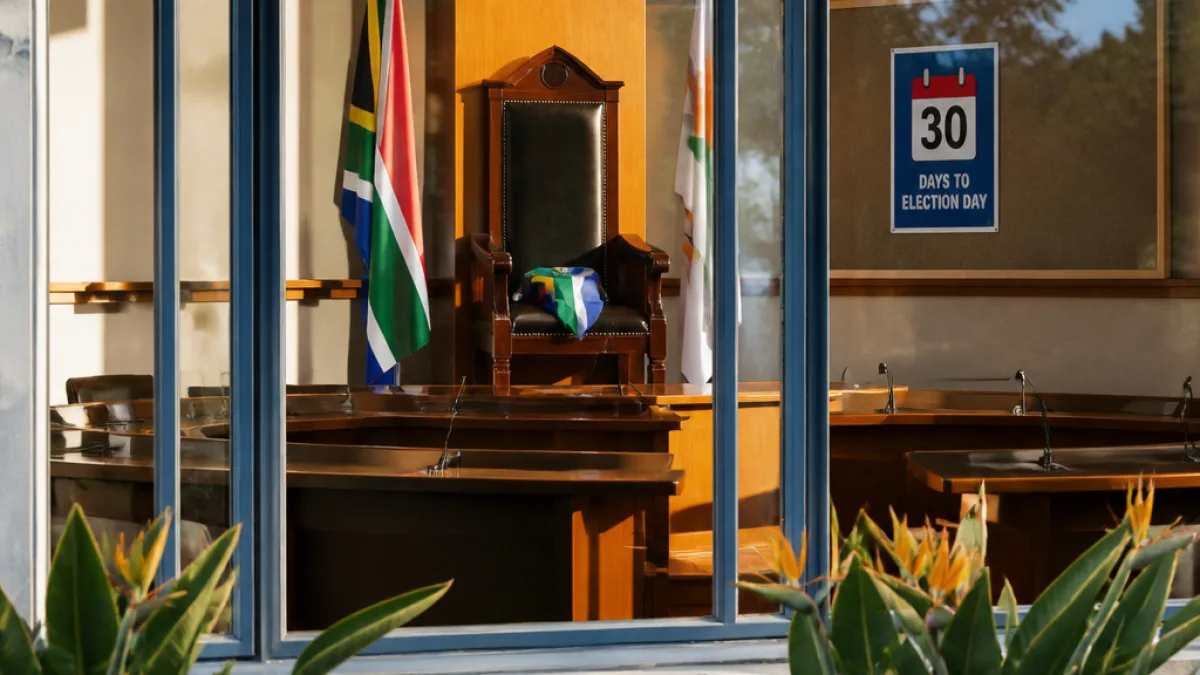
Knysna’s governance fragility has practical consequences: public health risks from sewage contamination, reduced investor confidence, and a strain on local employment tied to tourism and services. With municipal elections two months away, the governance record will form a central issue for voters deciding who should run the town through its next cycle.
| Party | Seats (21-seat council) |
|---|---|
| DA | 8 |
| ANC | 7 |
| KIM | 2 |
| PA | 2 |
| EFF | 1 |
| PBI | 1 |
The council’s arithmetic has produced successive fragile alliances rather than stable majorities. In August 2022 the PA switched allegiances, enabling an ANC-led coalition to install Aubrey Tsengwa as mayor; by February 2025 he had been replaced by Thando Matika. The current governing pact includes the ANC, EFF, PA and KIM.
Local business leaders, civic groups and residents are calling for clear commitments and credible plans to repair sanitation infrastructure and restore governance capacity. Without rapid, sustained action, Knysna risks both environmental degradation and a deepening credibility gap at a time when public trust is essential.
For a town whose economy and identity are closely bound to its natural assets, the political uncertainty and service failures present a test: whether local leaders can translate urgent fixes into a longer-term plan that protects the estuary, stabilises municipal administration and reassures residents and investors ahead of the polls.