The Democratic Alliance’s hold on the City of Cape Town faces a test after a new Ipsos municipal election survey indicated its support has slipped to 46% in the metro. The poll, conducted among 3,600 randomly selected South Africans, shows rising support for smaller parties such as the Patriotic Alliance (PA) and modest gains for the African National Congress (ANC).
Numbers that matter
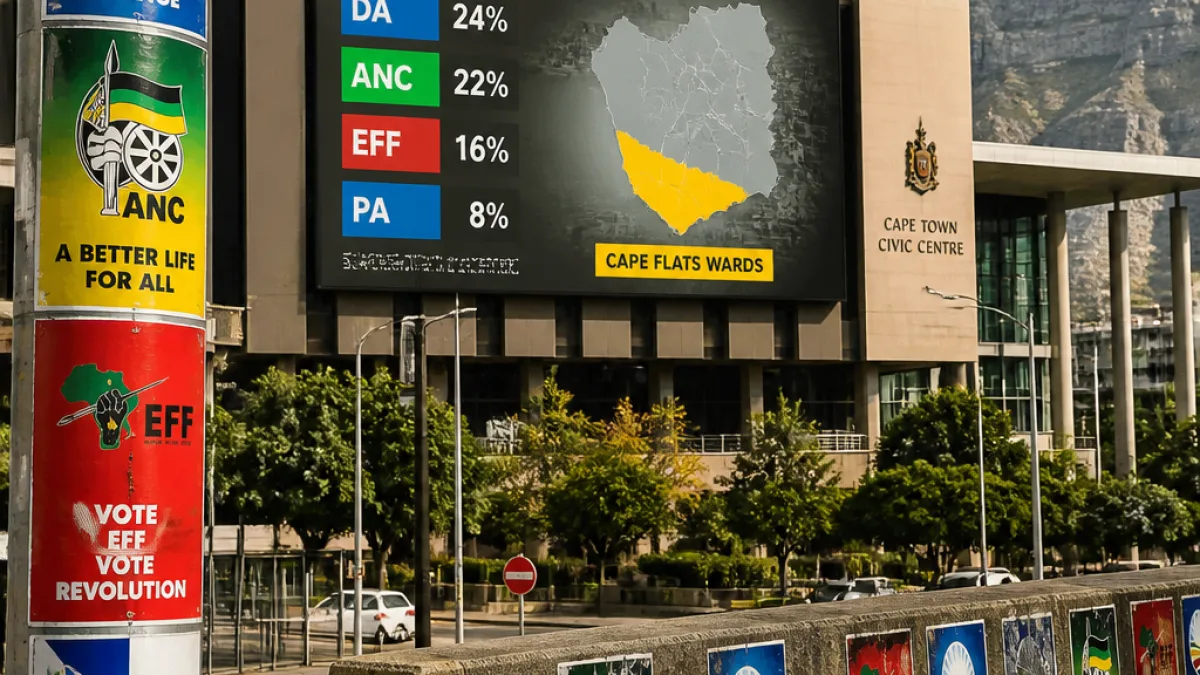
The Ipsos snapshot places the main parties in Cape Town as follows:
| Party | Survey support |
|---|---|
| DA | 46% |
| ANC | 26% |
| EFF | 11% |
| PA | 8% |
In 2021 the PA won only 1.49% of votes in Cape Town, securing four of the 231 council seats. The new figures suggest the party could substantially increase its share this year — particularly in pockets of the metro where it has already made inroads.
Where gains are coming from
According to the survey and party statements, the PA’s growth is concentrated in coloured communities on the Cape Flats. The party has also contested and won by-elections in parts of the Western Cape, including towns such as Oudtshoorn, and has taken wards from both the DA and the ANC in places like Kensington and Stellenbosch.
The Ipsos numbers point to a modest resurgence of the ANC among African voters in the metro, while the EFF maintains a double-digit share. The result is a fragmented electoral landscape that could complicate coalition dynamics if the DA loses an outright majority on 4 November.
Responses from leaders
Cape Town mayor and DA leader Geordin Hill‑Lewis acknowledged the challenge while stressing the party’s commitment to campaigning hard.
“We will work harder than all our opponents and we will never take our position for granted.”
PA spokesperson Steve Motale framed the party’s expansion as evidence of growing support across the Western Cape. Motale pointed to recent by‑election victories and said the PA intends to contest every ward in the City of Cape Town.
“We are making serious inroads in the Western Cape, especially in areas which were traditionally strong bases for the DA ... We are confident that we will do well in the Western Cape especially in the City of Cape Town.”
What this means for the council
If the DA’s support declines further from the Ipsos estimate, the party could lose its outright majority on the council and face tougher negotiations to form or sustain a governing coalition. Even if reduced, the DA would likely remain the largest single party, but a slimmer margin reduces flexibility and increases leverage for smaller parties — notably the PA and the EFF — during post‑election bargaining.
- Coalition arithmetic: A reduced DA majority will compel the party to intensify outreach or enter partnership arrangements with smaller parties.
- Ward-level volatility: The PA’s strategy of contesting many wards could translate into targeted gains that matter for council composition.
- Voter turnout: The final outcome will depend on who actually turns out on 4 November; polling figures are snapshots, not outcomes.
Local context and significance
The Western Cape has long been characterised by fragmented allegiances and vigorous local politics. In recent years by‑elections have delivered surprising results, signalling voters’ willingness to shift support between national and local players. For Cape Town, the combination of ward‑level contests, local service delivery concerns and the rise of smaller parties creates a less predictable municipal contest than in previous cycles.
For residents, the immediate implications centre on governance stability. A smaller DA majority or a coalition government could alter priorities in budgeting, service delivery and appointment of key officials. Parties confident in their growth say they will press their local platforms; incumbents emphasise continuity and experience in running the city.
With less than two months to go until the municipal elections, campaign intensity in the metro is likely to increase. Parties will target both traditional strongholds and marginal wards in attempts to shape the council that manages Cape Town’s services, infrastructure and long‑term planning.
Voters will ultimately decide whether the Ipsos snapshot marks a temporary fluctuation or a meaningful shift in the political fabric of Cape Town.